 The No-Water-Change Aquarium
What is meant by the term old-water aquarium, or no-water-change aquarium? What are its characteristics and what do you need to watch out for? In this article, we also explain the advantages and disadvantages.
Definition of the no-water-change aquarium
A no-water-change aquarium (also called an old-water aquarium) is an aquarium in which, through minimal intervention and rare water changes, a long-term stable environment with its own microflora and microfauna develops. This creates a biological balance between fish, plants, microorganisms and decomposition processes that independently keeps pollutants such as ammonium and nitrite at a low level. The most important feature of a no-water-change aquarium is the water changes that are never or rarely performed. As a rule, only evaporated water is topped up. Such aquariums often have a very long running time and a correspondingly mature microbiology with high activity: bacteria, infusoria and microorganisms decompose organic material. In a certain sense a nutrient cycle exists, because the animals' waste products serve as food for the aquatic plants. Consequently, it is important for an old-water system to have sufficient aquarium plants as consumers and/or correspondingly sufficient filtration to keep pollutants and nutrient peaks low.
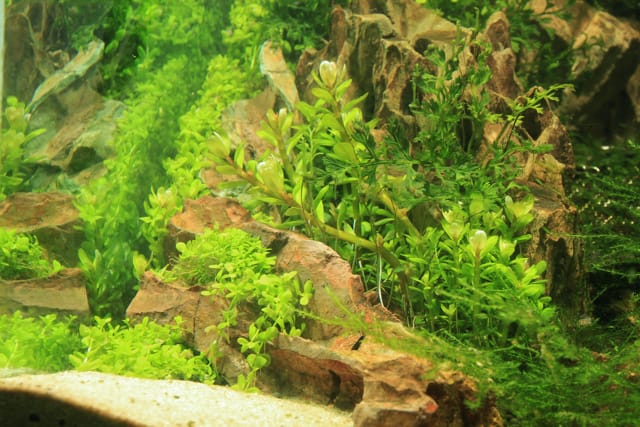
With little intervention, the balance is hardly disturbed. The goal of a no-water-change aquarium is to create a system that is as close to nature and as self-regulating as possible, that gets by with minimal maintenance effort and in which the inhabitants live under stable conditions.
Caring for a no-water-change aquarium
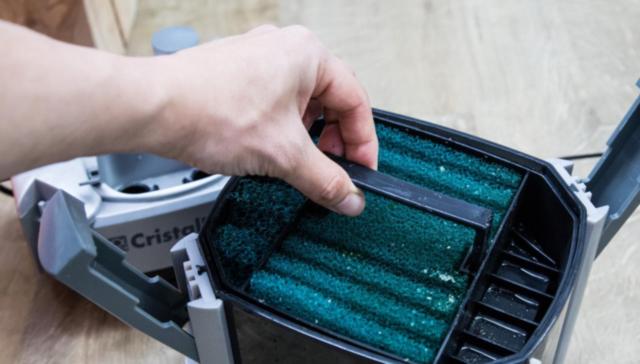
A no-water-change aquarium is characterized above all by its low maintenance, since regular water changes are omitted. Nevertheless, you cannot avoid certain measures to ensure a healthy environment for animals and aquatic plants. Even in a no-water-change aquarium, the glass panes and the filter should be cleaned at regular intervals, and any detritus and food leftovers siphoned off. This way you support the ecosystem to keep the load of organic waste as low as possible. A filter stocked with plenty of high-performance filter media is highly recommended for an aquarium run with old water.
Regularly checking and measuring the water parameters is important in order to recognize in time whether certain nutrients or pollutants are accumulating. This includes high-quality drop tests for the parameters KH, GH and pH to check general water values. Tests for PO4 and NO3 are important for assessing the water load. However, they are also important plant nutrients and should therefore not drop to zero. A decent Fe test rounds off the range of important water tests, so you can monitor another essential nutrient for aquarium plants.
So that the water level in the no-water-change aquarium does not constantly drop, you should minimize the degree of evaporation. This can be done, for example, with a closed aquarium cover. If you still have to top up water, demineralized water is best suited for this. If you use tap water for this purpose, which has a certain hardness, the hardness and also the pH in the aquarium rise over time. This is not desirable and causes unstable conditions in the long term.
To keep the water load within bounds in terms of redox potential without water changes, special equipment that produces active oxygen is suitable, such as an Oxydator or a Twinstar sterilizer. Through their special forms of oxygen, these break down organic pollutants and can be very helpful for a no-water-change aquarium.
Advantages and disadvantages of a no-water-change aquarium
Whether a no-water-change aquarium is the right thing for you is of course something everyone must decide for themselves. Basically, this form of the aquarium hobby is recommended more for advanced aquarists, as you should understand a little about water chemistry in order to understand the processes of such an ecosystem.
Advantages
Since a strong population of microorganisms and bacteria is constantly active, the tank stabilizes in the long term. pH, GH and KH change only slowly. A no-water-change aquarium is therefore ideal for sensitive species that tolerate fluctuations poorly. This system creates less stress for the animals, since there are no abrupt changes in water parameters from frequent water changes. Shrimp and some labyrinth fish and dwarf cichlids, for example, can benefit from this.
A natural biological balance prevails in a no-water-change aquarium, with a high density of biofilms and infusoria. This is advantageous, for example, for shrimp offspring, for fish that feed on surface growth such as catfish, and for rearing juveniles.
The biggest advantage is the lower maintenance effort, because water changes are omitted or greatly reduced. Only evaporated water is replenished, which can also be automated.
Over time, the old water takes on a natural coloring, because humic substances accumulate and tint the water slightly brownish. These humic substances have an antibacterial and calming effect. They promote the well-being of many blackwater or soft water species of ornamental fish.
Disadvantages of a no-water-change aquarium
In a no-water-change aquarium, there is a risk of certain substances accumulating, since they are not removed from the aquarium water by water changes. These include, for example, nitrate and phosphate as end products of organic loads, but also fats and proteins. Here the concentrations can build up over time. In the long term, this can lead to problems with algae or water quality if the system is not truly stable. There are also higher demands on the balance of the ecosystem; a no-water-change tank is less forgiving of mistakes than a classic aquarium. Overfeeding or overstocking in particular can destabilize it quite quickly.
A no-water-change aquarium is not suitable for all fish species. Species that need clear, clean or fast-flowing water often suffer in it. Especially in rearing tanks for many ornamental fish species, regular water changes are needed to keep the water load low.
A pH crash is also possible in a no-water-change tank. Since KH drops over time due to biological processes, dangerous pH drops can occur. This is especially critical in very soft water. This is one of the reasons why regular testing is required in such an aquarium, so that parameters like pH and KH can be monitored well.
Conclusion
A no-water-change aquarium is a special form of aquarium keeping that deliberately dispenses with adding fresh water. As already mentioned, you need to acquire sufficient knowledge of the aquarium hobby and water chemistry in order to run a no-water-change aquarium successfully. For beginners, and also for aquarists who prefer things less complicated, an aquarium maintained with regular water changes is rather recommended. It is somewhat more work, but it stabilizes the system in a simple way.