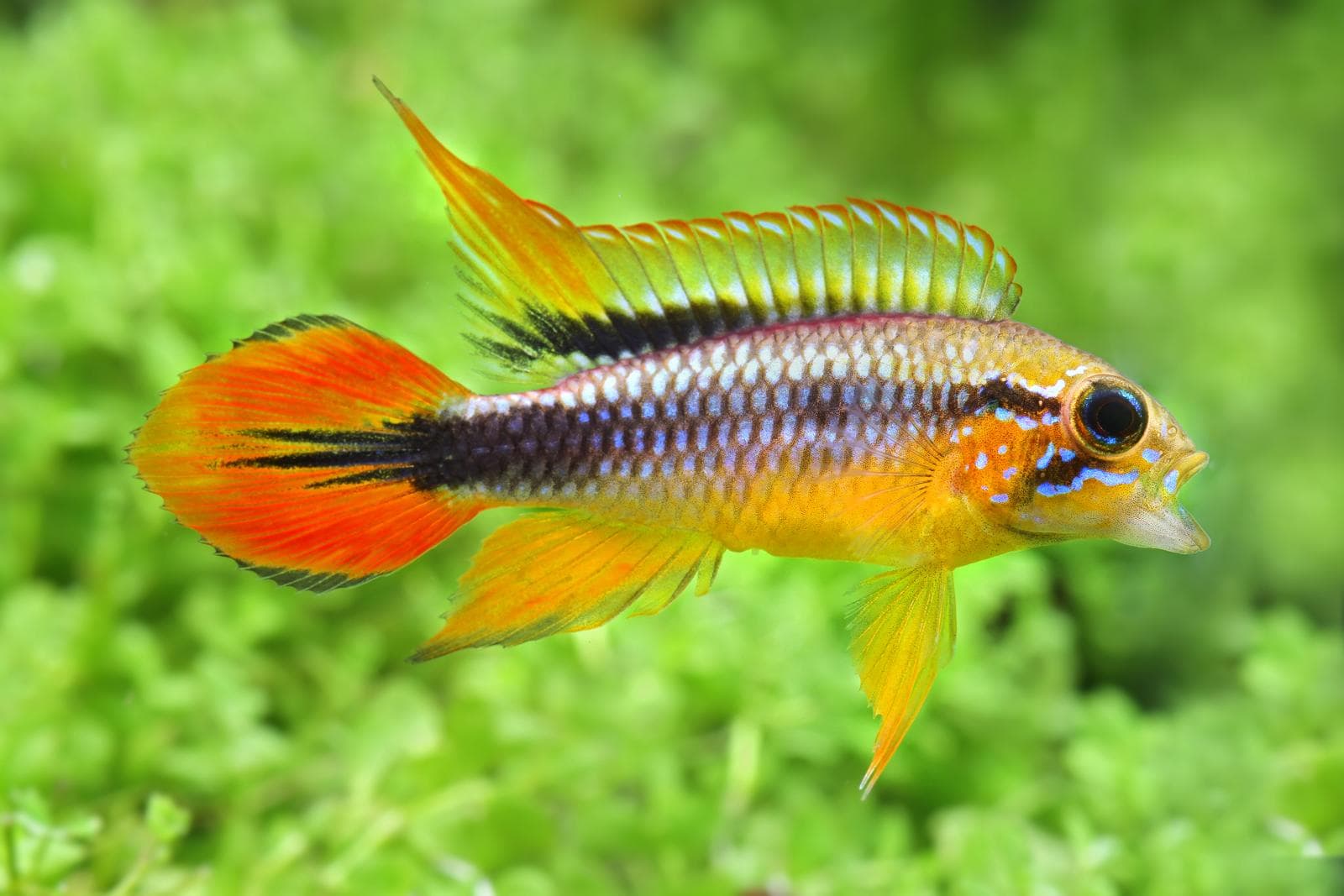
 South America Aquarium
A South America aquarium means an aquarium themed around ornamental fish and also aquatic plants that come from South America. If you want an environment that is as close to nature as possible for your aquarium inhabitants, you can also speak of a South American biotope aquarium. Often the aim is also to recreate specific regions, such as certain sections of South American rivers like the Amazon, Orinoco or Rio Negro, in an aquarium. In this article, we show you in more detail which conditions must be met for aquariums stocked with fish from, for example, Brazil, Colombia, Peru and Venezuela.
Water parameters in a South America aquarium

Although the water parameters still differ somewhat depending on the specific collection site or biotope, you can certainly assume soft water values for an aquarium with a "South America" focus. These include a low carbonate hardness (KH) and general hardness (GH) and a matching pH in the acidic to slightly acidic range (below 7). Our German tap water, which often comes out of the tap medium-hard to hard, is not always suitable for this. For the aquarist, however, there are plenty of ways to achieve perfect soft water values. Besides CO2 injection, which is also beneficial for plant growth, special treatment products can be used to lower both KH and pH. Filtering through peat is also very popular for a South America aquarium. This has the additional advantage of enriching the water with humic substances. Especially for animals that come from soft water biotopes, adding humic substances to the aquarium is extremely beneficial for their well-being. In the wild, humic substances play an immensely important role in surviving under rather hostile conditions. True blackwater habitats, which are extremely acidic and soft, have only a low water hardness and a low pH (for example the Rio Negro). The humic substances help the animals living there to obtain and collect vital minerals such as calcium. Calcium, for example, is necessary for bone formation. That is why adding humic substances in the aquarium is of particular importance for such ornamental fish.
As a rule, South American waters also have somewhat higher temperatures, so figures here are often between 24 and 28 °C. You should only settle on exact values once the stocking of a South America aquarium has been decided, so that you can match the conditions precisely to the aquarium inhabitants you want to keep. A powerful heater helps to create the necessary conditions.
Aquatic plants in a South America aquarium
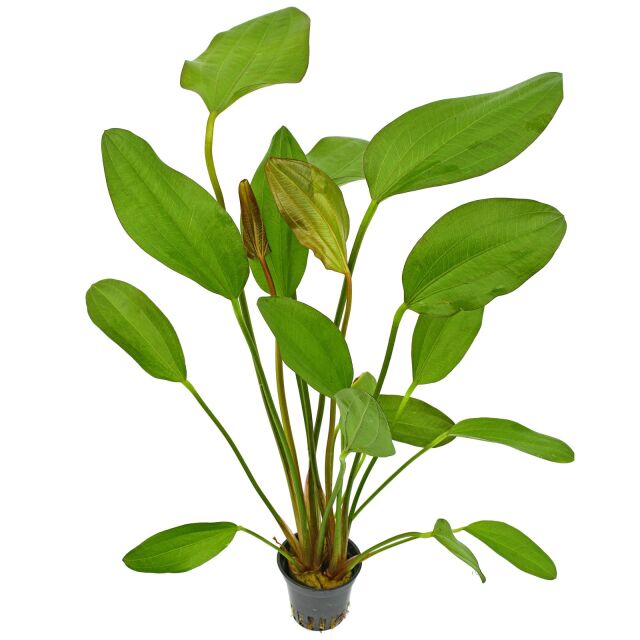
Although not all South American source biotopes have a lush aquatic plant world, the selection of suitable aquarium plants is very varied, so you can green your aquarium nicely. The plants not only serve as a visual enrichment; they also fulfill a biological purpose in a South America aquarium. They serve as hiding places and retreats for weaker animals and provide the necessary structure in the aquarium. Through their metabolism, excess nutrients in the water are broken down, and through photosynthesis plants are an ideal oxygen source for the animal world. A densely planted aquarium additionally offers good, natural competition for algae.
Typical aquatic plant species for a South America aquarium are the popular Echinodorus, which come in various sizes, colors and leaf shapes. Popular fast-growing species for the background and midground are, for example, Brazilian pennywort, cabombas or milfoil species. In the foreground, Lilaeopsis brasiliensis can be used, or small-staying sword plants such as Helanthium tenellum. If the lighting mood is meant to be somewhat more subdued, floating plants such as South American frogbit are a good fit; with its long roots, it offers ideal hiding places for juveniles at the water surface.
The substrate in a South America aquarium
Most South American fish species are used to a rather fine substrate from their home biotope, so substrates with a smaller grain size such as sand or gravel are a good choice. Many fish species also use the substrate for sifting and feeding. Especially with corydoras, a fine substrate that is as far as possible not sharp-edged is the right choice, so that the animals cannot injure their sensitive barbels in it. Of course, when choosing a substrate you should make sure not to pick one that hardens the water.
Sometimes, however, an active substrate like soil can also be helpful for achieving and stabilizing the recommended soft water values. In densely planted zones it can also be used well as a special nutrient substrate in those areas. Soil is likewise not sharp-edged, but it is relatively light. For use in open areas in aquariums with many soil-digging animals, it is therefore only recommended to a limited extent, since the constant stirring up of the substrate particles can sometimes cause cloudiness.
Furnishings in a South America aquarium
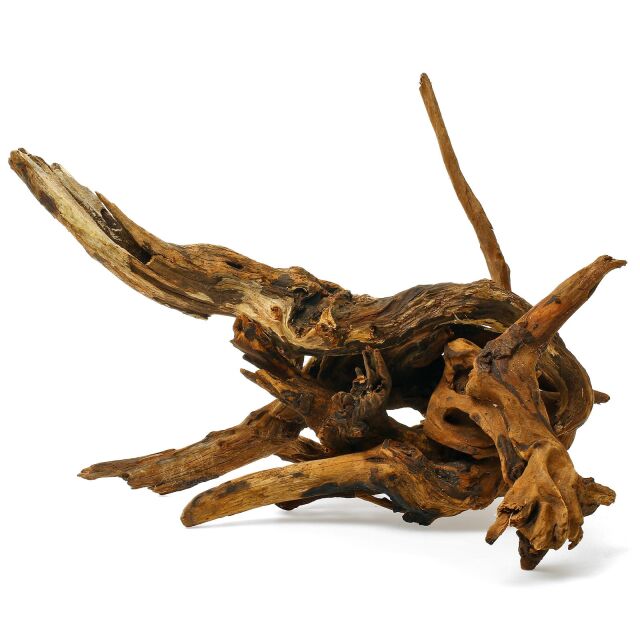
For an aquarium themed around South America, besides aquatic plants and the suitable substrate, driftwood in particular is a good choice, creating a nature-like environment. It provides the necessary structure and also creates many hiding and spawning opportunities for many fish species. If very dense wood such as mangrove or river wood is used, the water also takes on a slight brown tint from the tannins released. Especially for animals from blackwater biotopes, this creates the right feel-good atmosphere. The root decoration can gladly be rounded off with a few (preferably water-neutral) stones. Especially for catfish and dwarf cichlids, installing various caves and tubes additionally offers retreat and breeding opportunities.
Fish in a South America aquarium
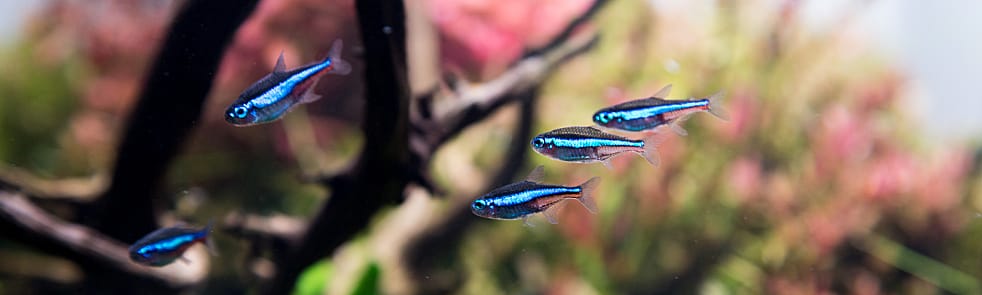
Tropical ornamental fish from South America of course come in enormous variety. These include, among others, the popular tetras and catfish, but also cichlids such as the popular dwarf cichlids. A South America aquarium can of course also be set up as a more regionally limited biotope, or you can specialize in a particular fish species. This then includes species aquariums of, for example, discus, angelfish or rare L-number catfish. The size of the glass tank naturally plays an overriding role for the creatures to be kept in it and should be taken into account first and foremost.
For a relatively "normal" fish stocking focused on South American species, a group of beautiful tetras as a schooling fish is a good start. Tetras impress with their bright colors, great schooling behavior and lively demeanor. They therefore need a lot of open swimming space, but also retreats, which can be provided, for example, by denser planting along the edges and decorative items.
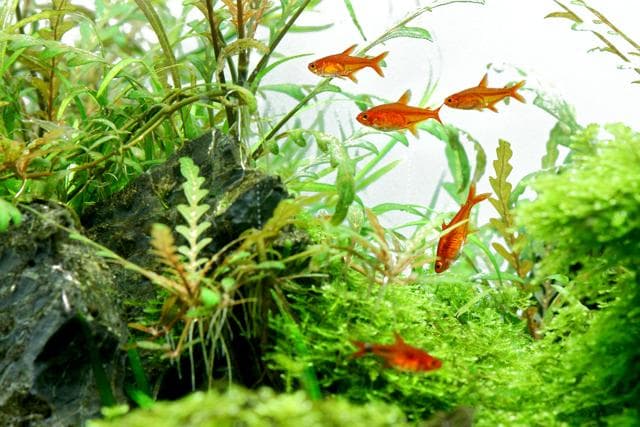
Copyright: Chris Lukhaup.
Busy corydoras, for example, can be chosen as suitable bottom dwellers and tankmates. For larger aquariums, other catfish species such as armored catfish or bristlenose catfish can also be included. Smaller catfish such as the popular Otocinclus should be kept in a suitably sized group; they are hard-working algae eaters and extremely popular aquarium fish. For catfish, there should definitely be suitable driftwood in the aquarium.
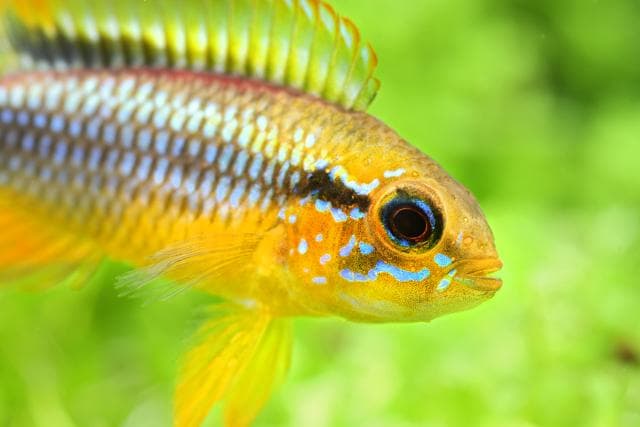
Copyright: Chris Lukhaup.
If the aquarium is large enough, a pair or a small group of dwarf cichlids can also be added. They stand out for their interesting social and breeding behavior and are true color highlights in the aquarium hobby. However, they occupy territories, which they sometimes defend against their own species and other aquarium inhabitants. The aquarium setup should therefore have good structure, and the glass tank should accordingly have enough volume.
The mixed stocking of a South America aquarium can sometimes be rounded off with fish that stay mainly near the water surface. Surface-oriented ornamental fish include the popular hatchetfish, which belong to the tetras. But some South American killifish, such as Rivulus xiphidius, also fall into this group. To offer the animals enough protection, floating plants are a welcome planting. A tightly fitting aquarium cover is of enormous importance, as these animals are very good jumpers.
Copyright header photo: Chris Lukhaup