 Whole-house water softeners and aquariums
In some parts of Germany, tap water is very hard. To protect the pipes and to make the water more useful and more pleasant for everyday use in the household, so-called whole-house water softeners are sometimes used. They make the water significantly softer. But can you also use the treated water well in a planted aquarium? In this article, we take a closer look.
What is a whole-house water softener?
Water that is too hard can be a disadvantage in the household. The constant buildup of limescale in appliances such as dishwashers, kettles and coffee machines, as well as in pipes, means a lot of upkeep and often shortens the service life of the affected appliances. A whole-house water softener, which is permanently installed in a building's water circuit, can help here. Such softeners often have a dial that lets you set the degree of softening. Whole-house water softeners also have a built-in cation exchanger based on a specific exchange resin. It is usually housed in cartridges or columns in or on the unit.
How does a whole-house water softener work?
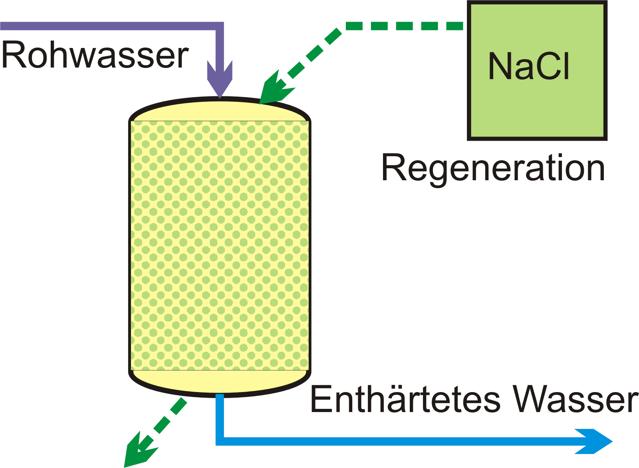
Copyright: Rasi57 - Own work via Wikimedia Commons, Source attribution, License: GNU Free Documentation License.
A water softener contains a so-called salt-based cation exchanger. The exchange resins inside it remove positively charged ions from the water flowing past, especially the alkaline earth metals such as calcium and magnesium, which are responsible for general hardness. In return, the resin releases sodium ions into the water. This is the principle of cation exchange. The higher the charge of the cations in the water, the more strongly they are bound to the cation exchanger. Since calcium and magnesium are divalent (Ca2+ and Mg2+), these cations are exchanged to a greater extent, which allows the general hardness of the water to be lowered significantly. Cations with a lower charge are then taken up less readily. Over time, the exchange resin of the cation exchanger becomes exhausted and has to be replaced or regenerated in order to work at full capacity again.
Water parameters of a whole-house water softener
The ion exchangers installed in the softener mainly reduce the general hardness by taking up calcium and magnesium ions. But other cations such as potassium are sometimes removed from the water as well, albeit to a lesser extent. Because of the cation exchange principle, the water from the whole-house water softener is heavily enriched with sodium.
By the way, the whole-house water softener has no effect on negatively charged ions (anions). So if the source water is already contaminated with silicate, nitrate or phosphate, these substances will be present in the aquarium water in full as well. While phosphate and nitrate can serve as useful nutrients for aquatic plants, a silicate content that is too high is rather a disadvantage, since it can provoke brown algae (diatoms). The only remedy here is to treat the water by reverse osmosis or to use suitable filter media that can bind silicate.
Whole-house water softeners and planted aquariums

In principle, water from a whole-house water softener is softer, but it is still only of limited use for a planted aquarium. The reduction in hardness mainly concerns the general hardness (GH); the carbonate hardness (KH) usually remains untouched and is then often higher than the general hardness. A high carbonate hardness is often unfavorable in a planted aquarium with regard to carbon fertilization, and it buffers the pH very strongly. It is then very difficult to reach a slightly acidic pH below 7 in order to achieve ideal conditions for nutrient uptake in aquatic plants (see also: "Liquid fertilizer and water hardness").
The ion exchanger also enriches the water heavily with sodium, so the natural ion ratios are significantly shifted. In such aquariums, potassium and magnesium are often lacking, although both are important macronutrients for aquarium plants. It therefore makes good sense to ensure healthy plant growth with suitable liquid fertilizers or water-hardening salts.
Conclusion
For more demanding aquarium keeping and for aquatic plants that go beyond the easy difficulty level, water from a whole-house water softener unfortunately comes with many disadvantages. The water is generally softer, but a high carbonate hardness remains, which is linked to high pH values and the disadvantages that come with them. Aquatic plants often lack important macronutrients such as magnesium and potassium, and the carbon supply is also somewhat harder to manage because of the high carbonate hardness. Due to the high sodium content and the fact that the KH is higher than the GH, the natural ion ratios are in part significantly shifted.