We use cookies to offer you an optimal shopping experience. These cookies can be grouped into categories. The necessary ones are essential for your purchase. Functional services enable additional content such as videos and maps. With further cookies we produce anonymized statistics. Others serve primarily marketing purposes and are used for the personalization of advertising. These cookies are used by 11 Services used in the shop. You can decide for yourself which cookies you want to allow.
We store your choice on your device (“local storage”) and ask you again after 12 months at the latest. You can change it at any time under “Cookie Preferences” in the footer. You can find details on cookie lifetimes and necessary cookies in our privacy policy.
These services are required to run the shop and for your purchase and cannot be switched off.
Strictly necessary cookies enable basic functions and are required for the website to work properly.
Description:
Shop functions: Essential Shop functions This includes: JTLSHOP (cookie, until you close the browser; keeps your session, the cart and your login), consent (browser storage; remembers your cookie choice, 12 months at most, during the session also in session storage), has_starting_point, cur_product_id and product_page_visits (session storage; navigation between products) as well as aquasabi-search-index-last-url, aquasabi-search-index-results and aquasabi-search-index-data (session storage; search results and lists when paging).
easyVision: easyVision lets website visitors customize the display – e.g. by adjusting contrast, font size, line and letter spacing, color rendering, a blue light filter or by disabling animations. Developed and hosted in Germany, the service is GDPR-compliant and supports statutory accessibility requirements (BFSG) from 2025. The service loads its scripts from cdn.sitecockpit.com and stores your settings (easy-vision-*) in your browser storage (no cookies).
Reviews: aquasabi_guid (cookie, 12 months) is only set when you click “Helpful” under a review. It stores a random ID so that the same person cannot count a review as helpful more than once.
Sorting and view: aquaSort and aquaDisplayType (cookies, 90 days) store the sorting or view (gallery or list) that you choose in a product list. They are only set when you choose a sorting or view.
Amazon Pay: Payment processing with Amazon Pay.
The service provider is Amazon Payments Europe S.C.A. Where Amazon Pay is offered (e.g. in the cart and at the checkout), the shop loads scripts and images from static-eu.payments-amazon.com, payments-eu.amazon.com and m.media-amazon.com and sets cookies (language, ledgerCurrency, apay-session-set). You can find out more in the privacy policy at https://www.amazon.de/gp/help/customer/display.html?nodeId=GRFTMVHP4HXMESSP
PayPal: Payment processing with PayPal.
The service provider is PayPal (Europe) S.à r.l. et Cie, S.C.A. Where PayPal is offered (e.g. in the cart and at the checkout), the shop loads scripts from www.paypal.com; for invoice payment via PayPal, c.paypal.com is added for fraud prevention. PayPal stores an entry in your browser storage (__paypal_storage__), and the shop remembers the chosen PayPal payment method in session storage (chosenPPCPaymentOption). You can find out more in the privacy policy at https://www.paypal.com/en/legalhub/paypal/privacy-full
Sofortüberweisung: On the confirmation page after an order with this payment method the shop loads a Klarna logo from x.klarnacdn.net.
Additional functions such as embedded videos and maps, spam protection in forms or the rating badge. Data is transferred to the respective provider when they load.
Show Youtube Videos
Description:
Displaying videos
Processing company:
Google Ireland Limited, Google Building Gordon House, 4 Barrow St, Dublin, D04 E5W5, Ireland
Helps us understand how the shop is used so that we can improve it.
We measure which pages and products are viewed and how visitors move through the shop. Google Analytics sets cookies (_ga, _ga_*) and sends usage data to Google.
Description:
Audience measurement and analysis of how the shop is used
Measures our advertising and enables personalised advertising on other sites.
We measure whether an ad on Facebook or Instagram led to a purchase and show visitors relevant ads again. Cookies are set for this: _fbp and _fbc (Meta) and as_fbclid (ours, 30 days; remembers the ID of the ad click). Meta receives data about your actions in the shop (e.g. product views, cart, purchase), your IP address and browser information; for a purchase our server may also send them directly to Meta (Conversions API). More in our privacy policy (retargeting/remarketing and conversion tracking).
Description:
Measure advertising success and show relevant ads again (Facebook, Instagram)
We measure whether an ad on TikTok led to a purchase. Cookies are set for this: _ttp, ttclid and _tt_* (TikTok) and as_ttclid (ours, 30 days; remembers the ID of the ad click). TikTok receives data about your actions in the shop (e.g. product views, cart, purchase), your IP address and browser information; for a purchase our server may also send them directly to TikTok (Events API). More in our privacy policy (retargeting/remarketing and conversion tracking).
We measure whether an ad in ChatGPT led to a purchase. Cookies are set for this: __oppref and __obref (OpenAI) and as_oppref (ours, 30 days; remembers the ID of the ad click). OpenAI receives data about your actions in the shop (e.g. product views, cart, purchase), your IP address and browser information; for a purchase our server may also send them directly to OpenAI (Conversions API). Data may be transmitted to OpenAI OpCo, LLC (USA). More in our privacy policy (retargeting/remarketing and conversion tracking).
Description:
Measure the success of ads in ChatGPT
Processing company:
OpenAI Ireland Limited, 1st Floor, The Liffey Trust Centre, 117-126 Sheriff Street Upper, Dublin 1, D01 YC43, Irland
We measure whether an ad led to a purchase and show visitors relevant ads again. Google Ads sets cookies (e.g. _gcl_*) and receives purchase data, where applicable in hashed form (SHA-256).
Description:
Measure advertising success and show relevant ads again (remarketing)
We use cookies that are essential for payment processing through our partners. Please select which payment providers you would like to use.
In order to unlock offers for extended payment options, in particular express checkout and payment in instalments, we require your consent to the data transfer and storage of third-party cookies of the payment provider PayPal. This allows us to also offer you express checkout and payment by instalments. Without your consent, only the technically necessary data transfer to PayPal will take place, but you will then not be able to use the express checkout or extended offers for payment by instalments on this site.
Description:
Using express checkout and Displaying offers for payment in instalments for individual items or your entire purchase.
Your consent ID:With this randomly generated number we can show on request what you selected. It contains no information about you.
Data privacy settings
Would you like to see these contents? Activate the desired contents for one session only or allow the website to remember these settings. Once you have given your consent, the third-party data can be loaded. For this, third-party cookies might be stored on your device. You can change these settings at any time (footer: “Cookie Preferences”). For further details, please see the Privacy notice.
Translated from German with AI assistance and reviewed by our editors.
Antler snails of the genus Clithon as well as snails of the genus Neritina and Vittina are often used as algae eaters in aquariums and especially in aquascapes and plant aquariums, also because they do not reproduce in the aquarium. Both snail types are similarly popular in aquaristics, but each species has its own special characteristics. We will introduce these aquatic snails in more detail below
Antler snails in the aquarium
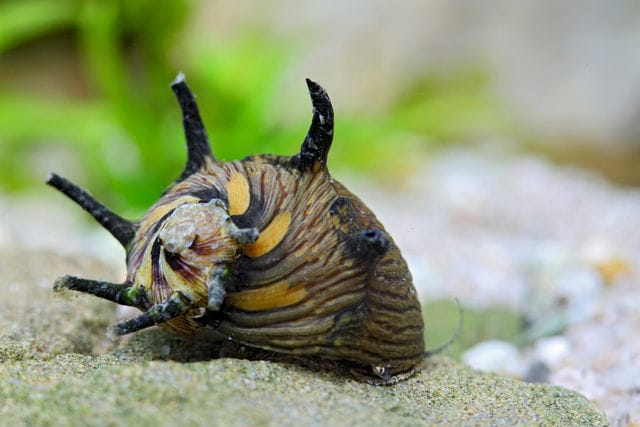
A snail of the genus Clithon with easily recognizable "antlers". Copyright by Chris Lukhaup.
Antler snails are extremely useful algae eaters in the aquarium, which can very effectively destroy algae deposits such as diatoms, green spot algae, dust algae and other green algae deposits. In case of a strong algae infestation, clear feeding traces can be seen on the aquarium glass, on the technique and decoration. Snails of the genus Clithon are among the most effective algae eaters for a freshwater aquarium. In addition, they do not grow very large (approx. 2 cm) and can therefore also be kept well in nano aquariums. Typical for antler snails are, as their name suggests, the small "antlers" which protrude from the snail shell. These are small, harmless thorn-like limestone projections. In the wild, they may be used to protect the snail from predators. When they grow in the aquarium, these appendages are no longer formed, and there are also antler snails, which by nature have no appendages at all. If the tips break off during transport, this is also no cause for concern. The snail does not feel anything of it, since these calcareous appendages on the shell are not interspersed with nerves. Antler snails are also quite appealing in color, sporting very different colours and patterns, starting with subtle brown or red tones up to pretty yellow/black ringed patterns. Clithon-Snails also have a lid with which they can close their shell tightly and securely to protect themselves from possible dangers, the so-called Operculum. Even a socialization with pea pufferfish is possible.
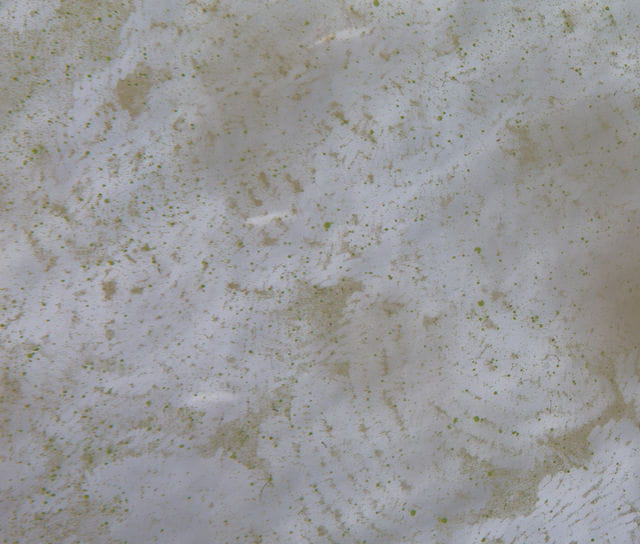
Feeding traces of Clithons or antler snails on the aquarium glass.
For an effective "cleaning staff" in the aquarium, it is recommended to use one specimen for about 10 litres of aquarium volume. Then there will be enough biofilms in the aquarium to prevent the snails from starving to death. If you want to do something good for your animals or have to nourish weak antler snails, you should feed them supplementary: appropriately prepared algae stones are ideal. For this purpose, a porridge of spirulina powder and water is slathered on flat stones and left to dry overnight. After the drying phase, the algae stone can now be placed in the aquarium for grazing. In addition to algae stones, dried Hokkaido pumpkin and green dried walnut leaves are also eaten. As a rule, antler snails do not eat artificial food.
Unfortunately, the antler snails which can be bought in the trade are always imports which often arrive very stressed by the transport. If these animals had to remain in a very densely populated dealer basin, the snails haven't had enough to eat over a longer period of time and are weakened accordingly. In this respect, antler snails are sometimes a little fragile and sensitive, especially during the settling-in period after the new purchase. Clithon-Snails are also partly sensitive to very high CO2-concentrations in the aquarium water.
The aquarist should take this into consideration, especially in the early days. Once the animals have settled in, however, the population is stable and provides for a clearly algae-free aquarium with clean panes, stones and wood. Also otherwise, these animals behave rather inconspicuously and don't cause any problems.
Especially in plant aquariums and aquascapes where soil is used and therefore a low total- and carbonate hardness is present, some caution is required. If the water parameters are too unfavourable (very soft and acidic), the snails may suffer damage to their shells, resulting in a lower life expectancy. The remedy here is to adjust the water values so that the invertebrates have a sufficient supply of lime to build up their shells.
Antler snails are not reproductive in a freshwater aquarium. For larvae to survive, brackish/saltwater is necessary. In aquaristics, breeding has not yet been successful. The fact that the animals do not reproduce can be seen as both a disadvantage and an advantage. On the one hand a snail plague is outside the range of possibilities, but on the other hand one is forced to buy new (import) animals in case of a loss. Nevertheless, from time to time female water snails of the genus Clithon will deposit whitish egg cocoons inside the aquarium, from which no young snails will develop. These tiny eggs have an elongated shape, are very hard, firmly attached to the ground and otherwise very resistant. It takes a while until they disappear again - often the cocoons are eaten by the snails themselves. Preferably the female Clithons lay their eggs onto objects like the aquarium glass, the tech or stones and driftwood. Where the egg-laying of these snails is concerned, the opinions are a bit divisive. Some aquarists don't have any problems with it, others however are underwhelmed by the aesthetics of it all. On the glass panes, for example, they can be easily scraped off with a sharp blade cleaner, on uneven surfaces the removal is much more difficult.
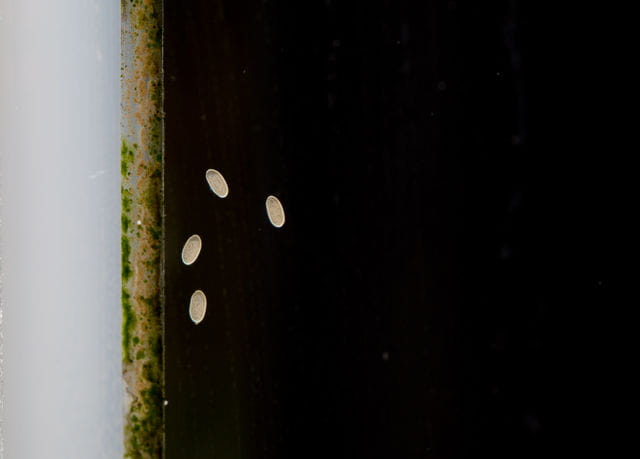
Typical egg clutches in the close-up.
Neritinas in the aquarium
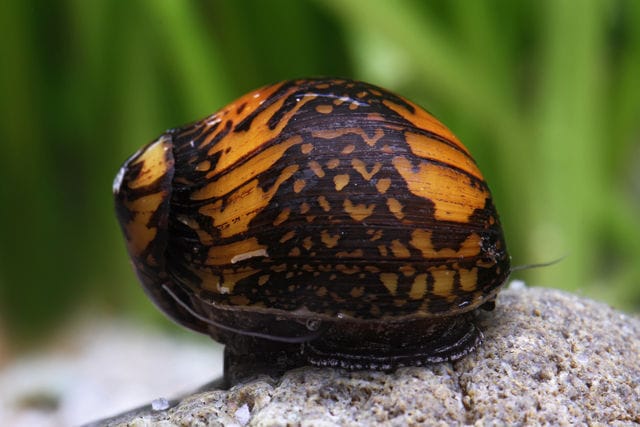
A beautiful Neritina variegata specimen. Copyright by Chris Lukhaup.
The Neritina respectively Vittina genera have quite similar characteristics and requirements in regards of keeping conditions as the smaller antler snails. They also feed on biofilms and are therefore excellent algae eaters in the aquarium when it comes to algae coatings. Also here the aquarist should pay attention to receive well-fed, thriving, vital animals. Neritina/Vittina have no "antlers" and are available in many different color variations. There are also some very pretty ornaments on the shell.
Compared to antler snails, Nerites are much larger, not only in total length (up to 3.5 cm), but also in circumference. Measured against the dimensions of a nano aquarium, these snails come across as true "juggernauts". They should therefore not be kept in aquariums that are too small. Furthermore, some species like the Neritina pulligera have the unfortunate habit of crawling along the aquarium glass just below the substrate and digging there. Lovingly placed plants and decoration such as small stones are jumbled or even excavated, and the loving design of the Aquascaper is thereby nullified. In this respect, the much smaller antler snails are much more pleasant guests in an aquascape, although the larger Nerites are the more efficient destroyers of algae deposits.
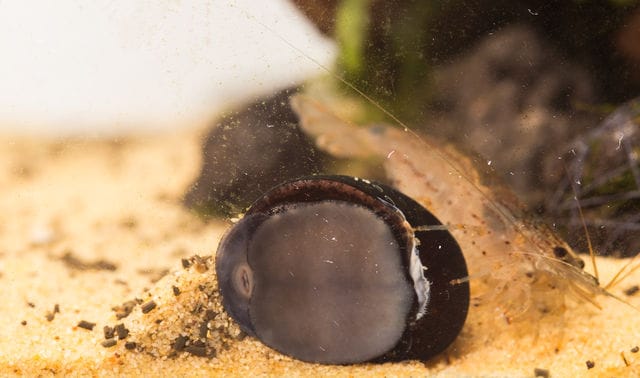
A nerite digging close to the substrate.
Female Nerites also deposit hard cocoons on objects in the aquarium, from which - for the same reasons as with antler-snails - no young will hatch. In a freshwater aquarium, these animals cannot reproduce. Similar to snails of the genus Clithon, Nerites also have a lid with which they can close their snail shell firmly and securely.
Compared to antler snails, Nerites are much more robust and less sensitive, for example with regard to the CO2 concentration in the aquarium water. Their tendency for shell damage also appears to be somewhat lower. In sum, Nerites are therefore to be regarded as somewhat easier to care for than Clithons.
