 Don't Be Afraid of Too Much Fertilizer
Again and again you hear, especially from owners of larger aquariums, that a supposedly high dose of fertilizer triggers skepticism. This applies in particular to nitrogen fertilizer such as GH Boost N. Here are a few examples:
- "What, 10 ml a day? Isn't that dose far too high?"
- "That is certainly harmful to the animals."
- "That will surely cause algae."
- "That seems way too high to me. So I stopped fertilizing for now."
In the last example, the skepticism even leads to the wrong consequence, and fertilization is drastically reduced. This can trigger algae growth and deficiency symptoms in the aquatic plants.
What to keep in mind
This phenomenon appears particularly often with owners of larger aquariums. Of course, a daily amount of about 10 ml of a liquid fertilizer sounds quite high. But you should not forget how much volume the aquarium has. 10 ml of fertilizer is comparatively a lot for a standard aquarium of 54 liters. But not for a 500-liter aquarium. It is therefore important: you should put the amount of fertilizer in relation to the aquarium size. Often it is hard to imagine how much water volume is actually available, which dilutes the fertilizer dose accordingly. What is much more relevant is therefore what comes out as nutrient input in mg/l through the fertilization.
The nutrient value decides
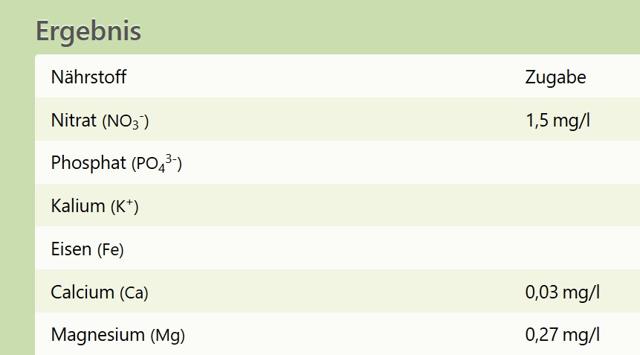
What matters above all is what nutrients in mg/l the stated amount of fertilizer actually adds. You can use the Flowgrow Nutrient Calculator for this. Simply enter the size of the aquarium at the top and the fertilizer including the dosage further down. If you now click "Calculate", the nutrient value appears at the bottom. This number is usually much smaller than the dose. But it is very decisive. To stay with our example, 10 ml of GH Boost N appears to be a high amount. In a 500 l aquarium, however, only 1.5 mg/l NO3 is added. And this 1.5 mg/l is the value you should refer to; besides, 1.5 mg/l also sounds much smaller than the 10 ml of fertilizer.
What does a planted aquarium consume per day?
To put the level of a certain nutrient value into perspective, it is worth comparing it with average values of planted aquariums. Here you can consult, for example, the research of Tom Barr and his fertilization system, the Estimative Index (E.I.). According to the E.I., aquatic plants in an aquarium under high-intensity lighting consume approximately the following per day:
- NO3 -> 1-4 mg/l
- NH4 -> 0.1-0.6 mg/l (though you should not dose ammonium, since according to Tom Barr it can trigger algae)
- PO4 -> 0.2-0.6 mg/l
You can gladly use these consumption values as a rough guideline for the consumption of planted aquariums and compare them with the nutrient values of your own aquarium's consumption.
One-time shock dosing
The phenomenon can be even more extreme when a one-time shock dose is required. If, for example, the NO3 content in the aquarium has dropped significantly, green algae are spreading and the plants are getting yellow leaves, then an immediate increase of the nitrate content to the target level of roughly 15 mg/l NO3 is a sensible measure. Let's assume nitrate in a 500 l planted aquarium is down to only 3 mg/l. To reach the remaining 12 mg/l, you would have to add around 80 ml of the fertilizer GH Boost N. This amount then seems very high. It is all the more important here for the aquarist to put the amount in relation to the total volume of the aquarium and to look at the actual nutrient input in mg/l (here: 12). The Flowgrow Nutrient Calculator is an enormous help for this too.
Exceptions
Indeed, there are a few exceptional cases where you should indeed pay attention to the amount of liquid fertilizer added. This applies, for example, to liquid fertilizers that contain urea or ammonium. Depending on the pH, toxic substances such as ammonia and/or nitrite can form under some circumstances. Here, attention should be paid to a pH below 7. In addition, the manufacturer's instructions for the respective product of course apply without fail.
Basically, in planted aquariums the guiding principle also applies that all nutrients (both micro- and macronutrients) should be present in a suitable ratio to each other. If there is an imbalance of nutrients, algae growth can sometimes occur. One example is an unbalanced ratio of too many micronutrients to macronutrients. This is often caused by too high a dose of complete iron fertilizer or the absence of NPK elements. This often produces red algae such as black beard algae or beard algae. This can easily be brought back into balance by correcting the nutrient ratios.