Nutrient consumption in the planted aquarium
Published
Translated from German with AI assistance and reviewed by our editors.
Nutrients
Aquarium plants need a wide variety of nutrients for healthy growth and a vital appearance, which we basically divide into micro and macro elements. In addition, light and carbon, which is generally supplied via a CO2 system, also count among the nutrients that aquatic plants need in the aquarium. In this article we have already explained the basics of this topic in more detail.
The very distinction between micro- and macronutrients indicates that plants need elements in different amounts. Micronutrients generally include important trace elements such as iron, manganese, boron, copper and molybdenum. Trace elements are only needed in very low concentrations, that is, in traces. Macronutrients, on the other hand, are needed in larger amounts, partly because of high consumption, and partly because the plants simply need large minimum concentrations to be available here.
In this article, we would like to look more closely at which nutrient elements are consumed heavily or only slightly by aquarium plants, and which should always be present at a certain base level and which should not.
Nitrogen
Nitrogen is generally supplied through fertilizers containing nitrate or through soil substrates. Although nitrate also arises as an end product of the nitrogen cycle through pollutant-degrading bacteria, this is often not enough in a planted aquarium to cover the plants' needs. Aquatic plants also consume nitrate to a high degree, for example when an aquarium is strongly lit and very densely stocked with fast-growing aquarium plants. Here, daily consumption values of 4 or 5 mg/l NO3 can certainly be no rarity. Nitrogen can therefore be regarded as the macronutrient with the highest consumption. The nitrate level should also not fall below 10 mg/l NO3 for a longer time, since deficiency symptoms can otherwise occur. These show, for example, as yellow leaves on older growth. If there is too little nitrogen for the plants, this can especially favor the growth of green algae.
As a target concentration in a planted aquarium, we therefore recommend the range of 15 to 25 mg/l NO3. A higher concentration is not harmful, but can result in the red coloration of certain plants fading. This element can be monitored in the aquarium with a suitable nitrate water test.
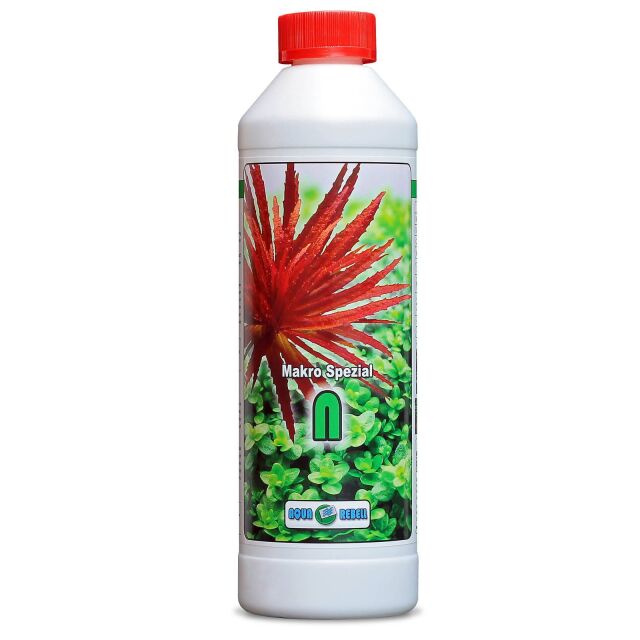
Conclusion: because of the high consumption and the fact that a minimum level of 10 mg/l NO3 should not be undercut, daily fertilization with a nitrate fertilizer is recommended. Nitrate is contained in ready-made macronutrient mixes such as Aqua Rebell Makro Basic NPK and Estimative Index, but can also be supplied as a single component via Makro Basic Nitrat, Spezial N and Advanced GH Boost N. The individual fertilizers differ mainly in their share of additional potassium.
Phosphorus
The element phosphorus is generally determined in aquarium water as phosphate (PO4) with a water test. Ideally, in a planted aquarium the concentration should be between 0.1 and 1 mg/l PO4. Compared with nitrate, phosphate is a nutrient with somewhat lower consumption; that is, it takes much longer for the corresponding deficiency symptoms to show up in the case of a phosphate deficiency. Plants can also store this element well as a reserve. The plants convert it into the acid phytate and then store it in the vacuoles of their cells. For a planted-aquarium keeper, phosphate is to be seen as a regulator of growth speed. Stronger phosphorus fertilization can accelerate growth as long as all the other nutrients are also sufficiently available. On the other hand, limiting phosphate can also slow growth somewhat. For this, the substance is dosed up to a target value (for example 0.5 mg/l) only once a week. This is then called pulse dosing. Afterward you let the concentration run toward zero and refresh the level after the next water change. For a deficiency to become really visible in this way, a correspondingly long period without enough phosphorus must have passed. Then growth stagnates, stunting occurs, and the plants turn dark in part or even purple. However, phosphate is also a breakdown product of organic load such as fish excretions or food leftovers. In that respect, phosphorus also reaches the plants in an aquarium through the metabolism of the animals. In aquariums with heavy stocking and corresponding feeding (for example with discus or angelfish), phosphate values are often elevated. Since phosphate is very reactive in water, concentrations that are too high should rather be avoided. Otherwise, for example, reactions with iron can take place that lead to precipitation as a solid, iron phosphate. The nutrients are then no longer directly available to the plants. In that case, measures for reducing the phosphate content should be taken.
The phosphate concentration sometimes shows itself through the formation of green spot algae in the aquarium. Here, though, both a content that is too high and one that is too low can play a role.
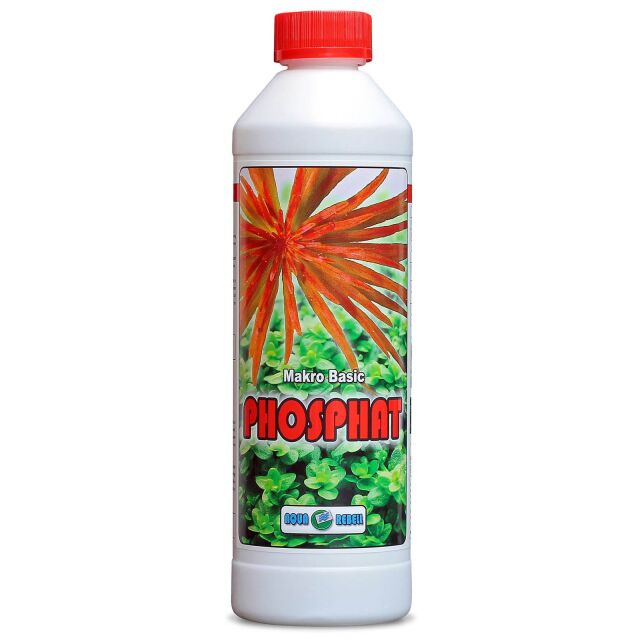
Conclusion: with phosphate, it takes quite a long time before a visible deficiency occurs. Rather, this element can be used in a targeted way as a growth catalyst or as a brake. Concentrations that are too high should be avoided because of the possibility of reacting with other substances such as iron. Phosphorus can be raised in a targeted way with Aqua Rebell Makro Basic Phosphat. However, ready-made NPK mixes also contain this nutrient. Adding it at the same time as iron-containing fertilizers that are only lightly protected by a complex shell should be avoided. The popular Aqua Rebell Mikro Basic Eisen, however, is not affected by this to such an extent that restrictions could arise in aquarium practice.
Potassium
Among the macronutrients, potassium is one of the elements that plants consume only slightly. Nevertheless, potassium should be sufficiently available and should therefore be supplied regularly. For a long time there was no suitable water test for it in aquaristics; fortunately, those times are now over. With very potassium-heavy fertilizers, this substance can sometimes accumulate strongly because of its low consumption. This may not be a problem, but in some cases it can represent a nutrient imbalance and sometimes cause algae growth (especially green algae coatings) and deficiency symptoms in the plants. It is important to know that potassium behaves antagonistically to other nutrient elements such as magnesium. Too much potassium can therefore prevent the uptake of magnesium. It is therefore important that potassium should be present at a certain, rather low base level without accumulating too much. In modern planted-aquarium keeping, a fixed ratio of calcium to magnesium to potassium is even advocated (at 2:1:0.5). However, it should be mentioned that this is not an essential basic requirement for all aquatic plants. Most species also get along very well with a ratio with a higher potassium share. Potassium is and remains an important macronutrient that can otherwise cause holes in the leaves when deficient.
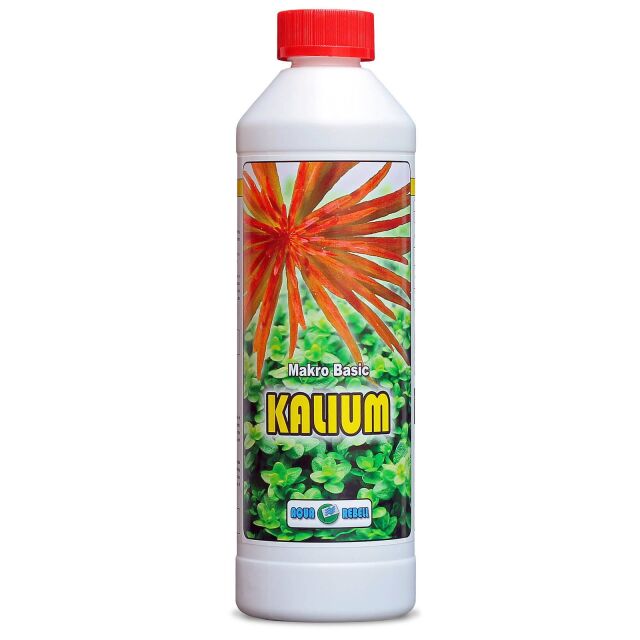
Potassium is sometimes already present in low doses in drinking water, but is also present in many hardening salts. Of course, this substance can be supplied in a targeted way through a fertilizer such as Makro Basic Kalium.
Especially in planted aquariums with high fish stocking, for example in a discus or angelfish aquarium, other macronutrients such as nitrate and phosphate are sometimes sufficiently available because of the water load from the animals, but potassium is not. Ready-made NPK mixes or single-component fertilizers can help close this nutrient gap here.
Conclusion: potassium is an important macronutrient that, unlike nitrate and phosphate, does not arise from water pollution in the aquarium. It should therefore definitely be supplied so that deficiency symptoms do not occur. However, potassium is not consumed particularly heavily, and it is advisable to also make sure that potassium does not accumulate too much, in order to prevent nutrient imbalances.
Magnesium
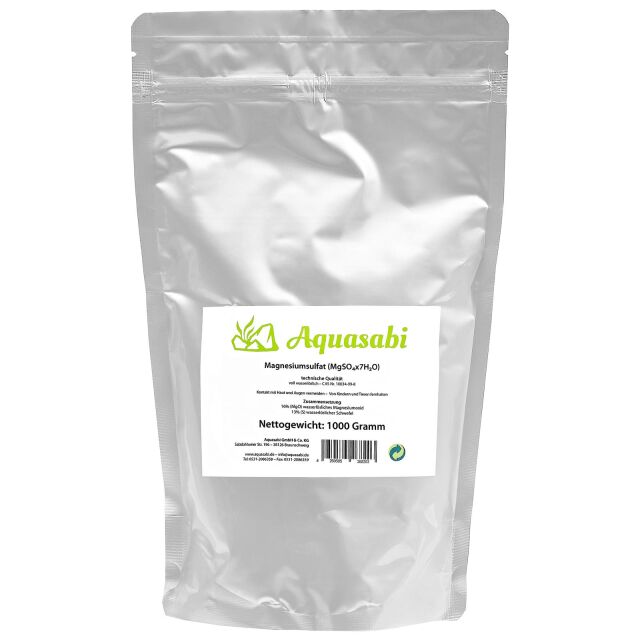
Magnesium is also a macronutrient that is quite important for photosynthesis but is consumed by plants only in very small amounts. For a long time, magnesium was not ascribed any significant role in planted-aquarium keeping, and a suitable magnesium water test was also long in short supply. More modern approaches now, however, take the content of this alkaline earth metal into account, and even in a specific ratio to calcium. Calcium and magnesium are both the main components of the general hardness of the water. In a planted aquarium, a ratio of about 3:1 calcium to magnesium is advocated to ensure a sufficient magnesium content for the plants. Therefore, unlike other macronutrients, with magnesium one cannot assume a certain base level in mg/l as a minimum value but should see it in relation to calcium and to general hardness. Since our German tap water is often quite rich in lime and medium hard to hard, the source water for a planted aquarium often has an unfavorable calcium-magnesium ratio with too high a share of calcium. Magnesium can then be added relatively easily via Epsom salt to set the right ratio. Since this substance is consumed very little, it is generally enough to adjust your aquarium water once to the desired values. A daily addition is then not necessary. At a water change, however, you should add enough Epsom salt proportionally to bring the fresh water back to a suitable calcium-magnesium ratio.
Conclusion: magnesium is a macro element that was underestimated for a long time in the history of planted-aquarium keeping. It is hardly consumed by the plants, but should be present in sufficient amounts, depending on a specific ratio to calcium. This matters especially when using very hard water. Magnesium can be added very simply via Epsom salt and only rarely needs to be dosed (with the fresh water exchange).
Iron
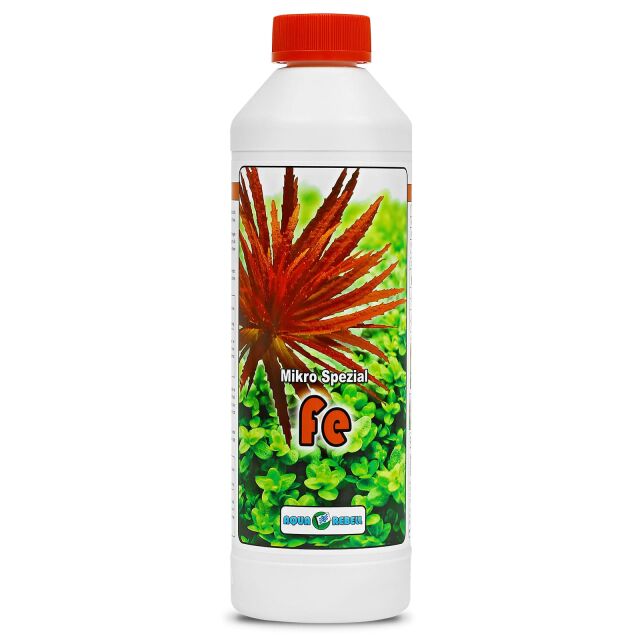
The nutrient element iron (Fe) is not one of the macronutrients but one of the micronutrients. This mainly means trace elements, which are mostly other metals such as nickel, copper, manganese or molybdenum. Among the micronutrients, however, iron is certainly the nutrient that aquatic plants need and consume to the greatest extent. In a planted aquarium, target values of 0.05 to 0.1 mg/l Fe are often given for iron. This can be checked well with a corresponding Fe test. Iron is generally fertilized with a so-called complete iron fertilizer, which then also adds further trace elements matched to it. Pure iron (without other trace elements) can be dosed with special iron fertilizers such as Aqua Rebell Mikro Spezial Fe. For uptake via the roots, nutrient-rich substrates or fertilizer tablets pressed into the substrate are suitable. Too high an Fe concentration in the water can easily trigger red algae such as black beard algae or beard algae, so you should not overdo the amount you add. The target concentrations mentioned above also do not necessarily have to be maintained permanently; they merely represent dosing amounts for calculating the doses. Depending on the form (divalent or trivalent) and chelation, iron can be taken up by the plants quite quickly and then also stored. Constantly re-measuring the iron content and topping up with an iron-containing fertilizer based on it is not expedient, since it can provoke red algae growth. What should be decisive is rather the appearance of the aquatic plants, which show an iron deficiency quite easily through pale shoot tips.
Conclusion: iron is a micronutrient. Unlike other nutrient elements such as nitrate, iron (Fe) and other trace elements do not necessarily have to be permanently measurable in a specific target range. A concentration that is too high can sometimes cause red algae to grow. Reducing the complete iron fertilizer often helps here. Instead of relying on measured values, the aquarist should pay much more attention to the growth pattern of the aquatic plants in order to possibly recognize an iron deficiency.
The special role of carbon
Carbon is a very essential element for the growth of aquatic plants, but it is not a mineral nutrient and is therefore, purely chemically speaking, not counted among the micro- and macronutrients. Because of the enormous carbon requirement in an aquarium with many aquatic plants, however, this element can in practical terms certainly be classified among the nutrients that should be present in larger amounts to achieve optimal growth results. In an aquarium, carbon is supplied in the form of carbon dioxide (CO2). This happens, for example, through the respiration of the inhabitants in the aquarium. In an aquarium with many aquatic plants, however, this is often not enough, so a CO2 system is generally used for the necessary supply. To monitor the carbon dioxide content in the aquarium water, a CO2 drop checker is recommended. Recommended target concentrations for a planted aquarium are in the range of 20 to 30 mg/l CO2. By the color of its test reagent, the drop checker shows whether this content is right, undershot or even exceeded. After all, a CO2 concentration that is too high can also be dangerous for the inhabitants of an aquarium.
Even the simplest aquarium plants benefit from the addition of carbon dioxide. This shows not only in a more vital appearance of the plants; the growth rate also increases enormously. A lack of carbon, on the other hand, can show in many ways, for example through yellow leaves or stunted growth. When carbon is lacking, some plants can extract this important element from the water through so-called biogenic decalcification. In the process, visible lime deposits form on the plants.
Conclusion: carbon supplied in the form of CO2 makes every aquarium plant healthier, stronger and faster growing. Since the deficiency symptoms of micro- and macronutrients can sometimes closely resemble those of a carbon deficiency, the rule here is to first check and, where necessary, improve the CO2 supply before attributing the deficiency to another nutrient. In that respect, carbon should always have top priority.
Adjusting consumption after trimming
A logical conclusion regarding the consumption of aquarium plants is that you always adjust the dosing amounts to the plant mass. A freshly set up planted aquarium consumes far fewer nutrient elements than an aquarium that has been running for a year and has a considerable plant mass. The aquarist should also note that radical cuts to the plant stock, such as a total plant trimming, also affect nutrient consumption. After trimming, the injured plant parts are first busy recovering and then forming new shoots. Consequently, nutrient consumption drops compared with before. In this case, the aquarist can adjust the fertilizer additions to the situation.