We use cookies to offer you an optimal shopping experience. These cookies can be grouped into categories. The necessary ones are essential for your purchase. Functional services enable additional content such as videos and maps. With further cookies we produce anonymized statistics. Others serve primarily marketing purposes and are used for the personalization of advertising. These cookies are used by 11 Services used in the shop. You can decide for yourself which cookies you want to allow.
We store your choice on your device (“local storage”) and ask you again after 12 months at the latest. You can change it at any time under “Cookie Preferences” in the footer. You can find details on cookie lifetimes and necessary cookies in our privacy policy.
These services are required to run the shop and for your purchase and cannot be switched off.
Strictly necessary cookies enable basic functions and are required for the website to work properly.
Description:
Shop functions: Essential Shop functions This includes: JTLSHOP (cookie, until you close the browser; keeps your session, the cart and your login), consent (browser storage; remembers your cookie choice, 12 months at most, during the session also in session storage), has_starting_point, cur_product_id and product_page_visits (session storage; navigation between products) as well as aquasabi-search-index-last-url, aquasabi-search-index-results and aquasabi-search-index-data (session storage; search results and lists when paging).
easyVision: easyVision lets website visitors customize the display – e.g. by adjusting contrast, font size, line and letter spacing, color rendering, a blue light filter or by disabling animations. Developed and hosted in Germany, the service is GDPR-compliant and supports statutory accessibility requirements (BFSG) from 2025. The service loads its scripts from cdn.sitecockpit.com and stores your settings (easy-vision-*) in your browser storage (no cookies).
Reviews: aquasabi_guid (cookie, 12 months) is only set when you click “Helpful” under a review. It stores a random ID so that the same person cannot count a review as helpful more than once.
Sorting and view: aquaSort and aquaDisplayType (cookies, 90 days) store the sorting or view (gallery or list) that you choose in a product list. They are only set when you choose a sorting or view.
Amazon Pay: Payment processing with Amazon Pay.
The service provider is Amazon Payments Europe S.C.A. Where Amazon Pay is offered (e.g. in the cart and at the checkout), the shop loads scripts and images from static-eu.payments-amazon.com, payments-eu.amazon.com and m.media-amazon.com and sets cookies (language, ledgerCurrency, apay-session-set). You can find out more in the privacy policy at https://www.amazon.de/gp/help/customer/display.html?nodeId=GRFTMVHP4HXMESSP
PayPal: Payment processing with PayPal.
The service provider is PayPal (Europe) S.à r.l. et Cie, S.C.A. Where PayPal is offered (e.g. in the cart and at the checkout), the shop loads scripts from www.paypal.com; for invoice payment via PayPal, c.paypal.com is added for fraud prevention. PayPal stores an entry in your browser storage (__paypal_storage__), and the shop remembers the chosen PayPal payment method in session storage (chosenPPCPaymentOption). You can find out more in the privacy policy at https://www.paypal.com/en/legalhub/paypal/privacy-full
Sofortüberweisung: On the confirmation page after an order with this payment method the shop loads a Klarna logo from x.klarnacdn.net.
Additional functions such as embedded videos and maps, spam protection in forms or the rating badge. Data is transferred to the respective provider when they load.
Show Youtube Videos
Description:
Displaying videos
Processing company:
Google Ireland Limited, Google Building Gordon House, 4 Barrow St, Dublin, D04 E5W5, Ireland
To submit forms on this page, you need to consent to the transfer of data and storage of third-party cookies by Google.
With your consent, reCAPTCHA, a Google service to avoid spam messages via contact forms, will be embedded.
This service allows us to provide our customers with a safe way to contact us via online forms. At the same time, the service prevents spam bots from compromising our services.
After you gave your permission, you might be asked to answer a security prompt to send the form.
If you do not consent, unfortunately you cannot use the form. Please contact us in a different way.
Helps us understand how the shop is used so that we can improve it.
We measure which pages and products are viewed and how visitors move through the shop. Google Analytics sets cookies (_ga, _ga_*) and sends usage data to Google.
Description:
Audience measurement and analysis of how the shop is used
Measures our advertising and enables personalised advertising on other sites.
We measure whether an ad on Facebook or Instagram led to a purchase and show visitors relevant ads again. Cookies are set for this: _fbp and _fbc (Meta) and as_fbclid (ours, 30 days; remembers the ID of the ad click). Meta receives data about your actions in the shop (e.g. product views, cart, purchase), your IP address and browser information; for a purchase our server may also send them directly to Meta (Conversions API). More in our privacy policy (retargeting/remarketing and conversion tracking).
Description:
Measure advertising success and show relevant ads again (Facebook, Instagram)
We measure whether an ad on TikTok led to a purchase. Cookies are set for this: _ttp, ttclid and _tt_* (TikTok) and as_ttclid (ours, 30 days; remembers the ID of the ad click). TikTok receives data about your actions in the shop (e.g. product views, cart, purchase), your IP address and browser information; for a purchase our server may also send them directly to TikTok (Events API). More in our privacy policy (retargeting/remarketing and conversion tracking).
We measure whether an ad in ChatGPT led to a purchase. Cookies are set for this: __oppref and __obref (OpenAI) and as_oppref (ours, 30 days; remembers the ID of the ad click). OpenAI receives data about your actions in the shop (e.g. product views, cart, purchase), your IP address and browser information; for a purchase our server may also send them directly to OpenAI (Conversions API). Data may be transmitted to OpenAI OpCo, LLC (USA). More in our privacy policy (retargeting/remarketing and conversion tracking).
Description:
Measure the success of ads in ChatGPT
Processing company:
OpenAI Ireland Limited, 1st Floor, The Liffey Trust Centre, 117-126 Sheriff Street Upper, Dublin 1, D01 YC43, Irland
We measure whether an ad led to a purchase and show visitors relevant ads again. Google Ads sets cookies (e.g. _gcl_*) and receives purchase data, where applicable in hashed form (SHA-256).
Description:
Measure advertising success and show relevant ads again (remarketing)
We use cookies that are essential for payment processing through our partners. Please select which payment providers you would like to use.
In order to unlock offers for extended payment options, in particular express checkout and payment in instalments, we require your consent to the data transfer and storage of third-party cookies of the payment provider PayPal. This allows us to also offer you express checkout and payment by instalments. Without your consent, only the technically necessary data transfer to PayPal will take place, but you will then not be able to use the express checkout or extended offers for payment by instalments on this site.
Description:
Using express checkout and Displaying offers for payment in instalments for individual items or your entire purchase.
Your consent ID:With this randomly generated number we can show on request what you selected. It contains no information about you.
Data privacy settings
Would you like to see these contents? Activate the desired contents for one session only or allow the website to remember these settings. Once you have given your consent, the third-party data can be loaded. For this, third-party cookies might be stored on your device. You can change these settings at any time (footer: “Cookie Preferences”). For further details, please see the Privacy notice.
Gravel is an extremely popular substrate for a freshwater aquarium. Besides sand and soil, it is one of the most frequently used substrates in the aquarium hobby. We explain the characteristics of gravel and how and why it can be used in an aquarium.
Grain size
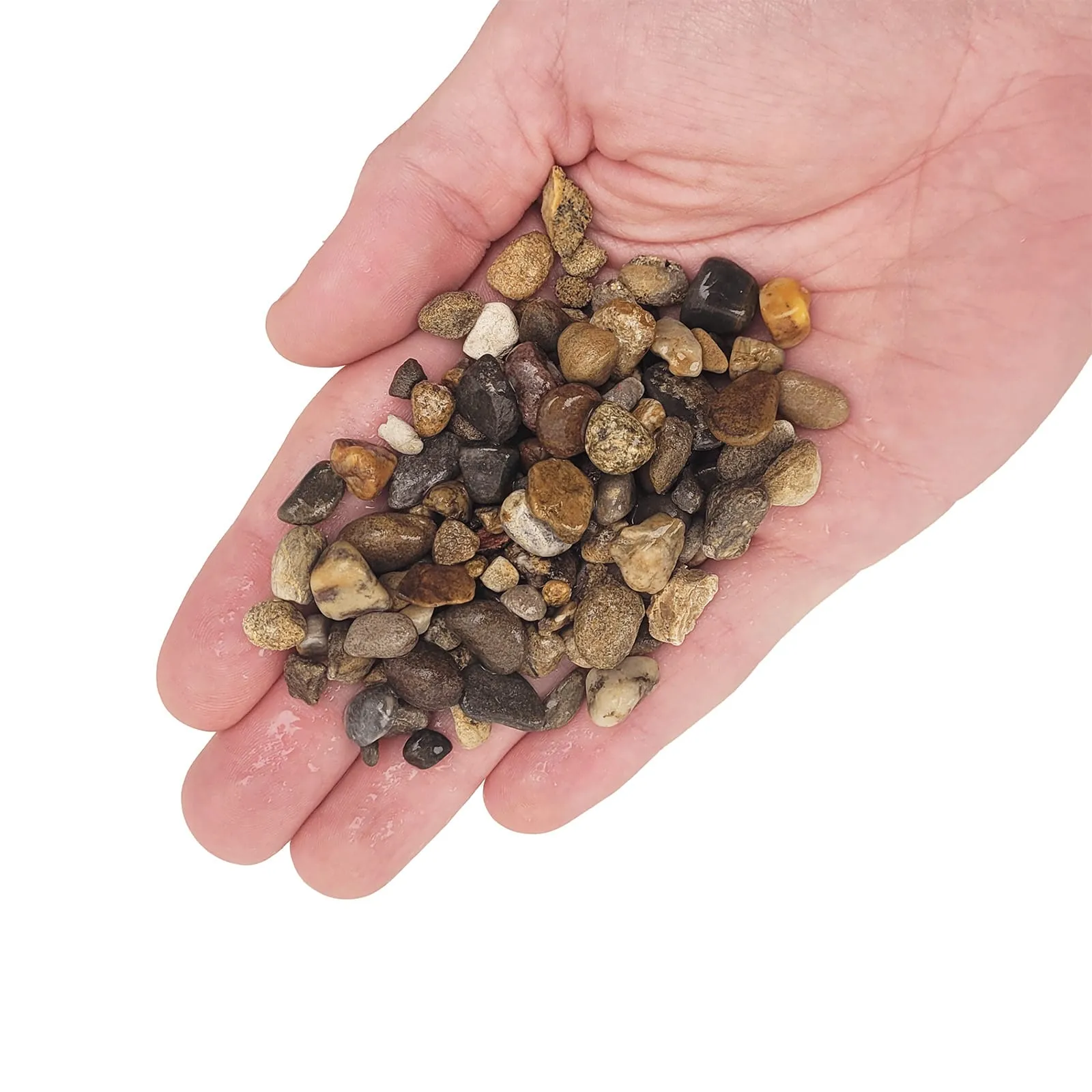
In principle, the transitions between the products sand and gravel are very fluid. According to the DIN standard, the distinction depends very much on the grain size of the individual particles. Basically, gravel exists at a grain size of 2 to 63 mm, with various subdivisions into coarse gravel, fine gravel and medium gravel. By definition, a grain size of less than 2 mm is called sand. Within the classification of sand, you can also expect finer gradations. You can find a more detailed explanation of the topic here.
Something else that is important for the aquarist: the density of the substrate is related to the grain size. The finer the substrate, the higher the density. Larger particles therefore stand for a looser substrate. Fine sand is a very dense substrate.
Types of gravel
Basically, a distinction is made between natural and artificial types of gravel. While the former are mined in nature and come onto the market at most slightly pre-washed, artificial gravels are often treated in a more elaborate way during production. For example, gravel grains can be given a special color and then coated with synthetic resin. The resin protects against the color influencing the parameters in the aquarium water. This also makes very striking colors such as pink, purple, green, blue or red possible, which would not occur like this in nature. Gravels coated with synthetic resin are in any case water-neutral. Among the natural types of gravel there may sometimes be slightly water-hardening types of rock. Especially in combination with a CO2 system, hardening can then take place. Without the input of carbon dioxide, this effect is almost negligible.

Furthermore, there are of course enormous differences in color, grain size and also the shape of the particles. The color of the gravel is primarily a visual matter; animals that shy away from light, for example, feel more comfortable on a dark substrate because it does not reflect light as strongly. Light-colored substrates, however, positively shine under a suitable aquarium lamp. As for grain size, there is first of all the clear distinction from sand. As described above, a grain size below 2 mm is declared as sand according to the DIN regulation. Above that, the types are defined as gravel, with a further, finer subdivision into fine gravel, medium gravel and coarse gravel. Which grain size you choose is, among other things, also a decision based on looks. There is also a biological role, however: coarser gravel creates larger gaps in the substrate. This promotes circulation in the substrate, but more detritus (mulm) can also accumulate in it, and the plants find it harder to get a hold in it. The pros and cons should therefore be weighed carefully against each other. You can also mix different grain sizes; aquascapers in particular use different types of substrate with different grain sizes to achieve great natural-looking effects that, for example, enhance the sense of depth and detail in the substrate area.
Basically, rounded particles are better for bottom dwellers so that there is no risk of injury from sharp-edged objects. This can be very decisive especially for bottom-sifting animals such as armored catfish. "Artificial" types of substrate in particular are therefore often rounded further during production in order to offer a shape that is very spherical. For this reason, some natural types of gravel in particular can be somewhat splintery to sharp-edged.
Preparing aquarium gravel
Depending on the product, the substrate should sometimes be prepared before it is added to the aquarium. This often means pre-washing the gravel. Natural types of substrate in particular have a higher proportion of dust and dirt that can otherwise cause cloudiness in the aquarium water. It is therefore worth washing the gravel out well under running water beforehand. Care is sometimes required when pre-washing products coated with synthetic resin. Here, warm or even hot water should preferably not be used so as not to affect the resin coating.
For pre-cleaning the gravel, all that is needed is clear fresh water and no cleaning agents at all. Usually the substrate is put outside into a suitable container that is allowed to overflow. The water is then added and the gravel stirred several times. The water now picks up the dust particles and becomes visibly dirty accordingly. You can now simply tip out the dirty water carefully or deliberately let the container overflow. Be sure to avoid substrate particles escaping from the container. You repeat this rinsing process until the water finally becomes as clear as possible. Afterward the gravel can be used in the aquarium.
Caring for gravel in the aquarium
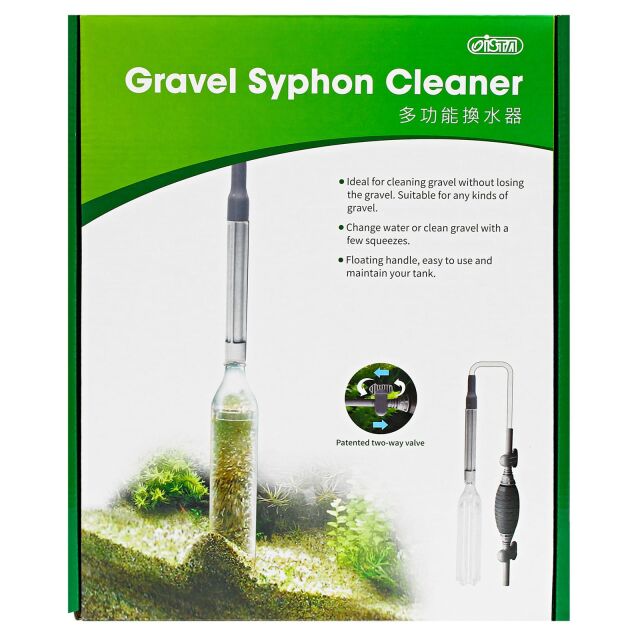
Because gravel in a coarser grain size in particular offers quite a lot of gaps in the substrate, considerably more detritus (mulm) and dirt can accumulate here than with much denser sand. If the degree of contamination gets out of hand, it is advisable to remove this detritus from the substrate. Classic gravel vacuums come into play here, which can pull the dirt out of the substrate excellently without causing strong swirling and rearrangement near the bottom.
On the other hand, the detritus should not be removed too often either, since important pollutant-degrading bacteria live in it. An aquarium that is too clean often has a disturbed microbiology, and not infrequently an infestation with cyanobacteria (blue-green algae) occurs because there is a lack of microbiological competition. If too many beneficial bacteria are removed by cleaning actions, a rise in toxic substances such as ammonium and nitrite is even possible. For this reason, for example, cleaning work on the substrate and the filter should preferably not be carried out at the same time but with a clear time offset. This way, at least a certain portion of beneficial bacteria is retained.
Nutrients and aquarium gravel
Aquarium gravels are generally passive substrates that contain no nutrients at all. Using substrate fertilizers under the gravel layer is therefore recommended in order to be able to offer the plants important nutrients through the roots as well. Adding fertilizer balls or tabs is also a sensible measure, for example to support the growth of certain plants in a targeted way.
There are some exceptions, however. Many gravel and sand substrates from the company Seachem are rich in various nutrients. The so-called Flourite substrates differ greatly in grain size, color and nutrient composition and therefore offer a lot of options for finding a suitable gravel substrate for every aquarium.
How much gravel for my aquarium?
Are you planning a new setup and would like to know how much gravel or sand you need? No problem, it can be calculated at least approximately. It is important to know roughly the grain size of the substrate; then you can calculate the required amount using rules of thumb. More on this in this article.
