We use cookies to offer you an optimal shopping experience. These cookies can be grouped into categories. The necessary ones are essential for your purchase. Functional services enable additional content such as videos and maps. With further cookies we produce anonymized statistics. Others serve primarily marketing purposes and are used for the personalization of advertising. These cookies are used by 11 Services used in the shop. You can decide for yourself which cookies you want to allow.
We store your choice on your device (“local storage”) and ask you again after 12 months at the latest. You can change it at any time under “Cookie Preferences” in the footer. You can find details on cookie lifetimes and necessary cookies in our privacy policy.
These services are required to run the shop and for your purchase and cannot be switched off.
Strictly necessary cookies enable basic functions and are required for the website to work properly.
Description:
Shop functions: Essential Shop functions This includes: JTLSHOP (cookie, until you close the browser; keeps your session, the cart and your login), consent (browser storage; remembers your cookie choice, 12 months at most, during the session also in session storage), has_starting_point, cur_product_id and product_page_visits (session storage; navigation between products) as well as aquasabi-search-index-last-url, aquasabi-search-index-results and aquasabi-search-index-data (session storage; search results and lists when paging).
easyVision: easyVision lets website visitors customize the display – e.g. by adjusting contrast, font size, line and letter spacing, color rendering, a blue light filter or by disabling animations. Developed and hosted in Germany, the service is GDPR-compliant and supports statutory accessibility requirements (BFSG) from 2025. The service loads its scripts from cdn.sitecockpit.com and stores your settings (easy-vision-*) in your browser storage (no cookies).
Reviews: aquasabi_guid (cookie, 12 months) is only set when you click “Helpful” under a review. It stores a random ID so that the same person cannot count a review as helpful more than once.
Sorting and view: aquaSort and aquaDisplayType (cookies, 90 days) store the sorting or view (gallery or list) that you choose in a product list. They are only set when you choose a sorting or view.
Amazon Pay: Payment processing with Amazon Pay.
The service provider is Amazon Payments Europe S.C.A. Where Amazon Pay is offered (e.g. in the cart and at the checkout), the shop loads scripts and images from static-eu.payments-amazon.com, payments-eu.amazon.com and m.media-amazon.com and sets cookies (language, ledgerCurrency, apay-session-set). You can find out more in the privacy policy at https://www.amazon.de/gp/help/customer/display.html?nodeId=GRFTMVHP4HXMESSP
PayPal: Payment processing with PayPal.
The service provider is PayPal (Europe) S.à r.l. et Cie, S.C.A. Where PayPal is offered (e.g. in the cart and at the checkout), the shop loads scripts from www.paypal.com; for invoice payment via PayPal, c.paypal.com is added for fraud prevention. PayPal stores an entry in your browser storage (__paypal_storage__), and the shop remembers the chosen PayPal payment method in session storage (chosenPPCPaymentOption). You can find out more in the privacy policy at https://www.paypal.com/en/legalhub/paypal/privacy-full
Sofortüberweisung: On the confirmation page after an order with this payment method the shop loads a Klarna logo from x.klarnacdn.net.
Additional functions such as embedded videos and maps, spam protection in forms or the rating badge. Data is transferred to the respective provider when they load.
Show Youtube Videos
Description:
Displaying videos
Processing company:
Google Ireland Limited, Google Building Gordon House, 4 Barrow St, Dublin, D04 E5W5, Ireland
To submit forms on this page, you need to consent to the transfer of data and storage of third-party cookies by Google.
With your consent, reCAPTCHA, a Google service to avoid spam messages via contact forms, will be embedded.
This service allows us to provide our customers with a safe way to contact us via online forms. At the same time, the service prevents spam bots from compromising our services.
After you gave your permission, you might be asked to answer a security prompt to send the form.
If you do not consent, unfortunately you cannot use the form. Please contact us in a different way.
Helps us understand how the shop is used so that we can improve it.
We measure which pages and products are viewed and how visitors move through the shop. Google Analytics sets cookies (_ga, _ga_*) and sends usage data to Google.
Description:
Audience measurement and analysis of how the shop is used
Measures our advertising and enables personalised advertising on other sites.
We measure whether an ad on Facebook or Instagram led to a purchase and show visitors relevant ads again. Cookies are set for this: _fbp and _fbc (Meta) and as_fbclid (ours, 30 days; remembers the ID of the ad click). Meta receives data about your actions in the shop (e.g. product views, cart, purchase), your IP address and browser information; for a purchase our server may also send them directly to Meta (Conversions API). More in our privacy policy (retargeting/remarketing and conversion tracking).
Description:
Measure advertising success and show relevant ads again (Facebook, Instagram)
We measure whether an ad on TikTok led to a purchase. Cookies are set for this: _ttp, ttclid and _tt_* (TikTok) and as_ttclid (ours, 30 days; remembers the ID of the ad click). TikTok receives data about your actions in the shop (e.g. product views, cart, purchase), your IP address and browser information; for a purchase our server may also send them directly to TikTok (Events API). More in our privacy policy (retargeting/remarketing and conversion tracking).
We measure whether an ad in ChatGPT led to a purchase. Cookies are set for this: __oppref and __obref (OpenAI) and as_oppref (ours, 30 days; remembers the ID of the ad click). OpenAI receives data about your actions in the shop (e.g. product views, cart, purchase), your IP address and browser information; for a purchase our server may also send them directly to OpenAI (Conversions API). Data may be transmitted to OpenAI OpCo, LLC (USA). More in our privacy policy (retargeting/remarketing and conversion tracking).
Description:
Measure the success of ads in ChatGPT
Processing company:
OpenAI Ireland Limited, 1st Floor, The Liffey Trust Centre, 117-126 Sheriff Street Upper, Dublin 1, D01 YC43, Irland
We measure whether an ad led to a purchase and show visitors relevant ads again. Google Ads sets cookies (e.g. _gcl_*) and receives purchase data, where applicable in hashed form (SHA-256).
Description:
Measure advertising success and show relevant ads again (remarketing)
We use cookies that are essential for payment processing through our partners. Please select which payment providers you would like to use.
In order to unlock offers for extended payment options, in particular express checkout and payment in instalments, we require your consent to the data transfer and storage of third-party cookies of the payment provider PayPal. This allows us to also offer you express checkout and payment by instalments. Without your consent, only the technically necessary data transfer to PayPal will take place, but you will then not be able to use the express checkout or extended offers for payment by instalments on this site.
Description:
Using express checkout and Displaying offers for payment in instalments for individual items or your entire purchase.
Your consent ID:With this randomly generated number we can show on request what you selected. It contains no information about you.
Data privacy settings
Would you like to see these contents? Activate the desired contents for one session only or allow the website to remember these settings. Once you have given your consent, the third-party data can be loaded. For this, third-party cookies might be stored on your device. You can change these settings at any time (footer: “Cookie Preferences”). For further details, please see the Privacy notice.
In an aquarium that has already been running for a longer time, it may be necessary for various reasons to renew or replace the substrate. Perhaps you no longer like the look, the soil has lost its effect, or the organic load in the substrate has become too high. These are all typical reasons why the substrate is replaced. Now, however, we have an already running aquarium stocked with aquatic plants, ornamental fish or invertebrates. How do you best proceed here? We explain that to you in this article.
Sessile bacteria
The experienced aquarist of course knows that there are important bacteria in the aquarium for breaking down pollutants in the sense of the nitrogen cycle. These bacteria convert substances toxic to fish, such as ammonium and nitrite, into harmless nitrate and live sessile. This means that these microorganisms do not float freely in the water but settle on surfaces. Filter materials and substrate particles in particular offer excellent colonization surfaces. The larger the surface area of the structures, the more bacteria can populate them and the more effective the breakdown of pollutants is. In a healthy ecosystem in the aquarium, enough bacteria live there to prevent the formation of concentrations of ammonium and nitrite that are toxic to fish. The stock then lives in an environment that is harmless in this respect.
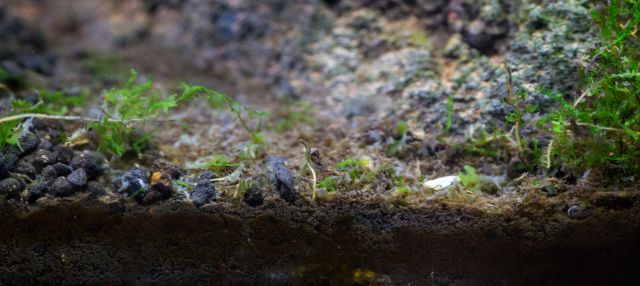
If you now replace the complete substrate, a lot of beneficial bacteria are removed in this way as well. The amount of bacteria living in the substrate is often underestimated here. Unfortunately, some time passes until the necessary microorganisms settle again in the new substrate. In principle, the aquarium then goes through a new cycling phase, and higher concentrations of ammonium and nitrite can occur. For the stock living in the aquarium, this means an immediate danger.
There are some aquarists who, in such cases, of course rely on the fact that there are still enough living bacteria inside the filter. Often, however, this is not enough to prevent the formation of toxic concentrations of ammonium and nitrite. If the animal stock then remains in the aquarium, the consequences can usually be felt the day after the substrate replacement, mostly in the form of poisoned or already dead animals.
This can sometimes happen even if you have used a so-called bacteria starter. A corresponding product does introduce new bacteria, but their amount is then often still not enough to establish a fully functioning nitrogen cycle immediately.
Suggested solutions
To keep the risk to the aquarium inhabitants as low as possible and to avoid poisoning as well as you can, there are some measures, which we present here.
Relocating the stock
Lucky is the one who owns a second aquarium into which the animal stock from the first aquarium can be moved temporarily. While the fish, shrimp and snails stay in their temporary home, the aquarium with the replaced substrate can get through its renewed cycling phase in peace. Of course, you can gladly speed up this process by adding bacteria products. The stock should only go back into the old aquarium, however, when the water parameters allow it and ammonium and nitrite are no longer detectable. It is therefore necessary to wait a few days or weeks in any case. When moving them back, it is also worth being careful and moving only a few fish back at first. After a few days, you can then gradually increase the number.
It is important to note that the temporary aquarium should of course also be fully cycled in terms of the nitrogen cycle. The necessary cycling time of a few weeks has to be taken into account when planning the substrate replacement in the other aquarium.
Conclusion: even though setting up and cycling a temporary aquarium takes time and some effort, this variant is the safest option for the animal stock.
Replacing the substrate step by step
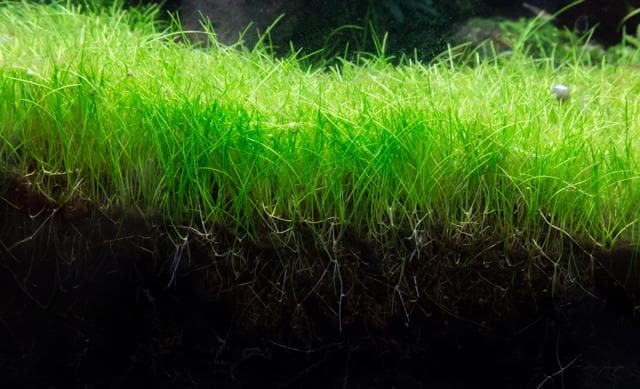
Another possibility can be to replace the substrate in the aquarium not all at once but gradually, in small steps over a longer period. Because only a small part of the important bacteria is removed, enough microorganisms remain with this measure to maintain the nitrogen cycle for the stock staying in the aquarium. In your mind, you divide the substrate into different areas, which you then provide with fresh substrate one after another. There should also always be enough time between the replacement rounds for bacteria to settle again in peace in the zones with new substrate.
The advantage of this measure is that you save yourself a temporary aquarium. There are, however, also certain disadvantages and uncertainty factors. For one thing, the effort of replacing the substrate several times is quite high and not easy either, because the substrate simply consists of many small particles. Mixing of the old and new substrate parts cannot really be prevented. To make matters worse, you have to do this, so to speak, flying blind, because the water often becomes impossible to see through when detritus and suspended particles are stirred up. Precise work becomes extremely difficult here. With regard to the microbiological aspects, it is also unclear how large such an area may be when you do a partial replacement. If you calculate the amount a bit too high, too many bacteria are removed and there is again a danger of fish poisoning.
Conclusion: a temporary aquarium is not necessary, but replacing individual substrate zones several times is laborious. Certain residual risks remain regarding the biological stability of the aquarium.
General notes
No matter which measure you choose, the well-being of the animals should come first. Replacing the substrate has a major influence on the microbiological situation. The aquarist is therefore advised to observe the animal stock closely during and after the rebuilding work and to check the ammonium and nitrite values in the water more regularly. The filter should not be cleaned immediately before, during and after the measure, so that at least there the important bacteria can keep working undisturbed. It cannot hurt to use a bacteria starter and to keep the organic load low by feeding less and changing water more often. Additional oxygen input through aeration or the use of an oxydator or Twinstar sterilizer to reduce germ pressure are also sensible supplementary measures.
