
We use cookies to offer you an optimal shopping experience. These cookies can be grouped into categories. The necessary ones are essential for your purchase. Functional services enable additional content such as videos and maps. With further cookies we produce anonymized statistics. Others serve primarily marketing purposes and are used for the personalization of advertising. These cookies are used by 11 Services used in the shop. You can decide for yourself which cookies you want to allow.
We store your choice on your device (“local storage”) and ask you again after 12 months at the latest. You can change it at any time under “Cookie Preferences” in the footer. You can find details on cookie lifetimes and necessary cookies in our privacy policy.
These services are required to run the shop and for your purchase and cannot be switched off.
Strictly necessary cookies enable basic functions and are required for the website to work properly.
Description:
Shop functions: Essential Shop functions This includes: JTLSHOP (cookie, until you close the browser; keeps your session, the cart and your login), consent (browser storage; remembers your cookie choice, 12 months at most, during the session also in session storage), has_starting_point, cur_product_id and product_page_visits (session storage; navigation between products) as well as aquasabi-search-index-last-url, aquasabi-search-index-results and aquasabi-search-index-data (session storage; search results and lists when paging).
easyVision: easyVision lets website visitors customize the display – e.g. by adjusting contrast, font size, line and letter spacing, color rendering, a blue light filter or by disabling animations. Developed and hosted in Germany, the service is GDPR-compliant and supports statutory accessibility requirements (BFSG) from 2025. The service loads its scripts from cdn.sitecockpit.com and stores your settings (easy-vision-*) in your browser storage (no cookies).
Reviews: aquasabi_guid (cookie, 12 months) is only set when you click “Helpful” under a review. It stores a random ID so that the same person cannot count a review as helpful more than once.
Sorting and view: aquaSort and aquaDisplayType (cookies, 90 days) store the sorting or view (gallery or list) that you choose in a product list. They are only set when you choose a sorting or view.
Amazon Pay: Payment processing with Amazon Pay.
The service provider is Amazon Payments Europe S.C.A. Where Amazon Pay is offered (e.g. in the cart and at the checkout), the shop loads scripts and images from static-eu.payments-amazon.com, payments-eu.amazon.com and m.media-amazon.com and sets cookies (language, ledgerCurrency, apay-session-set). You can find out more in the privacy policy at https://www.amazon.de/gp/help/customer/display.html?nodeId=GRFTMVHP4HXMESSP
PayPal: Payment processing with PayPal.
The service provider is PayPal (Europe) S.à r.l. et Cie, S.C.A. Where PayPal is offered (e.g. in the cart and at the checkout), the shop loads scripts from www.paypal.com; for invoice payment via PayPal, c.paypal.com is added for fraud prevention. PayPal stores an entry in your browser storage (__paypal_storage__), and the shop remembers the chosen PayPal payment method in session storage (chosenPPCPaymentOption). You can find out more in the privacy policy at https://www.paypal.com/en/legalhub/paypal/privacy-full
Sofortüberweisung: On the confirmation page after an order with this payment method the shop loads a Klarna logo from x.klarnacdn.net.
Additional functions such as embedded videos and maps, spam protection in forms or the rating badge. Data is transferred to the respective provider when they load.
Show Youtube Videos
Description:
Displaying videos
Processing company:
Google Ireland Limited, Google Building Gordon House, 4 Barrow St, Dublin, D04 E5W5, Ireland
To submit forms on this page, you need to consent to the transfer of data and storage of third-party cookies by Google.
With your consent, reCAPTCHA, a Google service to avoid spam messages via contact forms, will be embedded.
This service allows us to provide our customers with a safe way to contact us via online forms. At the same time, the service prevents spam bots from compromising our services.
After you gave your permission, you might be asked to answer a security prompt to send the form.
If you do not consent, unfortunately you cannot use the form. Please contact us in a different way.
Helps us understand how the shop is used so that we can improve it.
We measure which pages and products are viewed and how visitors move through the shop. Google Analytics sets cookies (_ga, _ga_*) and sends usage data to Google.
Description:
Audience measurement and analysis of how the shop is used
Measures our advertising and enables personalised advertising on other sites.
We measure whether an ad on Facebook or Instagram led to a purchase and show visitors relevant ads again. Cookies are set for this: _fbp and _fbc (Meta) and as_fbclid (ours, 30 days; remembers the ID of the ad click). Meta receives data about your actions in the shop (e.g. product views, cart, purchase), your IP address and browser information; for a purchase our server may also send them directly to Meta (Conversions API). More in our privacy policy (retargeting/remarketing and conversion tracking).
Description:
Measure advertising success and show relevant ads again (Facebook, Instagram)
We measure whether an ad on TikTok led to a purchase. Cookies are set for this: _ttp, ttclid and _tt_* (TikTok) and as_ttclid (ours, 30 days; remembers the ID of the ad click). TikTok receives data about your actions in the shop (e.g. product views, cart, purchase), your IP address and browser information; for a purchase our server may also send them directly to TikTok (Events API). More in our privacy policy (retargeting/remarketing and conversion tracking).
We measure whether an ad in ChatGPT led to a purchase. Cookies are set for this: __oppref and __obref (OpenAI) and as_oppref (ours, 30 days; remembers the ID of the ad click). OpenAI receives data about your actions in the shop (e.g. product views, cart, purchase), your IP address and browser information; for a purchase our server may also send them directly to OpenAI (Conversions API). Data may be transmitted to OpenAI OpCo, LLC (USA). More in our privacy policy (retargeting/remarketing and conversion tracking).
Description:
Measure the success of ads in ChatGPT
Processing company:
OpenAI Ireland Limited, 1st Floor, The Liffey Trust Centre, 117-126 Sheriff Street Upper, Dublin 1, D01 YC43, Irland
We measure whether an ad led to a purchase and show visitors relevant ads again. Google Ads sets cookies (e.g. _gcl_*) and receives purchase data, where applicable in hashed form (SHA-256).
Description:
Measure advertising success and show relevant ads again (remarketing)
We use cookies that are essential for payment processing through our partners. Please select which payment providers you would like to use.
In order to unlock offers for extended payment options, in particular express checkout and payment in instalments, we require your consent to the data transfer and storage of third-party cookies of the payment provider PayPal. This allows us to also offer you express checkout and payment by instalments. Without your consent, only the technically necessary data transfer to PayPal will take place, but you will then not be able to use the express checkout or extended offers for payment by instalments on this site.
Description:
Using express checkout and Displaying offers for payment in instalments for individual items or your entire purchase.
Your consent ID:With this randomly generated number we can show on request what you selected. It contains no information about you.
Data privacy settings
Would you like to see these contents? Activate the desired contents for one session only or allow the website to remember these settings. Once you have given your consent, the third-party data can be loaded. For this, third-party cookies might be stored on your device. You can change these settings at any time (footer: “Cookie Preferences”). For further details, please see the Privacy notice.
Because of the so-called lime-carbonic acid equilibrium, there is a relationship between the pH value, the CO2 content and the carbonate hardness (KH) of water. These values are often summarized in a table. Here we show you what it is all about.
The lime-carbonic acid equilibrium
The so-called lime-carbonic acid equilibrium refers to the chemical equilibrium between carbonic acid, or carbon dioxide, and calcium carbonate (CaCO3). When this balance is present, an aqueous solution no longer contains any free carbonic acid. It is then neither able to dissolve lime nor, on the other hand, to precipitate lime.
The so-called free carbonic acid is present almost entirely in the form of CO2; only a small portion of approx. 0.7% reacts with water (H2O) to form hydrated carbonic acid H2CO3:
CO2 + H2O ↔ H2CO3
Depending on the pH value of the water, carbonic acid forms or decomposes into other substances. The following reaction equation is relevant here:
H2CO3 ↔ H+ + HCO3-
So carbonic acid can decompose further into H+ ions and hydrogen carbonate (HCO3-). The latter can in turn decompose in a next step into H+ ions and carbonate:
HCO3- ↔ H+ + CO32-
As already mentioned above, these reactions depend strongly on the pH value of the water. If few H+ ions are present, meaning the pH value is rather high, considerably more carbonates and hydrogen carbonates (CO32- and HCO3-) are formed. If, however, there are more H+ ions in the water, the pH value is lower. The reaction then runs more in the other direction and more carbonic acid forms, and ultimately considerably more CO2 (and water).
Biogenic decalcification
Hydrogen carbonates (HCO3-) are readily soluble in water, but carbonates (CO32-) are considerably less so. These combine with the calcium ions dissolved in the water and can then precipitate as lime (CaCO3). In the aquarium, such a lime coating can sometimes be seen, for example as whitish deposits on plant leaves or other decoration. This usually happens when the aquatic plants carry out biogenic decalcification, which is caused by a CO2 deficiency, meaning there is hardly any free CO2 left. The plants then obtain the carbon they need from the hydrogen carbonate in the water. As a result, the pH value rises and the mass ratio shifts toward carbonate. When the solubility limit of carbonates and calcium in the water is reached, they then precipitate as a solid (lime), which forms these visible coatings on the plant leaves.
Carbonic acid and its forms
Carbonic acid can dissolve lime (CaCO3) and convert it into calcium hydrogen carbonate [Ca(HCO3)2]. This often occurs in an aquarium that is fertilized with CO2 but also contains calcareous stones as decoration. The carbonic acid from the CO2 supply breaks down the lime inclusions in the stones. As a result, both KH and GH of the water rise, and ultimately the pH as well.
The CO2 incorporated in carbonates is also referred to as bound carbonic acid. Semi-bound carbonic acid is the portion of CO2 that is bound in hydrogen carbonate [Ca(HCO3)2].
Together with the free carbonic acid (here CO2), a total of three different forms of carbonic acid are therefore possible, which can also coexist. As mentioned, this depends on the pH value.
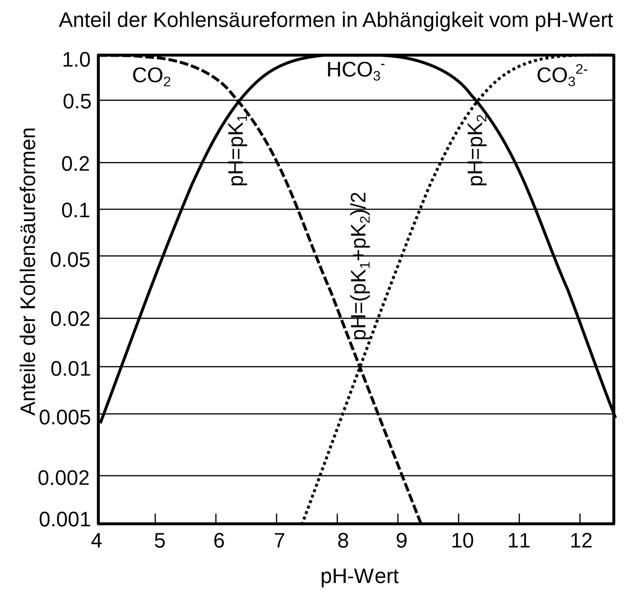
The simultaneous occurrence of two forms is in this case called the "associated" carbonic acid of the other form. In the aquarium hobby, the content of hydrogen carbonates in the water is often expressed as carbonate hardness (KH). Proceeding from this, the corresponding amount of CO2 is regarded as "associated" or defined as the "associated carbonic acid".
Hydrogen carbonates would continue to decompose if the matching free "associated" carbonic acid in the form of CO2 were not present. It can therefore also be said that the water is in lime-carbonic acid equilibrium when the amount of free carbonic acid corresponds to the amount of associated carbonic acid. In this balance, no further excess CO2 is present.
If the concentration of free associated carbonic acid is too low, lime can therefore form in the form of precipitates. The hydrogen carbonates then become unstable and decompose further into carbonates, which can then form lime with the calcium present in the water.
If, however, more free than associated carbonic acid is present, the water is lime-aggressive and strives to return to the state of equilibrium by dissolving lime.
The KH-pH-CO2 table
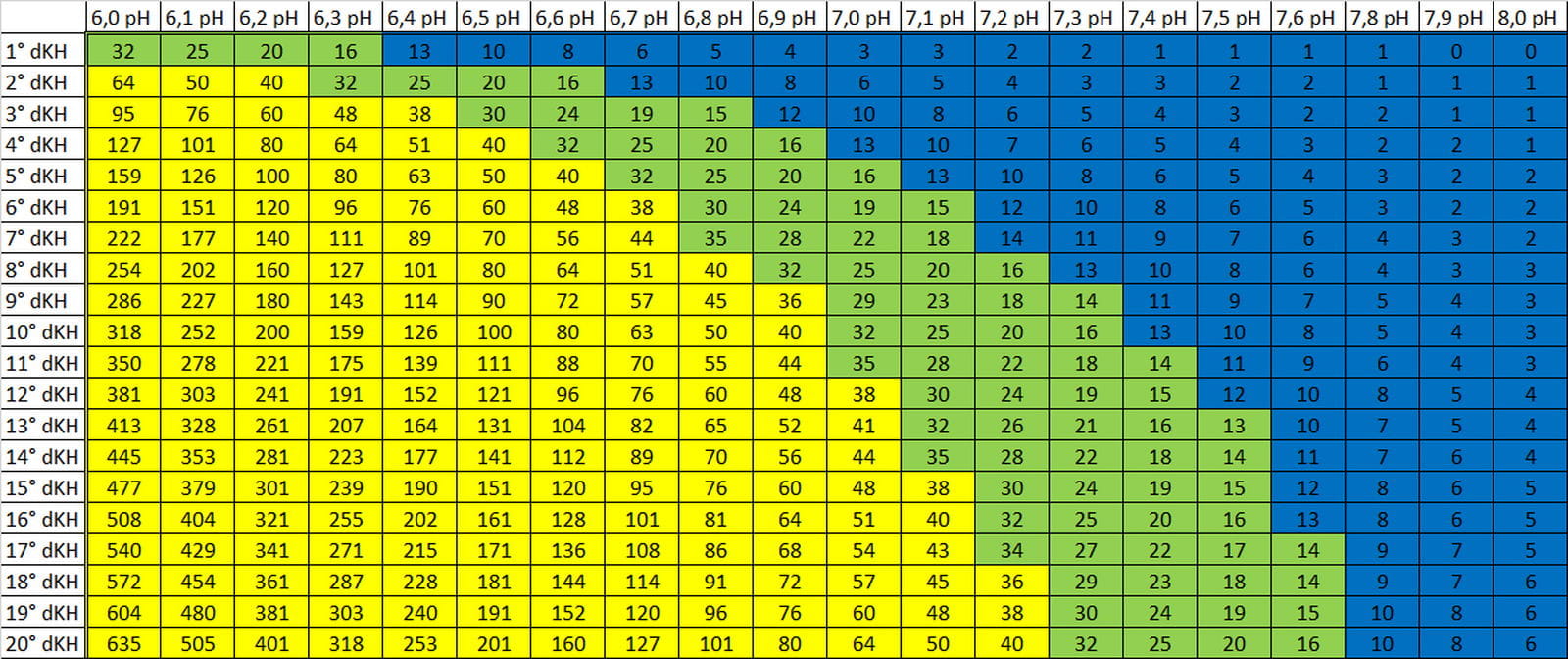
Based on the relationships described above, the following table can be drawn up. Depending on a particular pH and KH, you can read off the CO2 value here.
The CO2 content is also color-coded, in a way similar to the color scheme of a CO2 drop checker, designed so that it makes sense for the growth of aquatic plants. Sufficient CO2 concentrations are shown here with a green background. Blue means too little carbon dioxide for aquarium plants, and a yellow color stands for a CO2 concentration that is too high, which could sometimes cause problems for the aquarium inhabitants.
Using the table in the aquarium hobby
The all-important question for the aquarist is, of course, to what extent can this table be used in practice? First of all, it should be mentioned that this is a purely theoretical construct in which other factors have no influence on the parameters pH, KH and CO2. In an aquarium, however, things can look quite different, since the aquarium water contains other substances that can influence these parameters. Above all, besides carbonate hardness there are other buffer systems that can stabilize the pH value. These include above all humic substances and phosphates, which can occur more or less in an aquarium as a rule. Phosphate often gets into the water through aquarium fertilizers but also as a breakdown product of fish excretions; humic substances get in, for example, through introduced driftwood, other natural materials such as peat, alder cones and, of course, humic substance products.
These other elements in the water can distort the relationship of pH, KH and CO2 and thus influence the values in the table. Many aquarists use the table incorrectly and use it as a test for determining the CO2 content in real time. For this, the KH and pH values determined by liquid drop test are used to then calculate the CO2 value from the table. In reality, though, it looks quite different because of the other interfering factors. To determine the CO2 concentration independently, a so-called drop checker with test reagent is needed. For this, the test solution has a fixed KH that is independent of the aquarium water, which then displays a reliable result.
The KH-pH-CO2 table is therefore not completely useless after all, since it offers a first point of reference and a rough guideline for how the associated water parameters stand, at least in theory. The table is a good starting aid especially for setting up a pH controller. It is just that this table should rather not be used as a direct CO2 test.