pH value in the aquarium

By Aram Schneider Published Updated
Translated from German with AI assistance and reviewed by our editors.
Among the generally relevant water parameters for an aquarium, the so-called pH value is an important factor. In this article we explain what it is all about.
Definition of the pH value
The pH value is an exact unit that indicates whether an aqueous solution is neutral, acidic or basic. It is determined by the activity of the hydrogen ions (H+) it contains. Mathematically, the pH value is the negative base-10 logarithm of the concentration of hydrogen ions present.
The name, or rather the abbreviation, pH came about because in 1909 Søren Sørensen, a Danish chemist, established this notation. The letter H was fittingly chosen as the symbol for hydrogen ions, while the letter p was set rather arbitrarily as an index for his solutions from the series of measurements. Later in history, pH was also interpreted as potentia Hydrogenii, which can be translated with the words power (potentia) and hydrogen (Hydrogenium).
Classification of the pH value
On a scale, certain pH values can be assigned to different ranges. The so-called neutral point is represented by the value 7. A value below 7 defines an aqueous solution as acidic, while a value above 7 indicates a basic (alkaline) property. The pH scale therefore covers a total range of values from 0 to 14. It should also be mentioned that the pH value of aqueous solutions also depends on the temperature of the liquid.
Significance of the pH value in the aquarium hobby
Just like other water parameters such as hardness and temperature, the pH value of the water is a property of essential importance, even if it may not seem so at first glance. In the natural habitats of fish, invertebrates and also aquatic plants, very specific parameters prevail that depend on the location and to which the organisms are accustomed. This includes the pH value, or at least a certain pH range. To create conditions that are as ideal as possible for the animals and plants, it is important to pay attention to the water parameters of their original habitats and to reproduce them as well as possible. Of course, this includes the pH value as well.
When keeping different animal species together (including those of different origin), you must therefore make sure that they prefer at least similar water parameters. Some species are far more adaptable here, while others need conditions that are as exact as possible, since otherwise they do not feel well.
Due to chemical circumstances, there are also certain relationships between the pH value and other elements that make up the water in an aquarium. We will now take a closer look at these connections as follows.
Relationship between pH value and water hardness
Because of the so-called carbonate-carbonic acid equilibrium, the pH value, the CO2 concentration and the carbonate hardness (KH) are in a fixed relationship (see the table below). It is striking that an alkaline pH value goes together with a high carbonate hardness and an acidic pH value with a correspondingly low KH.
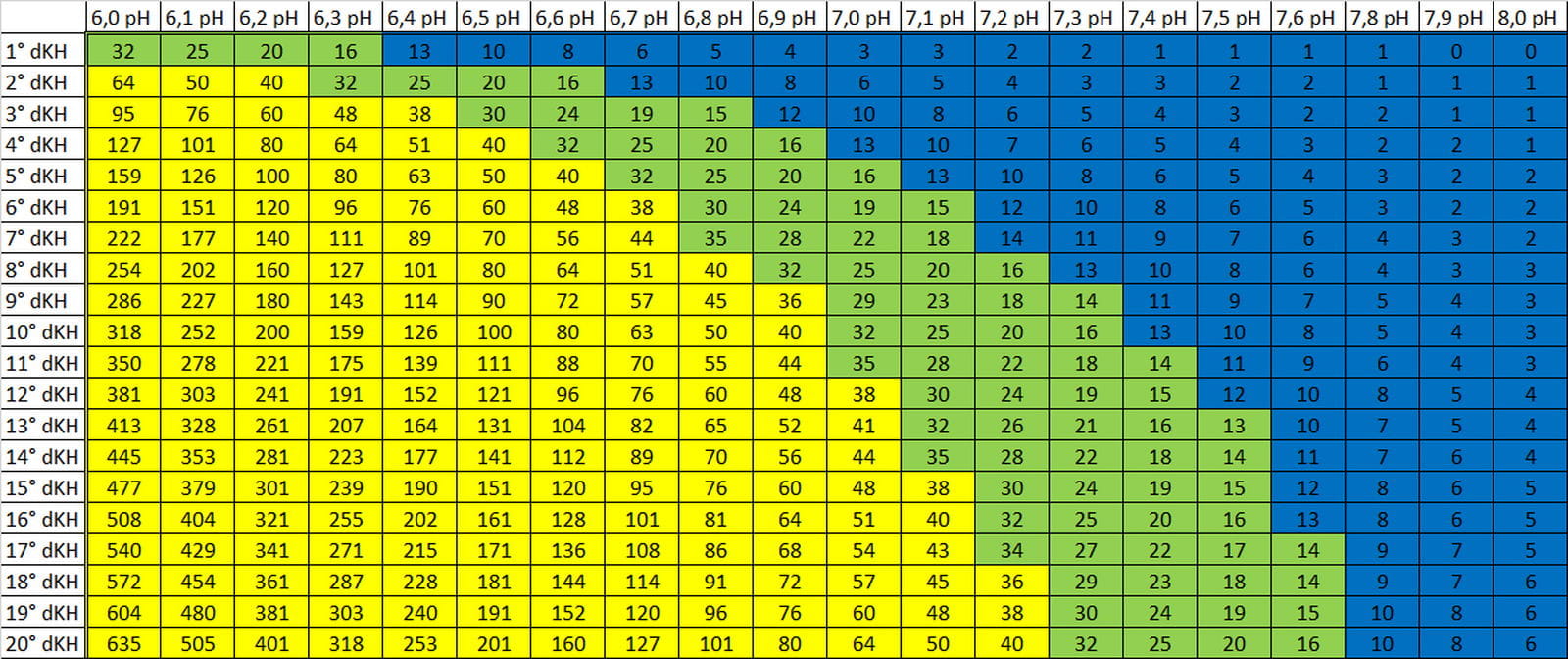
If you want to adjust the pH value in your aquarium to a certain value, it is best done by taking the corresponding carbonate hardness into account. For example, it is easier, and sometimes only possible at all, to reach an acidic pH value when the KH is low.
Do you want to lower the pH value in your aquarium? In this article we give some practical tips on how to do this best.
Relationship between pH value and ammonium/ammonia
Ammonium and ammonia are known in the aquarium hobby above all as substances that are toxic to fish. In fact, however, there is an important relationship here with the pH value of the water. Depending on it, this nitrogen compound is present either predominantly as ammonium (at acidic pH) or as ammonia (at alkaline pH). The main difference is that ammonium is relatively harmless to the inhabitants of the aquarium, while the ammonia form can be toxic to fish, for example. In aquariums focused on fish stocking in which a high pH value is relevant (this includes quite a few aquariums with African cichlids, for example from Lake Malawi and Lake Tanganyika), special caution is therefore advised. Even a content of 0.2 mg/l ammonia can be dangerous for aquarium fish.
Ammonium/ammonia also appears as a so-called peak during the cycling phase of an aquarium. Clearly measurable concentrations often occur here, because the bacterial activity that breaks down pollutants is not yet fully established in the early phase of an aquarium. The aquarist should therefore only add fish once ammonium/ammonia and also the next stage of the nitrogen cycle, nitrite, can no longer be detected. Here, too, special caution is required at a pH value above 7.
Would you like to learn more about ammonium and ammonia? Then here we have an article with further information for you.
Relationship between pH value and nutrient availability
For aquatic plants in an aquarium, the pH value plays a decisive role in the uptake and availability of important nutrients. A slightly acidic pH value is a clear advantage for most plant species. Especially in the substrate, a pH value below 7 makes it easier to take up trace elements through the roots. These include, for example, iron, manganese, boron, copper and zinc. The following table shows, for land plants, the solubility of various nutrient elements depending on the pH value in the soil. This can also be applied to the requirements of aquarium plants. It clearly shows how beneficial a slightly acidic pH value is for the uptake of trace elements, but also of macronutrients such as nitrogen, potassium and phosphorus.
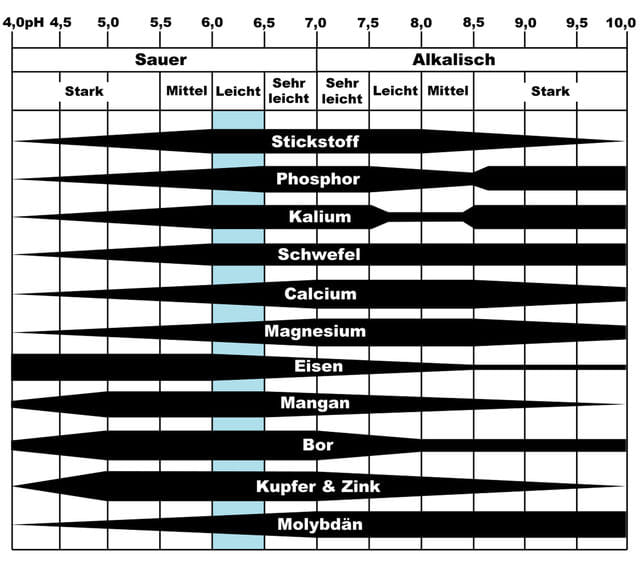
Modified (translated into German) from: CoolKoon - Own work, license: CC BY 4.0.
Would you like to learn more about nutrient availability? We have a separate article on this here.
Factors influencing the pH value in the aquarium
In an aquarium, many different factors influence the pH value or the carbonate hardness (KH), which in turn can influence the pH value. In a planted aquarium or aquascape, the main factor is the supply of CO2. Introducing the gas CO2 produces a small fraction of carbonic acid, which in turn contributes to lowering the pH value. On the other hand, driving out carbon dioxide through strong aeration or surface agitation of the aquarium water results in an increase in the pH value.
The soil substrates often used in planted aquariums and shrimp breeding tanks also lower the pH value. This is due to the cation exchange capacity of this active substrate. It takes up positively charged ions such as Ca2+ and Mg2+ from the water and releases hydrogen ions in exchange. The higher concentration of H+ ions consequently lowers the pH value.

Certain natural products can also help to influence the pH value and lower it in a simple way. This is often done by adding humic acids, which are present, for example, in alder cones or peat. The water in the aquarium is also tinted brownish by the enrichment with humic substances. By the way, you can find out what other benefits humic substances have for the aquarium hobby here.
The pH value can be raised deliberately through the aeration mentioned above, but also by using water-hardening rock, certain care products or hardening salts. Very often this goes hand in hand with a simultaneous increase in carbonate hardness.
Measuring the pH value in the aquarium
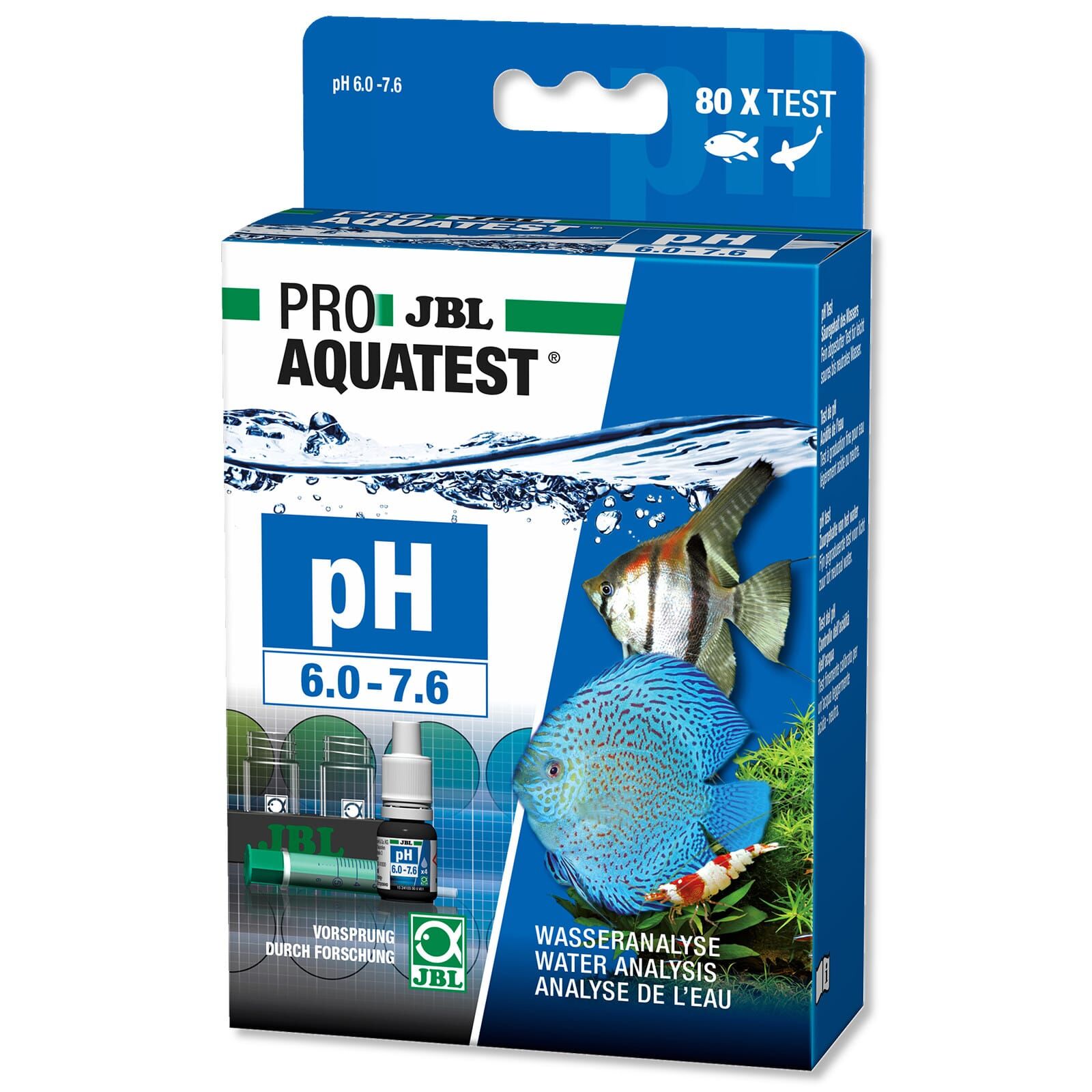
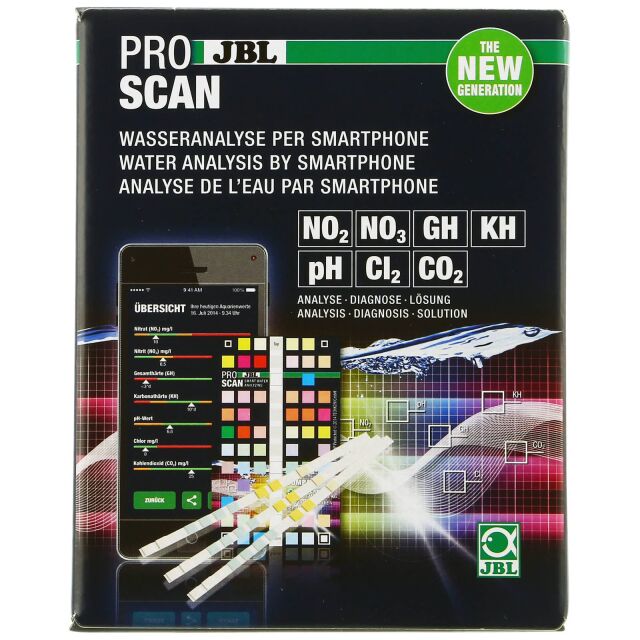
The pH value can be determined in quite a variety of ways with various aquarium water tests. If you use so-called test strips, which measure several water parameters at once, the pH value is usually included. This also applies to apps that read test strips, such as JBL ProScan.
Determination with the popular drop tests is somewhat more accurate. From the manufacturer Seachem, the pH Alert deserves a mention as a continuous water test. Here the test is simply stuck to the glass of the aquarium so that you can read the pH value at any time over a longer period.