We use cookies to offer you an optimal shopping experience. These cookies can be grouped into categories. The necessary ones are essential for your purchase. Functional services enable additional content such as videos and maps. With further cookies we produce anonymized statistics. Others serve primarily marketing purposes and are used for the personalization of advertising. These cookies are used by 11 Services used in the shop. You can decide for yourself which cookies you want to allow.
We store your choice on your device (“local storage”) and ask you again after 12 months at the latest. You can change it at any time under “Cookie Preferences” in the footer. You can find details on cookie lifetimes and necessary cookies in our privacy policy.
These services are required to run the shop and for your purchase and cannot be switched off.
Strictly necessary cookies enable basic functions and are required for the website to work properly.
Shop functions: Essential Shop functions This includes: JTLSHOP (cookie, until you close the browser; keeps your session, the cart and your login), consent (browser storage; remembers your cookie choice, 12 months at most, during the session also in session storage), has_starting_point, cur_product_id and product_page_visits (session storage; navigation between products) as well as aquasabi-search-index-last-url, aquasabi-search-index-results and aquasabi-search-index-data (session storage; search results and lists when paging). easyVision: easyVision lets website visitors customize the display – e.g. by adjusting contrast, font size, line and letter spacing, color rendering, a blue light filter or by disabling animations. Developed and hosted in Germany, the service is GDPR-compliant and supports statutory accessibility requirements (BFSG) from 2025. The service loads its scripts from cdn.sitecockpit.com and stores your settings (easy-vision-*) in your browser storage (no cookies). Reviews: aquasabi_guid (cookie, 12 months) is only set when you click “Helpful” under a review. It stores a random ID so that the same person cannot count a review as helpful more than once. Sorting and view: aquaSort and aquaDisplayType (cookies, 90 days) store the sorting or view (gallery or list) that you choose in a product list. They are only set when you choose a sorting or view. Amazon Pay: Payment processing with Amazon Pay. The service provider is Amazon Payments Europe S.C.A. Where Amazon Pay is offered (e.g. in the cart and at the checkout), the shop loads scripts and images from static-eu.payments-amazon.com, payments-eu.amazon.com and m.media-amazon.com and sets cookies (language, ledgerCurrency, apay-session-set). You can find out more in the privacy policy at https://www.amazon.de/gp/help/customer/display.html?nodeId=GRFTMVHP4HXMESSP PayPal: Payment processing with PayPal. The service provider is PayPal (Europe) S.à r.l. et Cie, S.C.A. Where PayPal is offered (e.g. in the cart and at the checkout), the shop loads scripts from www.paypal.com; for invoice payment via PayPal, c.paypal.com is added for fraud prevention. PayPal stores an entry in your browser storage (__paypal_storage__), and the shop remembers the chosen PayPal payment method in session storage (chosenPPCPaymentOption). You can find out more in the privacy policy at https://www.paypal.com/en/legalhub/paypal/privacy-full Sofortüberweisung: On the confirmation page after an order with this payment method the shop loads a Klarna logo from x.klarnacdn.net.
Additional functions such as embedded videos and maps, spam protection in forms or the rating badge. Data is transferred to the respective provider when they load.
Show Youtube Videos
Displaying videos
Processing company:Google Ireland Limited, Google Building Gordon House, 4 Barrow St, Dublin, D04 E5W5, Ireland
Terms of use: https://policies.google.com/privacyShow Shopauskunft Rating-Badge
Used to provide the services of shopauskunft.de.
Processing company:Händlerbund Management AG
Terms of use: https://www.shopauskunft.de/datenschutzIntegration of Google Maps services
Performance measurement; Providing personalized services, including content and ads; Providing our services
Processing company:Google Ireland Limited
Terms of use: https://policies.google.com/privacy?hl=enTo submit forms on this page, you need to consent to the transfer of data and storage of third-party cookies by Google. With your consent, reCAPTCHA, a Google service to avoid spam messages via contact forms, will be embedded. This service allows us to provide our customers with a safe way to contact us via online forms. At the same time, the service prevents spam bots from compromising our services. After you gave your permission, you might be asked to answer a security prompt to send the form. If you do not consent, unfortunately you cannot use the form. Please contact us in a different way.
Stopping spam bots
Processing company:Google Inc.
Terms of use: https://policies.google.com/privacyHelps us understand how the shop is used so that we can improve it.
We measure which pages and products are viewed and how visitors move through the shop. Google Analytics sets cookies (_ga, _ga_*) and sends usage data to Google.
Audience measurement and analysis of how the shop is used
Processing company:Google Ireland Limited
Terms of use: https://policies.google.com/privacy?hl=enMeasures our advertising and enables personalised advertising on other sites.
We measure whether an ad on Facebook or Instagram led to a purchase and show visitors relevant ads again. Cookies are set for this: _fbp and _fbc (Meta) and as_fbclid (ours, 30 days; remembers the ID of the ad click). Meta receives data about your actions in the shop (e.g. product views, cart, purchase), your IP address and browser information; for a purchase our server may also send them directly to Meta (Conversions API). More in our privacy policy (retargeting/remarketing and conversion tracking).
Measure advertising success and show relevant ads again (Facebook, Instagram)
Processing company:Meta Platforms Ireland Limited, Merrion Road, Dublin 4, D04 X2K5, Irland
Terms of use: https://www.facebook.com/privacy/policy/We measure whether an ad on TikTok led to a purchase. Cookies are set for this: _ttp, ttclid and _tt_* (TikTok) and as_ttclid (ours, 30 days; remembers the ID of the ad click). TikTok receives data about your actions in the shop (e.g. product views, cart, purchase), your IP address and browser information; for a purchase our server may also send them directly to TikTok (Events API). More in our privacy policy (retargeting/remarketing and conversion tracking).
Measure the success of ads on TikTok
Processing company:TikTok Technology Limited, 10 Earlsfort Terrace, Dublin, D02 T380, Irland
Terms of use: https://www.tiktok.com/legal/page/eea/privacy-policy/enWe measure whether an ad in ChatGPT led to a purchase. Cookies are set for this: __oppref and __obref (OpenAI) and as_oppref (ours, 30 days; remembers the ID of the ad click). OpenAI receives data about your actions in the shop (e.g. product views, cart, purchase), your IP address and browser information; for a purchase our server may also send them directly to OpenAI (Conversions API). Data may be transmitted to OpenAI OpCo, LLC (USA). More in our privacy policy (retargeting/remarketing and conversion tracking).
Measure the success of ads in ChatGPT
Processing company:OpenAI Ireland Limited, 1st Floor, The Liffey Trust Centre, 117-126 Sheriff Street Upper, Dublin 1, D01 YC43, Irland
Terms of use: https://openai.com/policies/eu-privacy-policy/We measure whether an ad led to a purchase and show visitors relevant ads again. Google Ads sets cookies (e.g. _gcl_*) and receives purchase data, where applicable in hashed form (SHA-256).
Measure advertising success and show relevant ads again (remarketing)
Processing company:Google Ireland Limited
Terms of use: https://policies.google.com/privacy?hl=enWe use cookies that are essential for payment processing through our partners. Please select which payment providers you would like to use.
In order to unlock offers for extended payment options, in particular express checkout and payment in instalments, we require your consent to the data transfer and storage of third-party cookies of the payment provider PayPal. This allows us to also offer you express checkout and payment by instalments. Without your consent, only the technically necessary data transfer to PayPal will take place, but you will then not be able to use the express checkout or extended offers for payment by instalments on this site.
Using express checkout and Displaying offers for payment in instalments for individual items or your entire purchase.
Processing company:PayPal
Terms of use: https://www.paypal.com/de/webapps/mpp/ua/privacy-full?locale.x=en-GB
Your consent ID:
With this randomly generated number we can show on request what you selected. It contains no information about you.
Would you like to see these contents? Activate the desired contents for one session only or allow the website to remember these settings. Once you have given your consent, the third-party data can be loaded. For this, third-party cookies might be stored on your device. You can change these settings at any time (footer: “Cookie Preferences”). For further details, please see the Privacy notice.
By Aram Schneider Published Updated
Translated from German with AI assistance and reviewed by our editors.
Contents
In a planted aquarium, "organic load" refers to the accumulation of organic material such as leftover food, dead plant parts, fish waste and other biological waste matter. Visually, this becomes apparent through, for example, detritus buildup or filter sludge. Over time, these substances are broken down by microbes and can significantly affect the biological balance in the aquarium.
Basically, a certain amount of organic load is not unimportant in an aquarium, because a certain number of bacteria and corresponding food is needed for the breakdown of pollutants within the nitrogen cycle to work well. However, too high a level of waste is not beneficial.
Organic load in a planted aquarium can have various causes. This starts with the animal stocking and its diet and extends to the filtration and maintenance of the aquarium. As a rule, the organic load in a planted aquarium is often lower than in a fish aquarium, but proper maintenance should still be kept in mind over time.

Too much fish food causes uneaten leftovers to rot on or in the substrate. This is one of the most common causes of increased organic load in an aquarium. Leftover food is broken down by bacteria, which decompose organic substances such as proteins, fats and carbohydrates. This consumes oxygen and can produce toxic ammonium. The additives in fish food can also cause an increase in phosphate and nitrate.
Especially in newly set up tanks or in phases of poor plant care, dead plant material often occurs. A large mass of dead algae also counts here. This can be the case, for example, after an anti-algae treatment or blackout treatment of an aquarium. If this organic mass accumulates, it can lead to problems. Similar to leftover fish food, bacteria break down the dead plant parts. This requires oxygen and releases carbohydrates, proteins and fats. Other nutrients such as nitrogen, phosphate and also trace elements also return to the water column this way. In addition, cloudy water can result from fine organic particles.
A high number of fish and also very large fish produce more organic waste, which puts more strain on the filter system. The biological filtration in particular is strongly affected. The organic load is correspondingly high, for example with cichlid stocking. This becomes noticeable through increased detritus and filter sludge formation. Heavy stocking can also increase the proportion of suspended particles, which leads to cloudy water. A large stock of ornamental fish burdens the water with ammonium through urine and feces. Their bacterial breakdown requires sufficient oxygen and can therefore lead to oxygen deficiency.
If the filter is too small or poorly maintained, it cannot break down organic substances sufficiently. It is therefore important, already when planning the aquarium and its stocking, to rely on a filter with sufficient power and filter volume. If the filter is still too small, it is not a bad idea to simply install another filter. Filter maintenance, especially cleaning the hoses and the filter media, is indispensable to preserve the flow and filter performance.
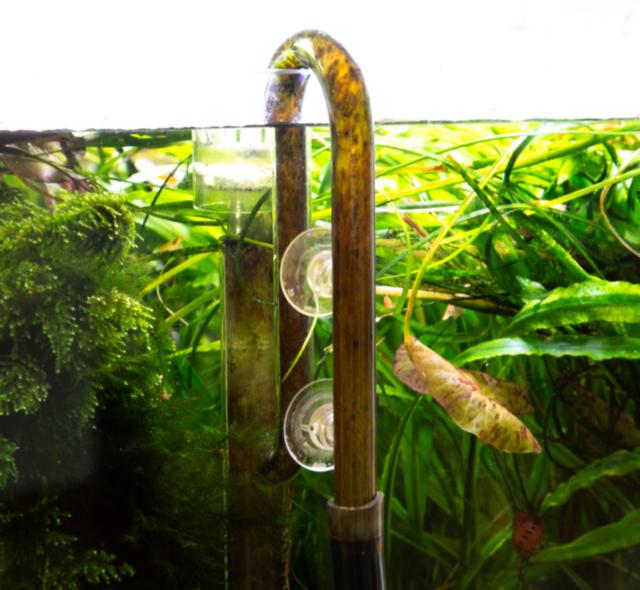
Unfortunately, an increased organic load can have negative effects on the aquarium. Often this only shows after a certain time. Certain algae growth (especially black beard algae) and also unpleasant odors can be such consequences.
The breakdown of the organic mass mainly involves microorganisms using oxygen. In some cases, the resulting increased bacterial activity can lead to cloudy water. Oxygen deficiency is also conceivable. This can become a problem especially at night, when plants no longer produce oxygen but additionally consume it. This effect can occur especially with a very high plant density in the aquarium. Aerating the aquarium overnight often helps, for example with an air stone controlled by a timer.
The increased breakdown of pollutants can lead to higher nitrate and phosphate values. That is not bad at first and is above all a readily measurable indicator of increased organic load. These substances can be reduced by sufficient water changes or, if necessary, adsorbers in the aquarium filter. They are also consumed as nutrients by aquatic plants. Nevertheless, attention should be paid to a balanced nutrient household. A very high phosphate content in particular can cause problems because of phosphate's reactivity, for example with the uptake of other nutrients by aquarium plants. For instance, phosphate can bond with iron, which leads to solid precipitation. The iron is then no longer available to the plants.

A certain amount of organic load is normal in every planted aquarium and even necessary for the biological balance. For this reason, you should not overdo cleaning measures and should always maintain a healthy population of beneficial bacteria. Otherwise there is a risk of cyanobacteria forming due to a lack of bacterial competition. However, if the organic load becomes too great, the whole ecosystem suffers. With good maintenance, appropriate stocking and balanced feeding, the organic load can be kept at a stable level over the long term - for healthy plants, vital fish and clear water.
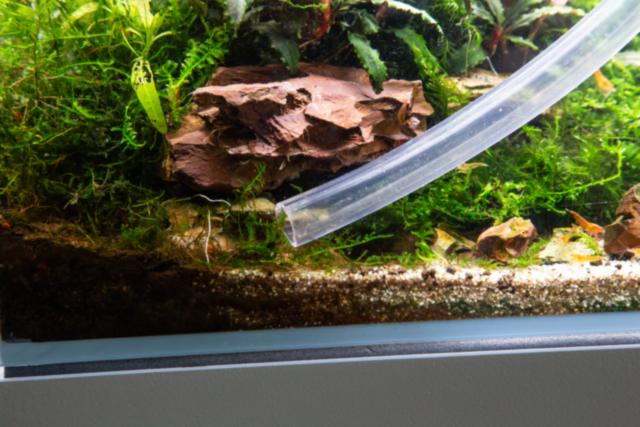
Consistent maintenance is therefore what matters most. Dead plant parts and detritus should be siphoned off regularly. This can be done simply by siphoning with a hose during the water change. A water change of 50% per week also helps to remove excess nutrients and pollutants. A healthy, fast-growing stock of enough aquarium plants helps to absorb nutrients and minimize organic residues. A vital condition of the aquatic plants is therefore especially important.
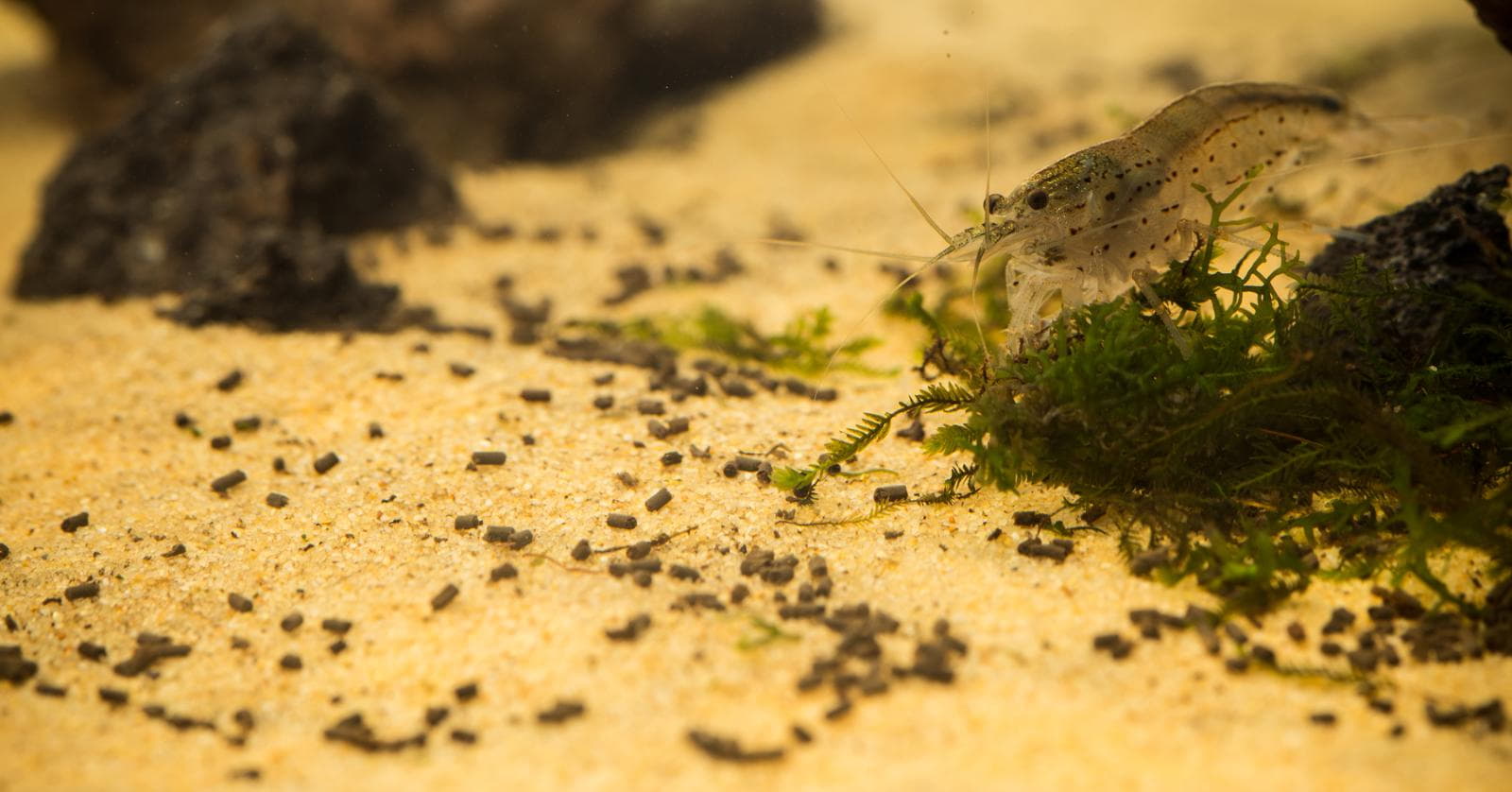
Plant-eating animals such as snails, shrimp and catfish are also helpful, as they can at least break the remains down into smaller components. This makes the work of other decomposers such as bacteria and other microorganisms easier.
An important and easily controlled aspect is the amount of food. You should only feed as much as the animals can eat within a few minutes. Leftover food should be removed as quickly as possible. Feeding dishes are ideal here, as both feeding and removing leftovers can be done very easily and in a targeted way.
Regular maintenance and care of the filter is also important. If there is a high organic load, the biological filtration should be more pronounced in such cases by using significantly more high-performance filter media. This offers pollutant-degrading bacteria more surface area to colonize.
Besides a well-stocked filter, regular cleaning work such as a weekly water change is a sensible measure. Adapted filtration with suitable filter media (mechanical and biological) ensures effective breakdown of organic substances. The filter, especially the pre-filter, should be cleaned regularly and filter sludge removed. To avoid losing all the beneficial bacteria living in the filter, you can leave part of the filter material untouched and/or use appropriate bacterial products to re-inoculate the filter.
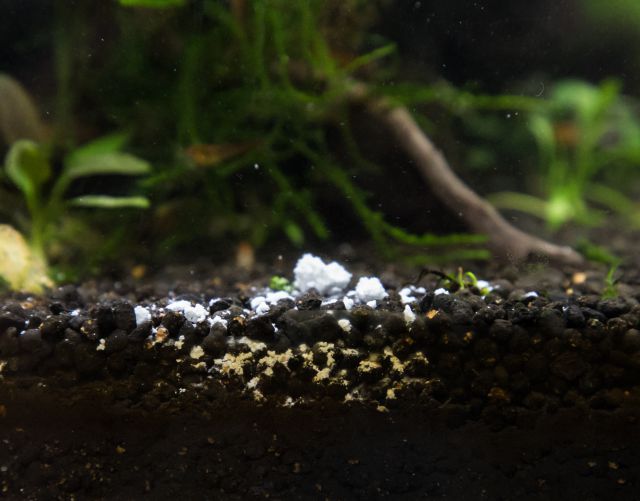
The substrate should also be cleaned from time to time so that it does not become too silted up. If too much organic waste (detritus) accumulates in the substrate, the risk of forming rot gases rises.
There are various methods to effectively remove detritus from the aquarium. One proven option is siphoning with a hose. Particularly practical: detritus usually collects in certain places in the tank, namely where the current is weak. These low-flow zones are often in the corners of the aquarium, where suspended particles can settle well. As long as flow and filtration remain unchanged, these typical detritus deposits also stay in place.
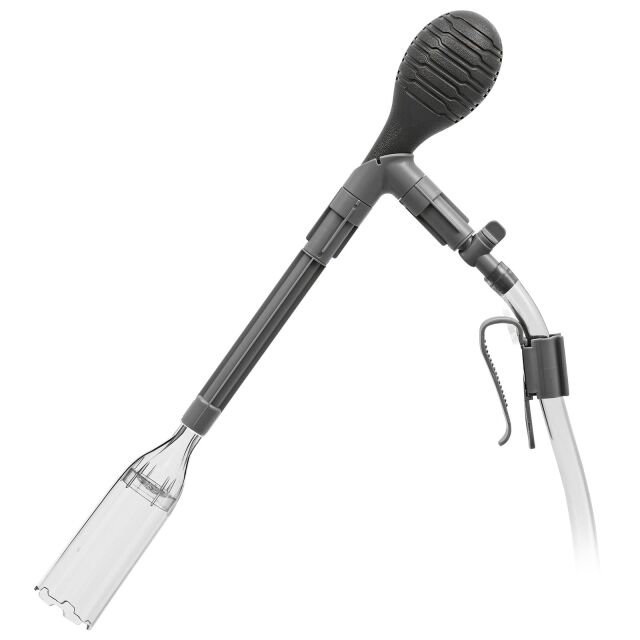
If the detritus has been worked deep into the substrate by digging or burrowing aquarium inhabitants, using a mulm bell is recommended. These devices allow targeted cleaning of the substrate: while light particles are picked up by the suction, heavier substrate components such as sand or gravel sink back down. This way the substrate material is largely retained. Another option is the use of special products for reducing detritus, for example the "Gravel & Substrate Cleaner". These are mostly bacteria-based products that break down organic material in the substrate. Besides reducing detritus, these products also help improve water quality, which is reflected in clearer and healthier aquarium water.