We use cookies to offer you an optimal shopping experience. These cookies can be grouped into categories. The necessary ones are essential for your purchase. Functional services enable additional content such as videos and maps. With further cookies we produce anonymized statistics. Others serve primarily marketing purposes and are used for the personalization of advertising. These cookies are used by 11 Services used in the shop. You can decide for yourself which cookies you want to allow.
We store your choice on your device (“local storage”) and ask you again after 12 months at the latest. You can change it at any time under “Cookie Preferences” in the footer. You can find details on cookie lifetimes and necessary cookies in our privacy policy.
These services are required to run the shop and for your purchase and cannot be switched off.
Strictly necessary cookies enable basic functions and are required for the website to work properly.
Shop functions: Essential Shop functions This includes: JTLSHOP (cookie, until you close the browser; keeps your session, the cart and your login), consent (browser storage; remembers your cookie choice, 12 months at most, during the session also in session storage), has_starting_point, cur_product_id and product_page_visits (session storage; navigation between products) as well as aquasabi-search-index-last-url, aquasabi-search-index-results and aquasabi-search-index-data (session storage; search results and lists when paging). easyVision: easyVision lets website visitors customize the display – e.g. by adjusting contrast, font size, line and letter spacing, color rendering, a blue light filter or by disabling animations. Developed and hosted in Germany, the service is GDPR-compliant and supports statutory accessibility requirements (BFSG) from 2025. The service loads its scripts from cdn.sitecockpit.com and stores your settings (easy-vision-*) in your browser storage (no cookies). Reviews: aquasabi_guid (cookie, 12 months) is only set when you click “Helpful” under a review. It stores a random ID so that the same person cannot count a review as helpful more than once. Sorting and view: aquaSort and aquaDisplayType (cookies, 90 days) store the sorting or view (gallery or list) that you choose in a product list. They are only set when you choose a sorting or view. Amazon Pay: Payment processing with Amazon Pay. The service provider is Amazon Payments Europe S.C.A. Where Amazon Pay is offered (e.g. in the cart and at the checkout), the shop loads scripts and images from static-eu.payments-amazon.com, payments-eu.amazon.com and m.media-amazon.com and sets cookies (language, ledgerCurrency, apay-session-set). You can find out more in the privacy policy at https://www.amazon.de/gp/help/customer/display.html?nodeId=GRFTMVHP4HXMESSP PayPal: Payment processing with PayPal. The service provider is PayPal (Europe) S.à r.l. et Cie, S.C.A. Where PayPal is offered (e.g. in the cart and at the checkout), the shop loads scripts from www.paypal.com; for invoice payment via PayPal, c.paypal.com is added for fraud prevention. PayPal stores an entry in your browser storage (__paypal_storage__), and the shop remembers the chosen PayPal payment method in session storage (chosenPPCPaymentOption). You can find out more in the privacy policy at https://www.paypal.com/en/legalhub/paypal/privacy-full Sofortüberweisung: On the confirmation page after an order with this payment method the shop loads a Klarna logo from x.klarnacdn.net.
Additional functions such as embedded videos and maps, spam protection in forms or the rating badge. Data is transferred to the respective provider when they load.
Show Youtube Videos
Displaying videos
Processing company:Google Ireland Limited, Google Building Gordon House, 4 Barrow St, Dublin, D04 E5W5, Ireland
Terms of use: https://policies.google.com/privacyShow Shopauskunft Rating-Badge
Used to provide the services of shopauskunft.de.
Processing company:Händlerbund Management AG
Terms of use: https://www.shopauskunft.de/datenschutzIntegration of Google Maps services
Performance measurement; Providing personalized services, including content and ads; Providing our services
Processing company:Google Ireland Limited
Terms of use: https://policies.google.com/privacy?hl=enTo submit forms on this page, you need to consent to the transfer of data and storage of third-party cookies by Google. With your consent, reCAPTCHA, a Google service to avoid spam messages via contact forms, will be embedded. This service allows us to provide our customers with a safe way to contact us via online forms. At the same time, the service prevents spam bots from compromising our services. After you gave your permission, you might be asked to answer a security prompt to send the form. If you do not consent, unfortunately you cannot use the form. Please contact us in a different way.
Stopping spam bots
Processing company:Google Inc.
Terms of use: https://policies.google.com/privacyHelps us understand how the shop is used so that we can improve it.
We measure which pages and products are viewed and how visitors move through the shop. Google Analytics sets cookies (_ga, _ga_*) and sends usage data to Google.
Audience measurement and analysis of how the shop is used
Processing company:Google Ireland Limited
Terms of use: https://policies.google.com/privacy?hl=enMeasures our advertising and enables personalised advertising on other sites.
We measure whether an ad on Facebook or Instagram led to a purchase and show visitors relevant ads again. Cookies are set for this: _fbp and _fbc (Meta) and as_fbclid (ours, 30 days; remembers the ID of the ad click). Meta receives data about your actions in the shop (e.g. product views, cart, purchase), your IP address and browser information; for a purchase our server may also send them directly to Meta (Conversions API). More in our privacy policy (retargeting/remarketing and conversion tracking).
Measure advertising success and show relevant ads again (Facebook, Instagram)
Processing company:Meta Platforms Ireland Limited, Merrion Road, Dublin 4, D04 X2K5, Irland
Terms of use: https://www.facebook.com/privacy/policy/We measure whether an ad on TikTok led to a purchase. Cookies are set for this: _ttp, ttclid and _tt_* (TikTok) and as_ttclid (ours, 30 days; remembers the ID of the ad click). TikTok receives data about your actions in the shop (e.g. product views, cart, purchase), your IP address and browser information; for a purchase our server may also send them directly to TikTok (Events API). More in our privacy policy (retargeting/remarketing and conversion tracking).
Measure the success of ads on TikTok
Processing company:TikTok Technology Limited, 10 Earlsfort Terrace, Dublin, D02 T380, Irland
Terms of use: https://www.tiktok.com/legal/page/eea/privacy-policy/enWe measure whether an ad in ChatGPT led to a purchase. Cookies are set for this: __oppref and __obref (OpenAI) and as_oppref (ours, 30 days; remembers the ID of the ad click). OpenAI receives data about your actions in the shop (e.g. product views, cart, purchase), your IP address and browser information; for a purchase our server may also send them directly to OpenAI (Conversions API). Data may be transmitted to OpenAI OpCo, LLC (USA). More in our privacy policy (retargeting/remarketing and conversion tracking).
Measure the success of ads in ChatGPT
Processing company:OpenAI Ireland Limited, 1st Floor, The Liffey Trust Centre, 117-126 Sheriff Street Upper, Dublin 1, D01 YC43, Irland
Terms of use: https://openai.com/policies/eu-privacy-policy/We measure whether an ad led to a purchase and show visitors relevant ads again. Google Ads sets cookies (e.g. _gcl_*) and receives purchase data, where applicable in hashed form (SHA-256).
Measure advertising success and show relevant ads again (remarketing)
Processing company:Google Ireland Limited
Terms of use: https://policies.google.com/privacy?hl=enWe use cookies that are essential for payment processing through our partners. Please select which payment providers you would like to use.
In order to unlock offers for extended payment options, in particular express checkout and payment in instalments, we require your consent to the data transfer and storage of third-party cookies of the payment provider PayPal. This allows us to also offer you express checkout and payment by instalments. Without your consent, only the technically necessary data transfer to PayPal will take place, but you will then not be able to use the express checkout or extended offers for payment by instalments on this site.
Using express checkout and Displaying offers for payment in instalments for individual items or your entire purchase.
Processing company:PayPal
Terms of use: https://www.paypal.com/de/webapps/mpp/ua/privacy-full?locale.x=en-GB
Your consent ID:
With this randomly generated number we can show on request what you selected. It contains no information about you.
Would you like to see these contents? Activate the desired contents for one session only or allow the website to remember these settings. Once you have given your consent, the third-party data can be loaded. For this, third-party cookies might be stored on your device. You can change these settings at any time (footer: “Cookie Preferences”). For further details, please see the Privacy notice.
By Aram Schneider Published Updated
Translated from German with AI assistance and reviewed by our editors.
Contents
"Patience is the most important virtue of the aquarist" - is a common saying. Does that also hold true for modern aquariums equipped with a lot of high-tech? Or is it simply a relic of times gone by? We offer a few thoughts on this.

An aquascape at the perfect moment (final shot).
Especially in aquascaping, where dreamlike photos of aquatic landscape designs can often be seen on the internet, these are usually snapshots of an aquarium shining in its most beautiful bloom. What many aquarists forget, however, is that an aquarium is a dynamic object. It changes and develops every day. So it takes time to develop before it reaches this "perfect" state. Not only that: the state will not last either, because development continues afterward. To keep an aquarium, and an aquascape in particular, in a certain form, certain maintenance measures are then necessary.

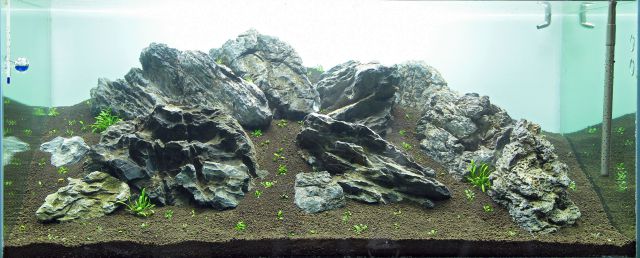
The same aquascape at the beginning, shortly after setup.
As an aquarist, you should accept to some extent that aquariums are simply not paintings to be hung in the living room. They are more than that; they are living objects subject to the cycle of nature. Beauty and decay belong together and should also be perceived on equal terms. As an aquarium owner you should also accept that things in an aquarium change constantly and that you have 100% influence over a great deal, but just not over everything. Accepting this fact also has a little to do with patience, because some things have to be tolerated, very often even tied to a certain period of time.

If you assume that an aquarium is a living object and develops over time, its course can be divided into certain phases. A very significant stage is at the beginning, the so-called cycling phase, which we will look at in more detail in the next section. This time frame is often marked by many instabilities and a certain restlessness that can demand quite a lot from the aquarist. The first goal is therefore to get an aquarium that "runs stably". Exactly when this state occurs cannot be predicted precisely. Individually, it can also turn out very differently. With the completion of the cycling phase, whose primary goal is to establish a stable nitrogen cycle, you cannot yet speak right away of a "stably running" aquarium, though. Often aquariums are then 1 to 2 months old but are still frequently strongly affected by algae growth and still have little plant mass. Only at an age of about 3 to 6 months does a certain balance set in, when the aquatic plants have gained the upper hand and algae growth is strongly pushed back. Balanced fertilization and regular trimming keep the aquarium in a balanced state, taking certain growth cycles into account. A certain stability is reached above all when the aquarium ecosystem can also "shrug off" certain fluctuations (for example seasonal ones) or external events (for example changing equipment, changing the stock). A stably running aquarium is, in principle, the goal of every aquarist, since it causes considerably less work and worry and reduces maintenance to a very low level.

When you set up a new aquarium, a great many things happen in a relatively short time. During the cycling phase, an aquarium goes through some important processes that are sometimes not visible but are essential for the aquarium's ecosystem. Above all, this includes establishing the nitrogen cycle, which is relevant for the breakdown of pollutants by sessile bacteria. These bacteria cannot be seen. At most, the various breakdown stages such as ammonia and nitrite, which are toxic to fish, can be detected with appropriate water tests. A "cycled" ecosystem in the aquarium is, however, of particular importance so that the biological processes and the breakdown of pollutants run correctly and the inhabitants of the aquarium are not endangered. In addition, the start-up phase of aquariums is plagued by various occurrences that are very typical of this phase and bring a certain restlessness. These include the appearance of algae (first diatoms, later green algae), possibly also cloudy water or the formation of slime on freshly introduced pieces of driftwood. All of these things are completely normal and often disappear by themselves after a certain time. The aquarist's patience is therefore very much tested during this period.

When you buy new aquatic plants, they are not immediately in the perfect condition that you may imagine in your head and that the glossy photos on social networks make seem appealing. Very often new aquarium plants are also introduced at the start of a cycling phase, which then first brings along the typical processes of that period. In addition, fresh aquatic plants go through a development of their own. This depends primarily on the form in which they are sold. Bunch plants, for example, have often already grown in the underwater form (submersed). Potted plants and in-vitro products, however, are usually still in the above-water form (emersed). Here the plant first has to adjust to growing underwater and therefore changes its form. Growth height, leaf shape and also color can thus still change. This transition costs the plant quite a lot of energy, and depending on the species, sensitive reactions can occur. For example, individual parts of the plant can turn mushy or the leaves can be shed. It is important not to give up on the plants in such cases and, at worst, angrily throw them away. With stem plants in particular, new healthy shoots can still grow even from bare stems. With rhizome plants such as anubias, ferns or Bucephalandra, the affected plant can recover if the rhizome is still firm and intact. All this of course requires above all patience, because quite a few weeks can go by until then. Simply provide good growing conditions through balanced plant nutrition and stable water parameters, and the aquarium plants will thank you for it and shine in full beauty at a later point.
Even after a nutrient deficiency or a change in the fertilization system, the aquatic plants need time before they can react visibly. Iron deficiencies can be remedied quite quickly, and after optimizing the fertilizer the plants become more vibrant in color again fairly quickly. Other nutrient deficits such as carbon and macronutrients need considerably more time; a period of about 3 weeks may be cited here as a reference. Leaves or plant parts that have been damaged once also remain defective and often no longer recover. It is rather a matter of assessing the new growth of the aquarium plants. If the plants sprout vigorously again here, you are on the right track, which of course requires some patience.

Especially in the cycling phase described above, an aquarium usually goes through several algae phases. This is completely normal and at first no cause for concern, since the entire biological balance in the aquarium first has to settle. In our experience, diatoms appear around week 2 and the first green algae from week 4 onward. Manual removal and introducing algae-eating animals help keep the algae in check. It takes a certain amount of time and demands energy and patience to get through this phase until the plants gradually push out the algae under good conditions. An aquarium is quite a bit more labor-intensive during this period than later, once it is cycled and the algae have all but disappeared.
But algae can also suddenly form in an aquarium that has been running for a longer time. They appear when, for example, changes in the environment of the aquarium have occurred or a nutrient deficiency has developed. Here you need to find and fix the cause.
If you can no longer get the situation under control, it is advisable to take countermeasures against the algae. In our guide here you will find a lot of information on how to identify the various types of algae and then also combat them accordingly. Until such a measure takes effect, however, some legwork and of course time are sometimes needed. It is worth investing this, though, since with a little patience you will be rewarded again with a brilliantly beautiful aquarium.