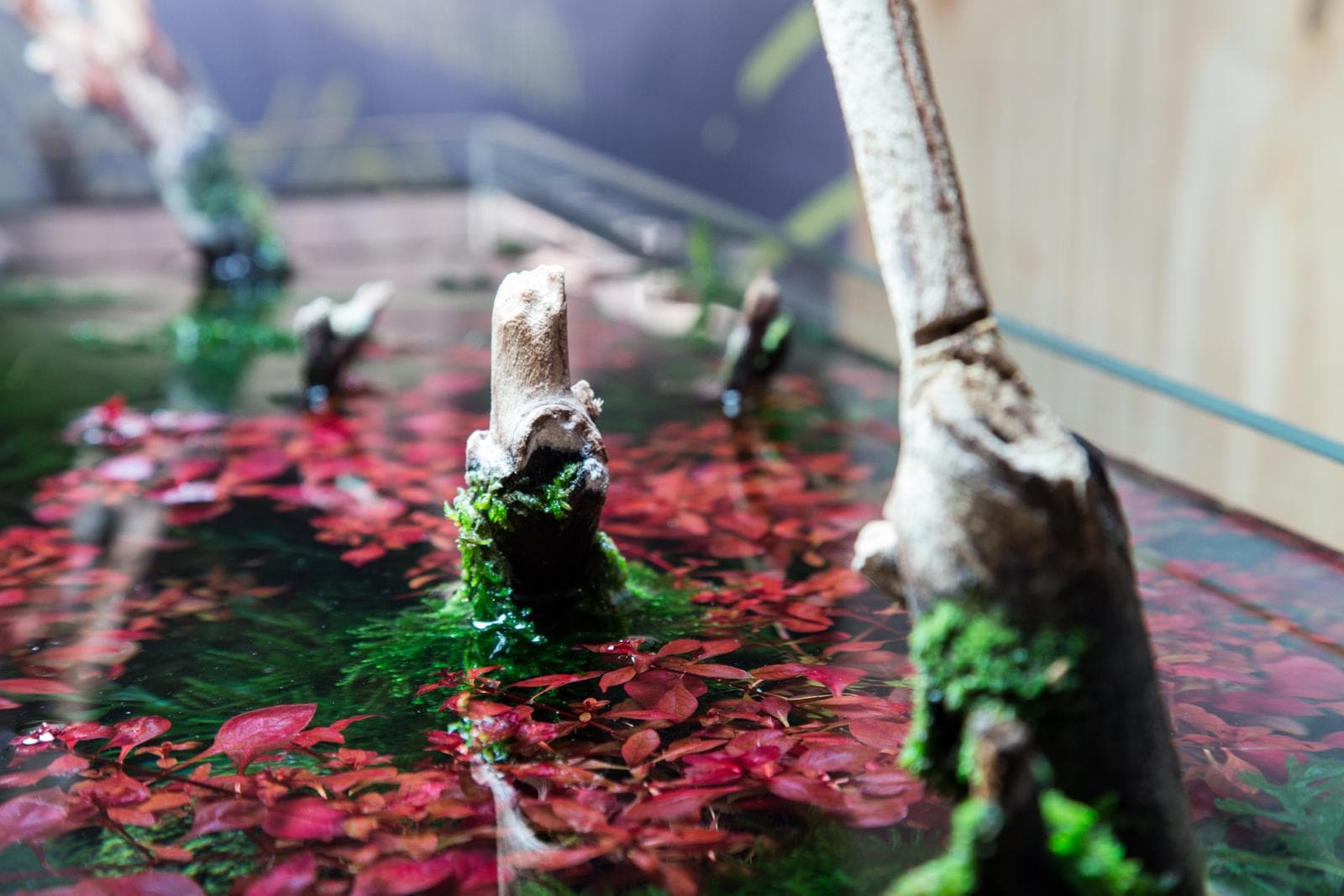
Aquatic plants during the cycling phase

By Aram Schneider Published Updated
Translated from German with AI assistance and reviewed by our editors.
Who doesn't know it: you buy a lot of fresh aquatic plants, plant your newly set up aquarium with them with great devotion, and after just a few days they lose their leaves or even whole plant parts fall apart. Many of our customers report "problems" with aquarium plants during the cycling phase of their aquarium. In this article, we explain what processes an aquatic plant goes through in this phase and why certain adjustment conflicts are normal.
What is the cycling phase, actually?
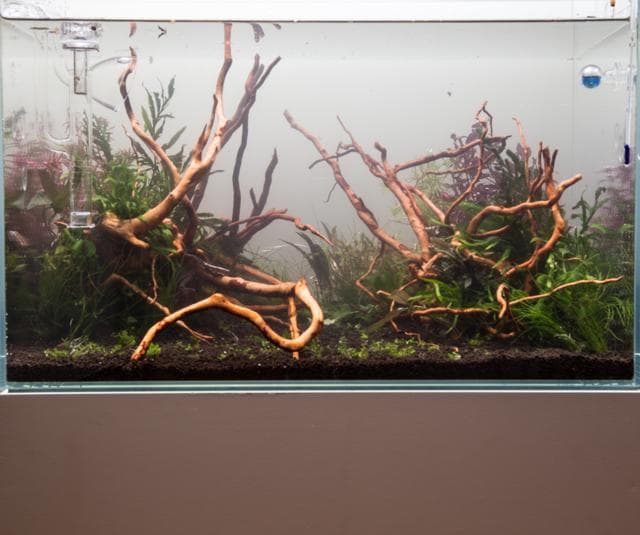
The so-called cycling phase refers to the period of time that a newly set up aquarium, or rather the ecosystem developing in it, needs to establish stable conditions. Important bacterial cultures, which are necessary for breaking down pollutants in the sense of the nitrogen cycle, are not present at all at the beginning and first have to develop. This takes a certain amount of time (usually a few weeks), and the cycling phase is marked by certain spikes of substances toxic to fish such as ammonia and nitrite. This is also called a nitrite peak or ammonium peak. They come about because certain microorganisms involved in the nitrogen cycle are not yet present in sufficient numbers to break down precisely these pollutants. You can find more detailed information on this topic in our article "The nitrogen cycle in the aquarium".
Besides the bacterial balance related to the nitrogen cycle, other microorganisms also first have to sort themselves out in the cycling phase in order to reach a certain equilibrium. These include, for example, biofilms and algae. An appearance of algae in the cycling phase is therefore to be regarded as completely normal. Often the first diatoms appear after about two to three weeks, and are then displaced by green algae a little later (you can find more information on this topic here).
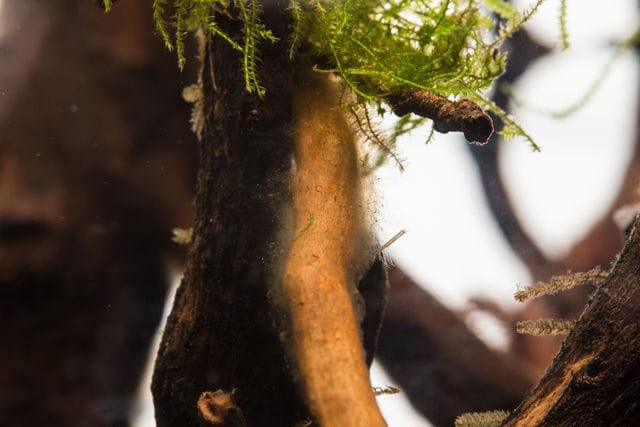
If the aquarist has used driftwood, it is sometimes covered with slimy coatings. These are likewise microorganisms that look unsightly but generally disappear again by themselves. Invertebrates such as snails and shrimp also like to eat this driftwood slime. With regard to dissolving aquatic plants, however, you should take care that this slime does not jump over to aquatic plants in the immediate vicinity. Simply siphoning off the coatings with a hose often helps here. You can find further details on the topic "driftwood slime" in this article.
Typical behavior patterns of aquatic plants in the cycling phase
Since the cycling phase is still characterized first and foremost by instability with regard to the whole ecosystem in the aquarium, certain adjustment problems in the plants are not uncommon. This can lead to leaf loss, plant parts turning mushy, and even total loss. That poor plant quality is the cause here can, in most cases, rather be ruled out. Other things play a more influential role. It should also not go unmentioned that certain plant species are more susceptible to this than others. We have summarized an overview of particularly sensitive plants in more detail in this article.
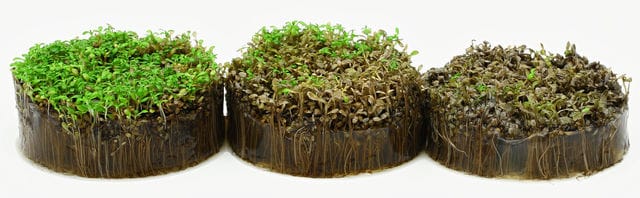
The culture form of the aquarium plant can be just as decisive. Emersed potted plants, for example, are much more robust than in-vitro plants. The latter were raised under sterile conditions and are now exposed in the aquarium to a germ load that was not there before. This is consequently an enormous strain on the plant. We have summarized the advantages and disadvantages of potted plants and in-vitro plants in more detail in this article.
The biggest feat of strength for the plants in the aquarium, however, is the conversion of the growth form from emersed to submersed.
Submersed and emersed
In principle, most aquatic plants are not pure aquatic plants at all that only have an underwater form (submersed). Rather, they are so-called marsh plants that can also adapt to the conditions with a growth form above water (emersed). In principle, almost all plants in the "pot" sales form, but also most in-vitro aquatic plants, are still in an emersed form, since they are generally cultivated above water in nurseries. If you put the plants into an aquarium in the emersed state, they first have to adjust to submersed growth over the course of a few days or weeks. The leaves in particular sometimes change markedly in shape and color. It often happens that the plant very quickly loses its now useless emersed leaves. Most of the energy is therefore put into the new growth of submersed foliage and root formation. In that respect, leaf loss in the beginning is no problem at all, and the plants in question should on no account be given up on or even thrown away right away. As long as the stems or the rootstock (rhizome) are still intact and firm, the aquatic plant has good chances of developing beautiful healthy shoots again.
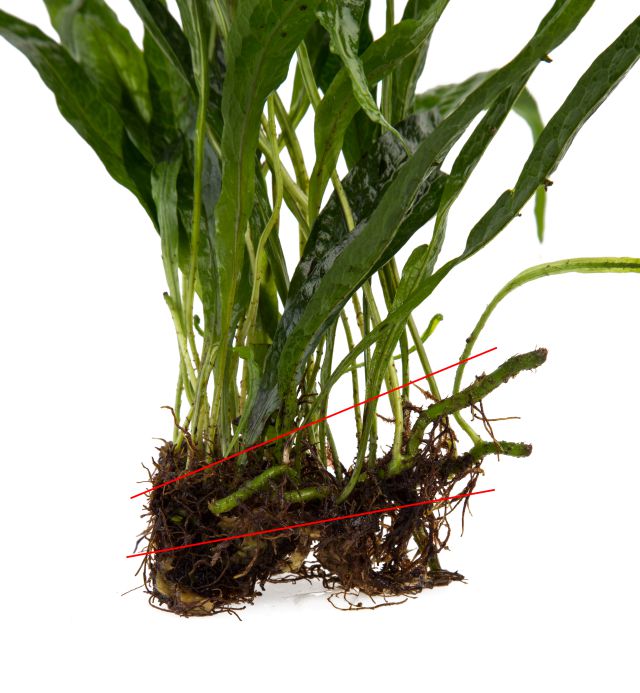
In this fern, the rootstock, the rhizome, is the middle area within the red lines.
The aquarist is then left with only the role of providing growing conditions that are as ideal as possible. Besides enough light, this includes a CO2 supply and nourishment with micro- and macronutrients via suitable liquid fertilizers.
Over-acidification
In planted aquariums with soil substrates, over-acidification can also be the cause of fresh aquatic plants dying off. This can sometimes be only a slight over-acidification near the substrate, which then results in the dying off of ground cover plants in particular or of the lower parts of stem plants. The effects are somewhat more drastic if you use very soft source water. Since soil softens even soft water further and lowers the pH value, there is a possibility of a pH crash here, especially if a CO2 system is also used, which in turn brings in additional acid in the form of carbonic acid.
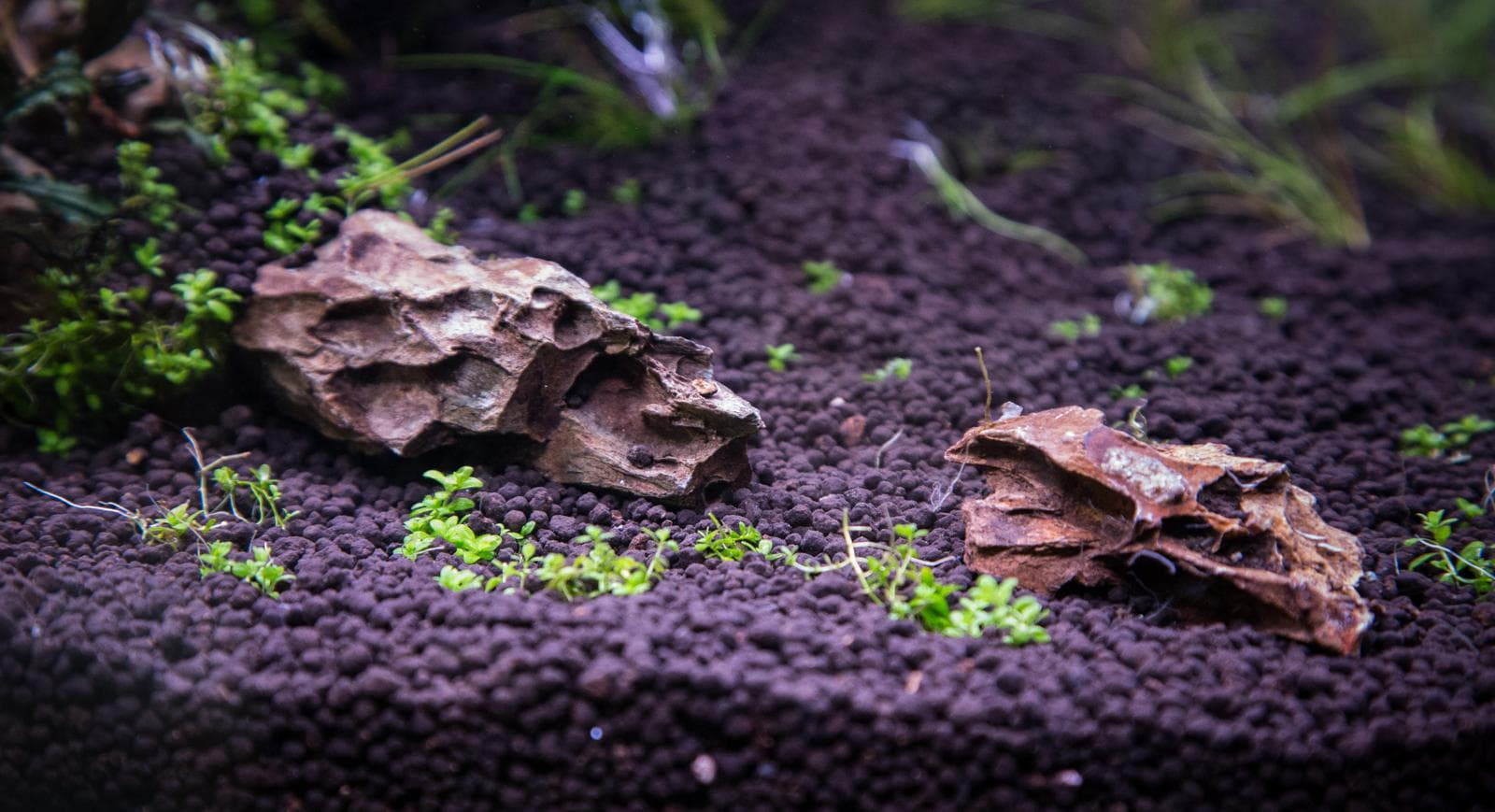
The effect can be increased further if the aquarist hardly does any water changes in the first weeks. Especially with nutrient-rich soils, manufacturers recommend large (at least 50%) water changes at short intervals (daily or every other day), and there is a reason for this. With regard to the parameters KH, GH and pH, the water changes provide the necessary stability and bring in enough minerals again to raise the carbonate hardness once more and buffer the pH value. These maintenance measures are therefore of particular importance and should be taken seriously. In some cases the aquarium water can also be hardened slightly again by adding water-hardening salt in order to avoid the effect of over-acidification.
With such drastic combinations of soil, soft water, CO2 injection and few water changes, over-acidification very often even affects other plant varieties and is not limited to aquarium plants that are in contact with the substrate. Epiphytes and mosses can also be affected. Above all the sensitive Bucephalandra are then affected and often react with drastic leaf loss and plant parts turning mushy.
It should also be mentioned that these effects occur even when there are water-hardening types of rock in the aquarium. In such cases, the effects that produce over-acidification often outweigh them after all.
In principle, it is therefore advisable to avoid an undetectable carbonate hardness, especially in the cycling phase. Through hardening or water changes, KH should be kept at least in the range of 2 to 4 in order to avoid damage from too much acid.
What to do when aquatic plants are dying off?
In principle, it can be said that a significant shedding of leaves, or even whole plant parts turning brown, does not necessarily mean that these aquarium plants are completely done for. Often enough healthy plant parts remain, which can then sprout healthy growth again under good conditions. To judge this, you should observe whether the plant's rootstock (rhizome) is still firm and intact. This is especially the case with epiphytes such as ferns, Anubias or Bucephalandra. With stem plants, at least part of the stem should still look firm and healthy. Stem plants often die off either only at the bottom or only at the top while the rest of the plant keeps growing healthily. Here you can cut off and remove the unsightly parts of the plant and then replant the healthy shoots.
Some aquascapers are aware of this and even deliberately cut aquatic plants back radically before planting. In this case, all emersed leaves on stem plants (except for a few at the tip) are removed by hand and, so to speak, only the bare stem is planted. Drastically shortening cryptocorynes is also especially popular. Here, one cut removes all the emersed leaves, and another cut then shortens the long roots. All that remains is the bare root ball, which is then planted in the substrate.
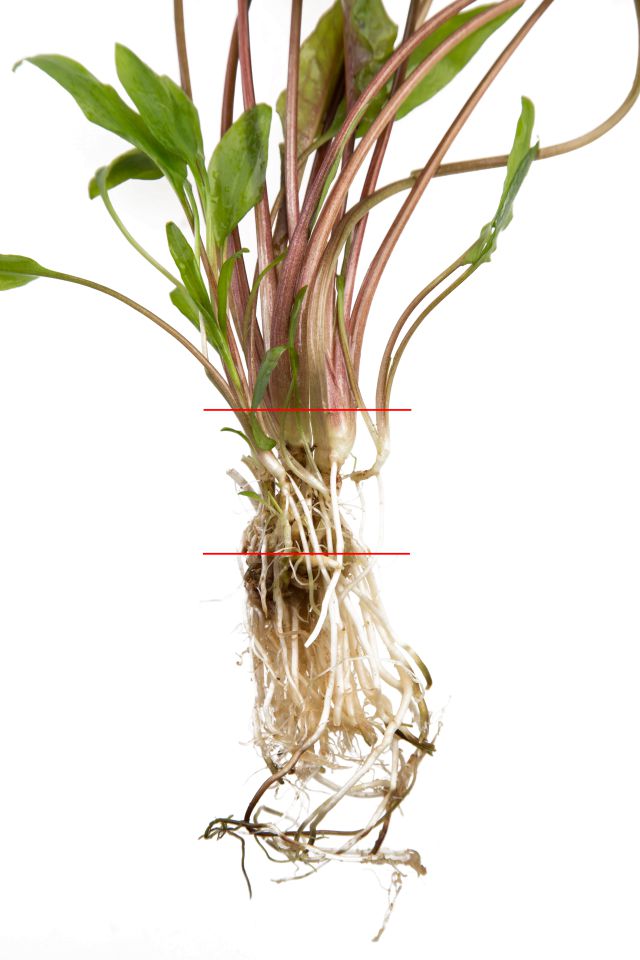
Some aquascapers cut cryptocorynes back very extremely by cutting off the roots and foliage. All that remains is the rootstock (the middle area within the red lines).
This makes planting easier (since there are no long roots in the way) and also reduces water load and maintenance work, since the plant then does not shed its emersed leaves in the aquarium. These radical trimming techniques are of course not a must and do not look nice at first. We only want to show that even with a heavily shortened plant, a nice growth pattern can be produced again. What matters for this, of course, is that the aquarium plants have enough light and nutrients available.
Providing good conditions for the aquatic plants
So that the aquarium plants get through the cycling phase well and can afterward make up for any losses caused by the adjustment, an optimal supply of all the important nutrients to the plants is the be-all and end-all. This includes enough light suited to the plants' growth behavior, a CO2 supply, and the addition of micro- and macronutrients.
Micronutrients means elements such as iron and other trace elements that the plants need only in small amounts (in traces). Macronutrients, on the other hand, should be present in larger amounts. These include nutrient elements such as nitrogen, potassium and phosphorus.
Nutrient-rich soil substrates support plant growth in the cycling phase because they offer many important nutrient elements. These active substrates then play out their advantages over passive substrates such as sand or gravel in this respect. In the medium to long term, however, the nutrient balance should be supported by suitable liquid fertilizers. This includes supplying the aquatic plants with iron and other important trace elements, which is generally done with a complete iron fertilizer. Macro elements can be supplied through certain ready-made mixes such as Estimative Index or through suitable single components. A promising fertilizer combination for a planted aquarium would be Mikro Basic Eisen with Makro Basic NPK, rounded off additionally by GH Boost N. This fertilizer provides balance in the nitrogen budget, especially in aquariums that have been running for a longer time, and specifically raises the nitrate content in the aquarium water.
You can find more on the topic of feeding aquatic plants in our article series "Fertilizing a planted aquarium, part 2" and "Part 3".