
Starting an aquarium

By Aram Schneider Published Updated
Translated from German with AI assistance and reviewed by our editors.
Especially for beginners in aquaristics, the question arises of how to get started with an aquarium properly in the first place. What is needed for it? What is the best way to set up an aquarium? What should you pay attention to in the start-up phase? When can I add fish? We answer all these questions here in our summary guide.
The equipment of an aquarium
In principle, you should distinguish between the components that make an aquarium functional in the first place (equipment) and the things that matter for the setup of the aquarium. These include, for example, aquatic plants, substrate and decorative items. In addition to the attractive look, biological functions also play an important role here. We will now go into these components in more detail.
Equipment

To create natural conditions such as sunlight, current, fresh air supply and temperature in an aquarium, suitable aquarium equipment is necessary. All these things are a matter of course in a natural body of water, but for the ecosystem in an aquarium to work well, the aquarist depends on these aids. Aquarium filters create water movement and clean the water, aquarium lights give the animals and plants enough light. The temperature can be regulated with a heater. These are first of all the basic technical items you need to start an aquarium. Besides the substrate, the filter plays a special role here, as beneficial bacteria settle in it that break down pollutants. In this context, the so-called "nitrogen cycle" should be mentioned, which describes the microorganisms involved and the conversion of the pollutants in more detail.
Beyond that, aquarium equipment can of course be refined and expanded further. For example, in a planted aquarium a CO2 system makes sense, which supplies the important nutrient carbon. Dosing pumps can additionally automate the fertilization of the aquatic plants. Automatic feeders likewise ensure a relaxing vacation for the aquarium owner and take over the daily feeding of the ornamental fish. If it gets too hot in summer, aquarium chillers come into play. Oxydators and sterilizers can be used to reduce the germ load and to introduce oxygen.
With all these technical aids, everyday aquarium keeping can be managed even more conveniently, or the living conditions for the inhabitants can be improved significantly once more.
You can find more information on the topic "Technical equipment in an aquarium" here.
Furnishings

Everything that does not fall under equipment and is brought in for the design of the aquarium counts as so-called furnishings. This is in particular the substrate, but also aquatic plants and other decoration such as stones, driftwood, caves or other hiding places. This is necessary for a natural environment in the aquarium and caters to the needs of the inhabitants, for example by offering hiding places, conditions for feeding, structures for establishing territories or spawning sites. Furthermore, some of these things also play an important biological role for the ecosystem in the aquarium.
Substrate
The substrate is an important part of an aquarium. Basically, different types of substrate are used here, for example fine sand, coarser gravel or even soil substrates that actively influence the water parameters. Which substrate is best suited cannot be answered across the board and depends heavily on what kind of aquarium is being used. For example: planted and shrimp aquariums are often run with soil, conventional aquariums such as a community aquarium rather with gravel, and sand is often used in South American aquariums. Each type of substrate has its own particular properties.
Soil, for example, is a substrate often made of volcanic and clay-containing components, with fairly round particles. Thanks to its cation exchange capacity, it is able to actively influence the water parameters in the aquarium. It thus affects the pH value and the hardness of the water and creates a soft and slightly acidic environment. For many animals and plants that love soft water, this is an optimal environment. Nutrient-rich soils also supply the aquatic plants with enough nutrient elements. You can find more information on the topic of "soil" here.

Sands and gravels are generally water-neutral and do not influence the water parameters. Nevertheless, there are a few types that can sometimes harden the aquarium water slightly. There are very natural substrates, but also some that are even dyed and coated in synthetic resin. Depending on the type, the particles are more or less rounded or slightly sharp-edged. The aquarist should pay attention to this if, for example, he or she wants to keep bottom-sifting species such as Corydoras catfish. They can sometimes injure their barbels on substrate that is too sharp-edged.
In principle, the difference between sand and gravel lies mainly in the grain size. By definition, sand particles are smaller than 2 mm, while larger pebbles are classified as gravel. Because of its small grain size, sand in the aquarium is a very dense substrate and offers few voids. Gravel and soil, on the other hand, are somewhat airier in structure because of their size and therefore sometimes offer better circulation in the substrate. The disadvantage, however, is that more detritus can also collect in the gaps; with dense sand this is usually only the case on the surface. You can find more info on the differences between sand and gravel here.
The substrate also plays an important role for the ecosystem in the aquarium, because, just like the filter, it houses numerous important bacteria and microorganisms. These are useful in the aquarium for breaking down pollutants. In terms of the nitrogen cycle, bacterial strains such as Nitrobacter and Nitrosomonas detoxify the water and convert toxic ammonium and nitrite into nontoxic nitrate, which can be taken up by the aquatic plants as a nutrient. A healthy flora and fauna of microorganisms in the substrate is therefore very important for a healthy ecosystem in the aquarium.
For aquatic plants, the substrate also serves as anchoring material that the roots can hold on to. Through their root system, aquarium plants can also supply themselves with nutrients. Heavy root-feeding plant species therefore like a nutrient-rich substrate, such as the corresponding soil or neutral substrate that has been enriched with nutrient elements using fertilizer tablets or other substrate fertilizer.
Aquarium plants

Is there anything more beautiful than a great underwater garden? Aquatic plants enrich an aquarium above all visually; the many different colors and shapes create a high-contrast and lively design. Aquarium plants come in different varieties and also for different areas of use. There are fast-growing stem plants, which are especially popular in the background of an aquarium. In the foreground, low-growing ground cover plants flourish, and in the midground, rather slow-growing and medium-height rosette plants such as Echinodorus and Cryptocoryne are often used. The decorative items placed in this layout plane, such as driftwood or stones, are often greened with epiphytes and mosses.
The diversity of species and selection of aquatic plants is now enormously high in aquaristics, so suitable aquarium plants can be found not only for every taste but also for different requirements, since there are plants of various difficulty levels. A demanding Dutch-style aquarist or aquascaper can therefore draw on the full range, but even aquariums with not quite so ideal conditions can be greened wonderfully with easy-to-keep plants.
Aquatic plants in the aquarium are not just pretty accessories, though; they also take on important biological roles for the ecosystem. Like other furnishings, they serve as hiding places and spawning sites and help structure the space. Fine-leaved species in particular make excellent homes for juveniles. Aquarium plants clean the water through their metabolism. They take up excess nutrients such as nitrate and phosphate from the water, and through their photosynthetic activity they are excellent oxygen suppliers.
If enough vitally nourished aquatic plants are present, they also provide good competition to algae, which can otherwise make the aquarium look unsightly.
For these benefits to prevail, the aquatic plants should of course also be well fed. In addition to suitable light, it is worth getting a CO2 system for the carbon supply. Important nutrient elements with micro- and macronutrients can be supplied via the substrate or with liquid fertilizer.
Do you want to know more about feeding aquarium plants? Then click here.
Decoration

In aquascaping, natural decorative items such as stones and driftwood are described as "hardscape". Beyond that, though, there are other furnishing materials, such as caves, tubes and other hiding places. This decoration serves first and foremost to structure the aquarium design. It creates spaces and delimits zones that can sometimes serve as territories for the animals. They also offer hiding places, spawning sites and retreats for the inhabitants. The midground of an aquarium in particular is lavishly decorated with hardscape, which can then additionally be greened with plants.
Stones in the aquarium are among the most popular natural decorative items. Types with great grain patterns, such as Mini Landscape or dragon stones, play a larger role here. But lava rock, sea mountain rock or pagoda stones are also popular types of rock. In principle, the aquarist should distinguish between water-neutral types and slightly water-hardening rock. The latter sometimes contain lime inclusions, which, especially in combination with an existing CO2 system, can lead to an increase in KH, GH and thus also in the pH value. This effect can be mitigated with regular water changes using softer water, or you can simply use water-neutral types of stone. This article gives a quite good overview of the various types of stone and lists which of them can influence the water and which cannot.
Driftwood in the form of, for example, mangrove, bogwood, Red Moorwood or river wood offers great design possibilities in aquaristics. Wood types are available in a wide variety, for example more compact types of wood, very delicately branched twigs, or even ready-made bonsai trees for the aquarium. Depending on the type of wood, a more or less strong brown tint to the water can occur, especially at the beginning, but you can get it well under control with many water changes or by using Purigen. Unlike stone, wood is an organic material, and it is not uncommon for bacterial films to form during the cycling phase, which are completely harmless, however. They are also readily eaten by invertebrates such as snails and shrimp. In our overview article we have presented various types of wood from our shop.
Setting up the aquarium

Once all the materials and technical items are together, one of the most beautiful moments in aquaristics surely begins: setting up the aquarium. This is best done dry, that is, the water only goes into the glass tank at the very end. You can still prepare the aquatic plants accordingly for planting.
First the substrate is added and then the hardscape is arranged, that is, driftwood and stones are positioned. Then it is best to moisten the entire setup with a spray bottle filled with water and start planting the aquarium. This works best with suitable planting tweezers. You can find out how to plant the various aquatic plants here. Only toward the end is the glass tank filled and all the necessary equipment installed and started up. Now the aquarium is ready to go!
If you are looking for inspiration: you can find a good step-by-step tutorial on setting up an aquascape at the following link.
The cycling phase
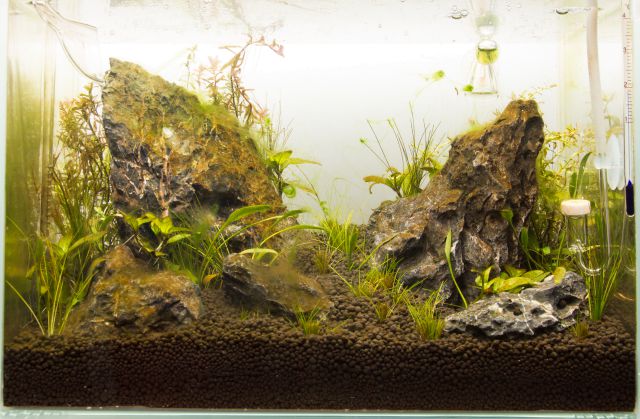
At the beginning, every aquarium goes through the so-called cycling phase. During this period, many biological relationships in particular are not yet in balance. The breakdown of pollutants is not yet working properly. For this, the nitrogen cycle first has to become established, and with it the associated bacterial strains that process substances toxic to fish, such as ammonium and nitrite. For that reason, the aquarist should not add animal inhabitants right from the start but only after a longer waiting period and gradually. You can only be completely sure once elements such as ammonium and nitrite are in the undetectable range.
The aquatic plants also go through an adjustment in the beginning. This is because many plant species that were bought as in-vitro or potted plants are still in their above-water form (emersed). Under water (submersed), their appearance changes. In the process, some plants may shed their old leaves, or even whole plant parts may turn mushy or die off. This is not a big deal but a perfectly normal side effect of this adjustment. Normally enough healthy plant parts remain, from which splendid and healthy shoots can then develop again. It is important here to create good conditions for the plants by offering them enough nutrients in the form of light, CO2, and micro- and macronutrient elements.
Algae growth is also typical at this stage, above all because the plants are still busy with their adjustment and cannot yet provide good competition. It is relatively normal for brown algae coatings (diatoms) to form after a few weeks, which are then replaced a little later by green algae. As soon as the plants have started growing, however, the balance shifts and algae growth gradually decreases. The aquarist is welcome to help things along a bit here and remove the algae as well as possible in the meantime so that they do not get out of hand. Using algae eaters also pays off then; algae-eating animals such as snails and shrimp are industrious helpers here and, especially at the beginning, an important building block in natural algae control in an aquarium. They should therefore be part of the initial stocking.
You can find more information on the topic "cycling phase" here, by the way.
Fertilization from the start

To supply your aquarium plants well from the start, appropriate fertilization is recommended. However, in line with their initial needs, it should be kept sparing at first. Since most plants are still busy adjusting to submersed growth after planting, their metabolism is not yet running at full speed. The plant mass is also often not yet very extensive at the beginning. You can therefore start liquid fertilization a few days later and then only with a fraction of the manufacturer's recommendation.
In principle, with fertilization you should distinguish whether a nutrient-rich substrate (soil) was used in the aquarium or neutral, nutrient-free gravel or sand. With nutrient-rich soils, the substrate takes over the nutrient supply in the first days and weeks. In some cases this can even be a bit too generous. It is therefore often recommended to do quite large and frequent water changes in the first week to flush out any nutrient surplus. Additional liquid fertilization is not necessary during this period, or only to a small extent.
With nutrient-poor substrates, on the other hand, liquid fertilization plays a more important role, since it is the only way nutrients get in. Here fertilization via the water column should begin significantly earlier than in an aquarium with nutrient-containing soil.
We have explained exactly how fertilization works during the cycling phase in this article. There you will also find an example of a fertilization schedule for the first weeks of a planted aquarium.