How stocking affects water parameters

By Aram Schneider Published Updated
Translated from German with AI assistance and reviewed by our editors.
Aquarium inhabitants such as ornamental fish, shrimp and snails burden the aquarium water through their metabolism and ultimately their excretions. In this article, we tell you which values can be affected.
Pollutants in aquarium water
In principle, every animal can burden the aquarium water through its excrement, but also through uneaten food or other organic waste. As a result, the water becomes enriched with pollutants. While in a natural flowing water the constant exchange of fresh water ensures that these elements stay at low concentrations, in an aquarium it is mainly the "keeper" who is responsible for removing unwanted substances. This is done primarily through regular and generous water changes.
Polluted aquarium water becomes enriched with fats and proteins over time, and the germ load rises through an increase in potential pathogens. But there are also "pollutants" that can be broken down naturally in the aquarium. First of all, nitrogen compounds should be mentioned, which through bacterial activity in the sense of the nitrogen cycle are ultimately converted to nitrate. Unlike its precursors ammonia and nitrite, nitrate (NO3) is not toxic to aquarium inhabitants and is also an important nutrient for aquatic plants.
Phosphate can also accumulate in the water as a result of organic load. Frozen food in particular has a bad reputation for containing quite a lot of phosphate, above all if you do not rinse it thoroughly beforehand. Phosphate is also a nutrient for aquatic plants, but plants do not consume it in such large quantities as nitrogen in the form of nitrate.
Reducing pollutants with aquatic plants

The water load, which in the aquarium is expressed by nitrate and phosphate, can be reduced significantly by a corresponding number of aquarium plants, especially if they are many fast-growing species. It is also important, however, that the plants lack nothing, including other important nutrient elements. Besides sufficient light, a carbon supply and liquid fertilization with iron and trace elements (micronutrients) should be present, as well as other nutrients such as potassium, which are needed in large amounts (macronutrients).
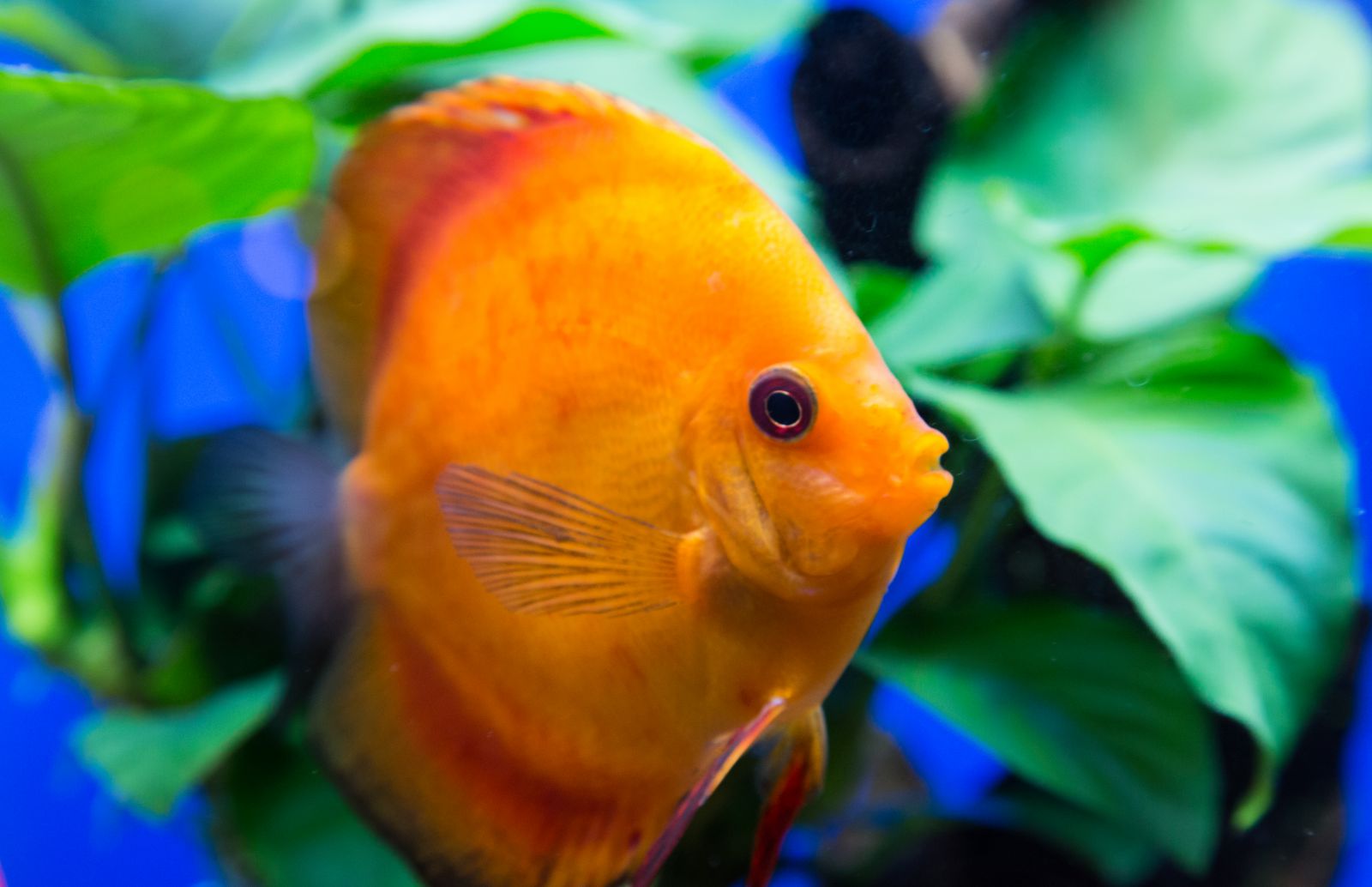
In an aquascape or planted aquarium, which often contain a large number of different aquatic plants and at the same time a rather sparse animal stocking, it is even common practice for the aquarist to also add nutrients such as nitrate and phosphate through liquid fertilizer. Here the nutrient input is often far from sufficient to meet the consumption by the aquatic plants. But there are also other exceptions: in aquariums with large cichlids such as discus or angelfish, there is quite often an elevated concentration of nitrate and phosphate, especially if only few or only slow-growing aquatic plants are present.
Do the fish produce enough nutrients?
Whether an aquarium provides enough nutrients with regard to nitrate and phosphate produced by the fish stocking depends on two important factors. One is the stocking itself. The selection of ornamental fish is by now immeasurably large, so the range of possibilities can be correspondingly varied. With increasing stocking density (and decreasing planting), however, the likelihood that these elements accumulate increases. If lavish feeding, above all with frozen food, is then added, as well as rare or insufficiently large water changes (below 50%), the likelihood rises significantly once more. Particularly conspicuous, however, are aquariums with fish stocking that have a fast metabolism. A lot of food is processed here. As already mentioned above, these include aquariums stocked with large cichlids, especially the popular discus or angelfish.
In typical aquascapes or other planted aquariums, which often have only a small stocking, there is usually not enough nutrient input from animal inhabitants. Here, the nutrients mentioned often have to be added extra through liquid fertilizer.
Checking the nutrient input from the stocking
Whether, in the individual case of a particular aquarium, there is actually a sufficient nutrient input of nitrate and phosphate from the animal inhabitants can be determined above all by measurement using appropriate water tests. A consumption measurement can be done by comparing current values with those of the previous week (note: fertilization with nitrate and phosphate is not taken into account here!). Since a water change also influences the parameters, it is better to leave it out. If very regular (for example weekly) water changes take place, you can apply the following principle: do the first measurement right after a water change. Do the second measurement about a week later, but before the next water change.

If both measured values are about the same, the nutrient input with regard to these substances is in balance. If the values decrease, higher consumption appears to be taking place. If the values increase, the input of these elements from the animal stocking is higher than the ecosystem in the aquarium can use. In the latter case, the upcoming water change is particularly important to reduce the "pollutants" again.
Rounding off the nutrient balance for the aquatic plants
If the fish stocking supplies an elevated content of nitrate and phosphate, this is not a guarantee that the aquatic plants will now grow well in any case. As mentioned above, other nutrients such as carbon, trace elements or potassium should also be available in sufficient amounts. In particular, using a complete iron fertilizer and a CO2 system are necessary prerequisites for healthy plant growth. Furthermore, the concentrations of the nutrients should aim for certain target values and, if possible, also be in a good ratio to each other. As rough guideline values for healthy plant growth, the following should be mentioned:
- 10 to 25 mg/l nitrate (NO3)
- 0.1 to 1 mg/l phosphate (PO4)
- 5 to 10 mg/l potassium (K)
- 0.05 to 0.1 mg/l iron (Fe)
- A CO2 level of about 20-30 mg/l, measurable with a drop checker including test reagent
- >10 mg/l magnesium (Mg)
Measures for reduction
If certain concentrations of an element such as nitrate or phosphate are too high, you should first consider increased maintenance through larger and more frequent water changes. However, these substances can also be removed from the water in a targeted way using so-called adsorbers as filter material. But nitrate removers and phosphate adsorbers also become exhausted over time, depending on the concentration of the substance in the water. These filter media then have to be checked regularly and replaced if necessary. You can find more detailed information on removing phosphate and nitrate here and here.
Possible nutrient scenarios
In many cases of planted aquariums with, for example, dense stocking or many cichlids, a certain nutrient input is already taking place. However, as already mentioned above, the ratios of the nitrate and phosphate introduced must be in a certain balance in order to ensure good conditions for plant growth in the aquarium. Consideration must also be given to other macronutrients, as well as carbon and micronutrients. We present some possible scenarios here.
Too little nitrate
Quite low nitrate values together with phosphate concentrations above 1 mg/l PO4 are, according to experience, a sign of a certain nutrient imbalance, which can very well be accompanied by problems such as algae growth or the appearance of cyanobacteria. The task here is to adjust the nitrate content accordingly and fertilize it up. This can be done, for example, with nitrogen fertilizers such as Makro Basic Nitrat or GH Boost N. The fertilization should be rounded off by a corresponding supply of micronutrients (for example with Basic Eisen) and, if possible, a carbon supply with a CO2 system.
Too little potassium
Nitrate and phosphate do arise as waste substances in the aquarium, but the third building block of the macronutrient series (NPK) does not: potassium. Depending on the source water, potassium is only moderately present and should then be added in a targeted way if there are already considerable concentrations of NO3 and PO4 present. This can be done with a pure potassium fertilizer such as Aqua Rebell Makro Basic Kalium. If both potassium and nitrate are insufficient, Makro Basic Nitrat is a good choice as a liquid fertilizer, since it can supply both elements in sufficient amounts.
Here too, besides optimizing the macronutrients, a sufficient supply of iron and other trace elements as well as a CO2 system should be in place.
Too little phosphate
PO4 is quite understood as a nutrient element that does not necessarily have to be detectable in the water column permanently. As long as phosphate is being supplied (for example through appropriate feeding) and no deficiency symptoms are present on the aquatic plants, there is sometimes no need for action. However, if there is hardly any input from, for example, fish food, a single component such as Aqua Rebell Makro Basic Phosphat can bring the PO4 content in a targeted way to a certain desired level. Here too, for a balanced overall situation, carbon and micronutrients should be supplied in addition to the macronutrients.