We use cookies to offer you an optimal shopping experience. These cookies can be grouped into categories. The necessary ones are essential for your purchase. Functional services enable additional content such as videos and maps. With further cookies we produce anonymized statistics. Others serve primarily marketing purposes and are used for the personalization of advertising. These cookies are used by 11 Services used in the shop. You can decide for yourself which cookies you want to allow.
We store your choice on your device (“local storage”) and ask you again after 12 months at the latest. You can change it at any time under “Cookie Preferences” in the footer. You can find details on cookie lifetimes and necessary cookies in our privacy policy.
These services are required to run the shop and for your purchase and cannot be switched off.
Strictly necessary cookies enable basic functions and are required for the website to work properly.
Description:
Shop functions: Essential Shop functions This includes: JTLSHOP (cookie, until you close the browser; keeps your session, the cart and your login), consent (browser storage; remembers your cookie choice, 12 months at most, during the session also in session storage), has_starting_point, cur_product_id and product_page_visits (session storage; navigation between products) as well as aquasabi-search-index-last-url, aquasabi-search-index-results and aquasabi-search-index-data (session storage; search results and lists when paging).
easyVision: easyVision lets website visitors customize the display – e.g. by adjusting contrast, font size, line and letter spacing, color rendering, a blue light filter or by disabling animations. Developed and hosted in Germany, the service is GDPR-compliant and supports statutory accessibility requirements (BFSG) from 2025. The service loads its scripts from cdn.sitecockpit.com and stores your settings (easy-vision-*) in your browser storage (no cookies).
Reviews: aquasabi_guid (cookie, 12 months) is only set when you click “Helpful” under a review. It stores a random ID so that the same person cannot count a review as helpful more than once.
Sorting and view: aquaSort and aquaDisplayType (cookies, 90 days) store the sorting or view (gallery or list) that you choose in a product list. They are only set when you choose a sorting or view.
Amazon Pay: Payment processing with Amazon Pay.
The service provider is Amazon Payments Europe S.C.A. Where Amazon Pay is offered (e.g. in the cart and at the checkout), the shop loads scripts and images from static-eu.payments-amazon.com, payments-eu.amazon.com and m.media-amazon.com and sets cookies (language, ledgerCurrency, apay-session-set). You can find out more in the privacy policy at https://www.amazon.de/gp/help/customer/display.html?nodeId=GRFTMVHP4HXMESSP
PayPal: Payment processing with PayPal.
The service provider is PayPal (Europe) S.à r.l. et Cie, S.C.A. Where PayPal is offered (e.g. in the cart and at the checkout), the shop loads scripts from www.paypal.com; for invoice payment via PayPal, c.paypal.com is added for fraud prevention. PayPal stores an entry in your browser storage (__paypal_storage__), and the shop remembers the chosen PayPal payment method in session storage (chosenPPCPaymentOption). You can find out more in the privacy policy at https://www.paypal.com/en/legalhub/paypal/privacy-full
Sofortüberweisung: On the confirmation page after an order with this payment method the shop loads a Klarna logo from x.klarnacdn.net.
Additional functions such as embedded videos and maps, spam protection in forms or the rating badge. Data is transferred to the respective provider when they load.
Show Youtube Videos
Description:
Displaying videos
Processing company:
Google Ireland Limited, Google Building Gordon House, 4 Barrow St, Dublin, D04 E5W5, Ireland
Helps us understand how the shop is used so that we can improve it.
We measure which pages and products are viewed and how visitors move through the shop. Google Analytics sets cookies (_ga, _ga_*) and sends usage data to Google.
Description:
Audience measurement and analysis of how the shop is used
Measures our advertising and enables personalised advertising on other sites.
We measure whether an ad on Facebook or Instagram led to a purchase and show visitors relevant ads again. Cookies are set for this: _fbp and _fbc (Meta) and as_fbclid (ours, 30 days; remembers the ID of the ad click). Meta receives data about your actions in the shop (e.g. product views, cart, purchase), your IP address and browser information; for a purchase our server may also send them directly to Meta (Conversions API). More in our privacy policy (retargeting/remarketing and conversion tracking).
Description:
Measure advertising success and show relevant ads again (Facebook, Instagram)
We measure whether an ad on TikTok led to a purchase. Cookies are set for this: _ttp, ttclid and _tt_* (TikTok) and as_ttclid (ours, 30 days; remembers the ID of the ad click). TikTok receives data about your actions in the shop (e.g. product views, cart, purchase), your IP address and browser information; for a purchase our server may also send them directly to TikTok (Events API). More in our privacy policy (retargeting/remarketing and conversion tracking).
We measure whether an ad in ChatGPT led to a purchase. Cookies are set for this: __oppref and __obref (OpenAI) and as_oppref (ours, 30 days; remembers the ID of the ad click). OpenAI receives data about your actions in the shop (e.g. product views, cart, purchase), your IP address and browser information; for a purchase our server may also send them directly to OpenAI (Conversions API). Data may be transmitted to OpenAI OpCo, LLC (USA). More in our privacy policy (retargeting/remarketing and conversion tracking).
Description:
Measure the success of ads in ChatGPT
Processing company:
OpenAI Ireland Limited, 1st Floor, The Liffey Trust Centre, 117-126 Sheriff Street Upper, Dublin 1, D01 YC43, Irland
We measure whether an ad led to a purchase and show visitors relevant ads again. Google Ads sets cookies (e.g. _gcl_*) and receives purchase data, where applicable in hashed form (SHA-256).
Description:
Measure advertising success and show relevant ads again (remarketing)
We use cookies that are essential for payment processing through our partners. Please select which payment providers you would like to use.
In order to unlock offers for extended payment options, in particular express checkout and payment in instalments, we require your consent to the data transfer and storage of third-party cookies of the payment provider PayPal. This allows us to also offer you express checkout and payment by instalments. Without your consent, only the technically necessary data transfer to PayPal will take place, but you will then not be able to use the express checkout or extended offers for payment by instalments on this site.
Description:
Using express checkout and Displaying offers for payment in instalments for individual items or your entire purchase.
Your consent ID:With this randomly generated number we can show on request what you selected. It contains no information about you.
Data privacy settings
Would you like to see these contents? Activate the desired contents for one session only or allow the website to remember these settings. Once you have given your consent, the third-party data can be loaded. For this, third-party cookies might be stored on your device. You can change these settings at any time (footer: “Cookie Preferences”). For further details, please see the Privacy notice.
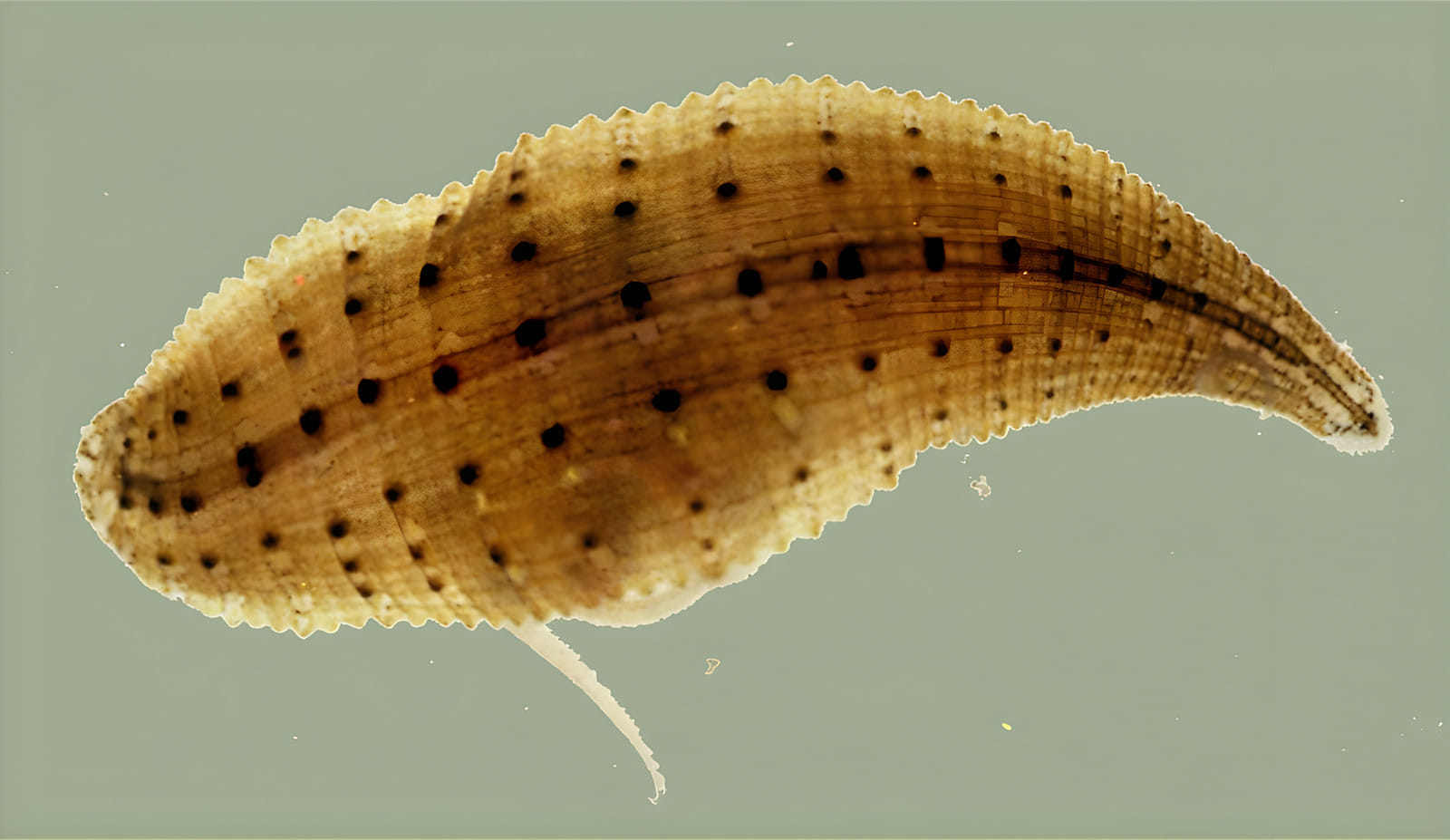
Source and copyright of the header picture: Prof. Dr. Ulrich Kutschera - Own image via Wiki Commons, license: CC BY-SA 3.0. Picture is edited (more sharpness, frame removed).
The so-called accompanying fauna, which can appear in the aquarium, may include, among other things, leeches. Although, in principle, leeches feed predatory, not all species pose a threat to your aquarium inhabitants. Therefore, they are not necessarily to be considered a pest. In this article, we give you assistance in the identification and handling of aquatic leeches.
Introduction of leeches
Not unlike other small beasties (planarian flatworms, hydra), leeches can end up in your tank alongside privately traded, submerse aquatic plants. Other paths like pre-owned aquarium equipment, decoration and substrate are possible, too. Since some leech species such as glossiphonia sp. (the snail-leech) are also native to Europe, an introduction through live food from ponds is possible, too. Snails in particular are a very popular “free ride”.
Control methods
To minimize the risk of introducing leeches - but also other unwanted accompanying fauna - into your aquarium, it is best to go for in vitro plants. These plants are cultivated, stored and sold under completely sterile conditions and are therefore free from any critters, algae and foreign plants. Another option would be to quarantine newly acquired aquarium plants and animals (refer : "preparing plants for your shrimp tank"). Pre-owned technology and decoration should be disinfected before use.
Types of leeches
In the following, we introduce some species of leech that can occasionally pop up in an aquarium. Matching this, you will get tips on identification and control methods for a leech infestation of your aquarium.
Snail-leeches
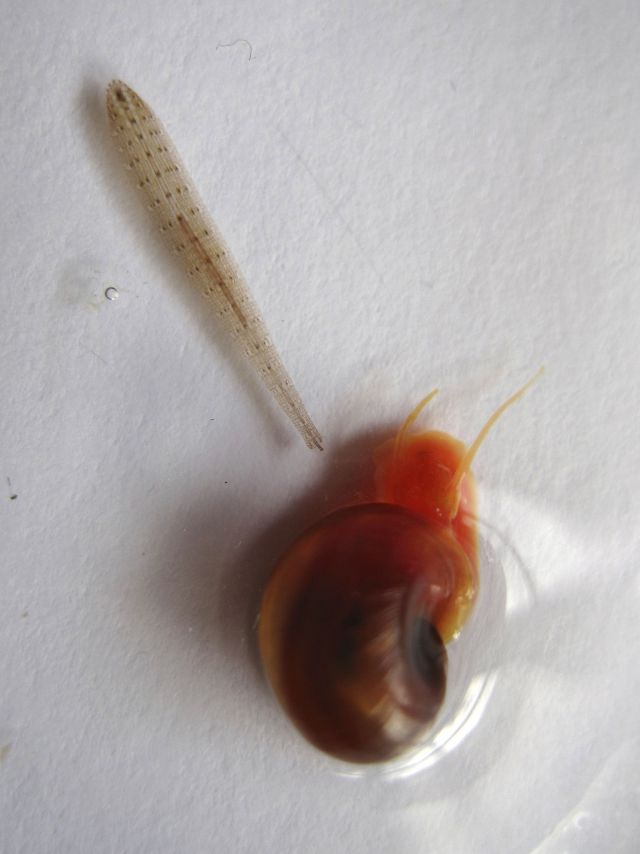
Copyright by Roland Emmenlauer.
Snail-leeches usually belong to the species Glossiphonia. The most common species are native to Germany and partly found in waters: the great snail-leech (Glossiphonia complanata) and the small snail-leech (Glossiphonia heteroclita). Insofar, caution is advised, when catching live-food from open waters. Snail-leeches can be pretty easily identified by their build - which is drop-shaped. Often, eggs and the digestive tract can be seen in the middle of the body, which makes them easily distinguishable from planarian flatworms. From species to species, snail-leeches vary in colour, reddish-brown, green and also creamy-white colours are possible. They can reach a length of up to three centimeters. Mostly they live hidden in the substrate or holding onto stones or plant leaves.
Snail-leeches live predatory off worms and snails, which are unceremoniously sucked dry. These leeches are unsurprisingly VERY unwelcome guests in aquariums containing more special snails like Tylomelania sp. Fortunately, they do not occur in larger groups, but are more likely to pop up as individuals.
The movement of the snail-leech resembles that of a caterpillar. First, the rear end is held on the ground by a suction cup, then the leech pushes its front end forward. Next, the suction cup at the front end attaches to the ground and the tail end follows. This mode of movement is quite different from planarians and other aquatic worms. Furthermore, snail-leeches are skillful swimmers - much unlike planatian flatworms -, moving surprisingly fast through the water in s-shapes. A snail-leech’s body doesn’t feel soft and slimy, but hard and gristly.
Control methods
Since snail-leeches don’t usually show up in large numbers, you can easily collect or suck away animals discovered in the aquarium. Natural predators are unfortunately unknown. Typical worm-killers like Panacur or Flubenol do not work against snail-leeches. Although preparations that contain copper are toxic to them, unfortunately those will also finish off other invertebrates such as crabs, shrimp and snails.
Asian freshwater leech
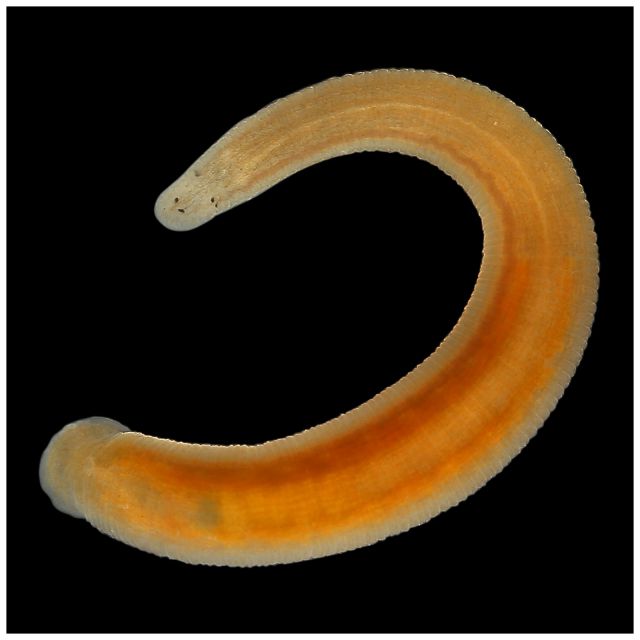
Barbronia weberi is among the Rhynchobdellida. Originating from Asia, this leech spread in Europe, Australia and America. The specimens in our aquariums were certainly first introduced to our homes in Germany with aquarium plants from Asian garden centers. Barbronia weberi has been firmly established in aquaristics. Of course, Asian leeches can still be brought in from Asia with aquatic plants. If you discover a brown-red, relatively slender leech in your aquarium, it is most likely a member of this species. It can reach a length of about 4 cm. When taking a closer look, it is noticeable, that Barbronia weberi has a thicker tail-end and a rather narrow head - depending on its level of stretchiness its body shape can vary quite drastically. The leech has three pairs of eyes, one in the middle and two more pairs on the left and right side of its head. This eye placement is characteristic for Barbronia weberi, thus a good photo of its head is enough for classification. Due to its appearance, this leech is well-distinguishable from planarian flatworms, but most of all by its locomotion: Similar to an inchworm, the leech makes steps as it progresses with the help of the suction cups at its front and rear end. Planarian flatworms and many other worms move in a more sliding manner. Furthermore, the Asian leech is a skillful and agile swimmer who wriggles through the water - planarians, on the other hand, can not swim at all.
Even though Barbronia weberi is a predatory leech, small worms and ground-dwelling microorganisms are on its menu. There is no danger for your fish, shrimp and snails.
Control methods
Barbronia weberi shouldn’t be seen as a large threat, since it’s a welcome live-food for many fish. A colonization of your tank in large numbers is also a very rare thing. The easiest and most effective way to combat a leech infestation is by manually collecting or siphoning them off. Deworming agents like Panacur and Flubenol are useless against leeches. Preperations containing copper can kill Barbronia weberi but will also severely harm other invertebrates like snails and shrimp. So such a treatment is not recommended, depending on the individual inhabitants of the aquarium.
European flat leech
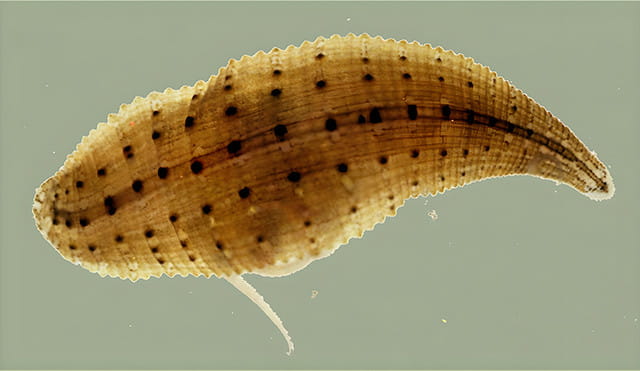
Copyright: Prof. Dr. Ulrich Kutschera - own image via Wiki Commons, license: CC BY-SA 3.0. Picture is edited (more sharpness, frame removed).
The name Helobdella europaea is a bit misleading. Most likely, the European flat leech is originally from South America. This leech, belonging to the Rhynchobdellida has spread all over the world. It has also settled in European waters, insofar an introduction into the aquarium by live food from ponds is possible. Originally, this leech was probably brought to Europe with imported aquatic plants. This species is capable of surviving in an aquarium. These leeches are rather small with a length of one to two centimeters and have only one pair of eyes. Very striking is its dotted pattern on the back with light to reddish body color. Other features are typical: a teardrop-shaped physique and a caterpillar-like locomotion by means of suction cups. The leeches care intensively for their brood, meaning that the mother carries the eggs and larvae for several weeks.
The European flat leech preys on other, smaller worms, snails and midge larvae. This leech seems to be harmless for aquarium fish, shrimp and snails might be considered potential prey, though.
Control methods
Similar to other leeches, the easiest way to get rid of them is to manually pick them off. Unfortunately, not much is known about other possible countermeasures. Just as with other leech species, deworming agents like Panacur and Flubenol won’t help, but preparations containing copper, will. As said before, these will also harm the miscellaneous invertebrates (shrimp, crabs and snails).