We use cookies to offer you an optimal shopping experience. These cookies can be grouped into categories. The necessary ones are essential for your purchase. Functional services enable additional content such as videos and maps. With further cookies we produce anonymized statistics. Others serve primarily marketing purposes and are used for the personalization of advertising. These cookies are used by 11 Services used in the shop. You can decide for yourself which cookies you want to allow.
We store your choice on your device (“local storage”) and ask you again after 12 months at the latest. You can change it at any time under “Cookie Preferences” in the footer. You can find details on cookie lifetimes and necessary cookies in our privacy policy.
These services are required to run the shop and for your purchase and cannot be switched off.
Strictly necessary cookies enable basic functions and are required for the website to work properly.
Description:
Shop functions: Essential Shop functions This includes: JTLSHOP (cookie, until you close the browser; keeps your session, the cart and your login), consent (browser storage; remembers your cookie choice, 12 months at most, during the session also in session storage), has_starting_point, cur_product_id and product_page_visits (session storage; navigation between products) as well as aquasabi-search-index-last-url, aquasabi-search-index-results and aquasabi-search-index-data (session storage; search results and lists when paging).
easyVision: easyVision lets website visitors customize the display – e.g. by adjusting contrast, font size, line and letter spacing, color rendering, a blue light filter or by disabling animations. Developed and hosted in Germany, the service is GDPR-compliant and supports statutory accessibility requirements (BFSG) from 2025. The service loads its scripts from cdn.sitecockpit.com and stores your settings (easy-vision-*) in your browser storage (no cookies).
Reviews: aquasabi_guid (cookie, 12 months) is only set when you click “Helpful” under a review. It stores a random ID so that the same person cannot count a review as helpful more than once.
Sorting and view: aquaSort and aquaDisplayType (cookies, 90 days) store the sorting or view (gallery or list) that you choose in a product list. They are only set when you choose a sorting or view.
Amazon Pay: Payment processing with Amazon Pay.
The service provider is Amazon Payments Europe S.C.A. Where Amazon Pay is offered (e.g. in the cart and at the checkout), the shop loads scripts and images from static-eu.payments-amazon.com, payments-eu.amazon.com and m.media-amazon.com and sets cookies (language, ledgerCurrency, apay-session-set). You can find out more in the privacy policy at https://www.amazon.de/gp/help/customer/display.html?nodeId=GRFTMVHP4HXMESSP
PayPal: Payment processing with PayPal.
The service provider is PayPal (Europe) S.à r.l. et Cie, S.C.A. Where PayPal is offered (e.g. in the cart and at the checkout), the shop loads scripts from www.paypal.com; for invoice payment via PayPal, c.paypal.com is added for fraud prevention. PayPal stores an entry in your browser storage (__paypal_storage__), and the shop remembers the chosen PayPal payment method in session storage (chosenPPCPaymentOption). You can find out more in the privacy policy at https://www.paypal.com/en/legalhub/paypal/privacy-full
Sofortüberweisung: On the confirmation page after an order with this payment method the shop loads a Klarna logo from x.klarnacdn.net.
Additional functions such as embedded videos and maps, spam protection in forms or the rating badge. Data is transferred to the respective provider when they load.
Show Youtube Videos
Description:
Displaying videos
Processing company:
Google Ireland Limited, Google Building Gordon House, 4 Barrow St, Dublin, D04 E5W5, Ireland
To submit forms on this page, you need to consent to the transfer of data and storage of third-party cookies by Google.
With your consent, reCAPTCHA, a Google service to avoid spam messages via contact forms, will be embedded.
This service allows us to provide our customers with a safe way to contact us via online forms. At the same time, the service prevents spam bots from compromising our services.
After you gave your permission, you might be asked to answer a security prompt to send the form.
If you do not consent, unfortunately you cannot use the form. Please contact us in a different way.
Helps us understand how the shop is used so that we can improve it.
We measure which pages and products are viewed and how visitors move through the shop. Google Analytics sets cookies (_ga, _ga_*) and sends usage data to Google.
Description:
Audience measurement and analysis of how the shop is used
Measures our advertising and enables personalised advertising on other sites.
We measure whether an ad on Facebook or Instagram led to a purchase and show visitors relevant ads again. Cookies are set for this: _fbp and _fbc (Meta) and as_fbclid (ours, 30 days; remembers the ID of the ad click). Meta receives data about your actions in the shop (e.g. product views, cart, purchase), your IP address and browser information; for a purchase our server may also send them directly to Meta (Conversions API). More in our privacy policy (retargeting/remarketing and conversion tracking).
Description:
Measure advertising success and show relevant ads again (Facebook, Instagram)
We measure whether an ad on TikTok led to a purchase. Cookies are set for this: _ttp, ttclid and _tt_* (TikTok) and as_ttclid (ours, 30 days; remembers the ID of the ad click). TikTok receives data about your actions in the shop (e.g. product views, cart, purchase), your IP address and browser information; for a purchase our server may also send them directly to TikTok (Events API). More in our privacy policy (retargeting/remarketing and conversion tracking).
We measure whether an ad in ChatGPT led to a purchase. Cookies are set for this: __oppref and __obref (OpenAI) and as_oppref (ours, 30 days; remembers the ID of the ad click). OpenAI receives data about your actions in the shop (e.g. product views, cart, purchase), your IP address and browser information; for a purchase our server may also send them directly to OpenAI (Conversions API). Data may be transmitted to OpenAI OpCo, LLC (USA). More in our privacy policy (retargeting/remarketing and conversion tracking).
Description:
Measure the success of ads in ChatGPT
Processing company:
OpenAI Ireland Limited, 1st Floor, The Liffey Trust Centre, 117-126 Sheriff Street Upper, Dublin 1, D01 YC43, Irland
We measure whether an ad led to a purchase and show visitors relevant ads again. Google Ads sets cookies (e.g. _gcl_*) and receives purchase data, where applicable in hashed form (SHA-256).
Description:
Measure advertising success and show relevant ads again (remarketing)
We use cookies that are essential for payment processing through our partners. Please select which payment providers you would like to use.
In order to unlock offers for extended payment options, in particular express checkout and payment in instalments, we require your consent to the data transfer and storage of third-party cookies of the payment provider PayPal. This allows us to also offer you express checkout and payment by instalments. Without your consent, only the technically necessary data transfer to PayPal will take place, but you will then not be able to use the express checkout or extended offers for payment by instalments on this site.
Description:
Using express checkout and Displaying offers for payment in instalments for individual items or your entire purchase.
Your consent ID:With this randomly generated number we can show on request what you selected. It contains no information about you.
Data privacy settings
Would you like to see these contents? Activate the desired contents for one session only or allow the website to remember these settings. Once you have given your consent, the third-party data can be loaded. For this, third-party cookies might be stored on your device. You can change these settings at any time (footer: “Cookie Preferences”). For further details, please see the Privacy notice.
Diatoms or brown algae are normally at most a marginal phenomenon during the cycling phase of an aquarium. They often disappear again on their own or are displaced by other biofilms. If these algae are a permanent problem, however, an elevated silicate content may be the cause. Here we show you how to best lower silicate in the aquarium.
The silicate level in the aquarium
Silicates are compounds of silicon and oxygen and represent the salts and esters of silicic acid. The basic building block is an SiO4 tetrahedron. In nature, these minerals even make up a large part of the minerals found in the Earth's crust.
The concentration of silicate (expressed here as SiO2) in aquarium water is one of the water parameters that play only a minor role. As a rule, silicate is hardly present in the water, or not at all. Silicates are, however, an important building block for brown algae such as diatoms. They use silicate, more precisely silicon dioxide, for their growth. Their box-shaped cell wall is built from this material.
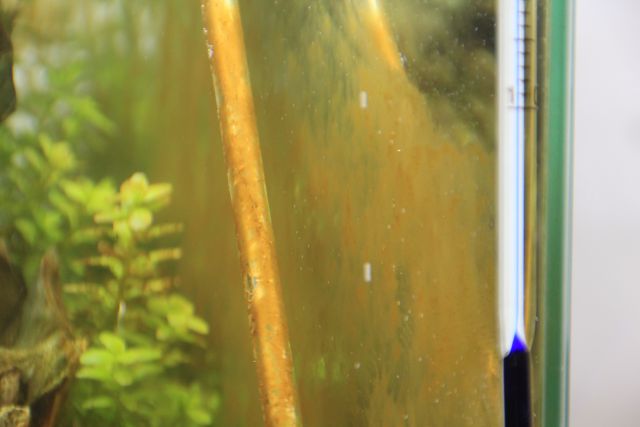
Diatoms usually only appear briefly in the cycling phase of a freshly set-up aquarium. They often disappear again on their own, because their food supply is soon cut off or other competing algae species and microorganisms spread and then displace the diatoms. If such brown algae, also called diatoms, are a permanent problem, however, an elevated silicate content may be the cause. You can verify this with a suitable water test.
Finding the cause
First of all, you need to find the cause of the elevated silicate content. Very often the source water is already contaminated. You can check this with a silicate water test or, if you use tap water, often look it up in the drinking water analysis of your water supplier. This is quite often posted on the websites of the respective water suppliers.
However, another element can also be the cause of the silicate input. Some natural substrates, such as soil, can sometimes release silicate.
Countermeasures
If diatoms are a greater problem in the aquarium, you should first try stocking suitable algae eaters. Invertebrates such as numerous snail species and shrimp, but also ornamental fish with sucker mouths, fall into this category.
If algae eaters are present in sufficient numbers, they can often push the algae back visually very far. Brown algae can also occur in aquariums that are rather weakly lit. Here, improving the lighting situation can sometimes lead to the diatoms being displaced by other biofilms such as green algae coatings. Whether this is really expedient is debatable, however, since you then simply find green coatings instead of brown ones.
There are various other approaches to removing silicate from aquarium water, which are then solved technically. First, there is the use of a silicate remover as a filter material, such as SilicateEx Rapid from JBL. Many silicate adsorbers, which are often a granulate based on iron hydroxide, however, also remove phosphate compounds from the water, and even preferentially so. In the first place, phosphate is thus bound in the filter material. In a planted aquarium this can sometimes be counterproductive, since the plants then lack an important macronutrient. The filter medium of a silicate adsorber also has to be replaced regularly as soon as it is exhausted and can no longer absorb substances.
An alternative would therefore be to use such a silicate adsorber, but only on the fresh water for a water change. For this, the fresh water has to be treated somewhat. The water is collected in a container that is large enough. You then place the right amount of silicate remover in it to match the water volume and let the water circulate for several days with the help of a circulation pump. Once the silicate has been removed, the fresh water can then be used for the aquarium. This is considerably more laborious, but has the advantage that you do not use the silicate remover directly in the aquarium. Consequently, there is also no lasting effect on the phosphate content, and added fertilizer is not bound by a filter medium either but is available to the plants.
Another possibility would be water treatment built up from scratch. Here, completely demineralized water is produced (for example by a reverse osmosis system with a downstream mixed-bed resin filter), which is then adjusted again to the desired water hardness parameters with a hardening salt. This also takes somewhat more effort, but you can then offer your aquatic plants and aquarium animals perfect water parameters.