We use cookies to offer you an optimal shopping experience. These cookies can be grouped into categories. The necessary ones are essential for your purchase. Functional services enable additional content such as videos and maps. With further cookies we produce anonymized statistics. Others serve primarily marketing purposes and are used for the personalization of advertising. These cookies are used by 11 Services used in the shop. You can decide for yourself which cookies you want to allow.
We store your choice on your device (“local storage”) and ask you again after 12 months at the latest. You can change it at any time under “Cookie Preferences” in the footer. You can find details on cookie lifetimes and necessary cookies in our privacy policy.
These services are required to run the shop and for your purchase and cannot be switched off.
Strictly necessary cookies enable basic functions and are required for the website to work properly.
Shop functions: Essential Shop functions This includes: JTLSHOP (cookie, until you close the browser; keeps your session, the cart and your login), consent (browser storage; remembers your cookie choice, 12 months at most, during the session also in session storage), has_starting_point, cur_product_id and product_page_visits (session storage; navigation between products) as well as aquasabi-search-index-last-url, aquasabi-search-index-results and aquasabi-search-index-data (session storage; search results and lists when paging). easyVision: easyVision lets website visitors customize the display – e.g. by adjusting contrast, font size, line and letter spacing, color rendering, a blue light filter or by disabling animations. Developed and hosted in Germany, the service is GDPR-compliant and supports statutory accessibility requirements (BFSG) from 2025. The service loads its scripts from cdn.sitecockpit.com and stores your settings (easy-vision-*) in your browser storage (no cookies). Reviews: aquasabi_guid (cookie, 12 months) is only set when you click “Helpful” under a review. It stores a random ID so that the same person cannot count a review as helpful more than once. Sorting and view: aquaSort and aquaDisplayType (cookies, 90 days) store the sorting or view (gallery or list) that you choose in a product list. They are only set when you choose a sorting or view. Amazon Pay: Payment processing with Amazon Pay. The service provider is Amazon Payments Europe S.C.A. Where Amazon Pay is offered (e.g. in the cart and at the checkout), the shop loads scripts and images from static-eu.payments-amazon.com, payments-eu.amazon.com and m.media-amazon.com and sets cookies (language, ledgerCurrency, apay-session-set). You can find out more in the privacy policy at https://www.amazon.de/gp/help/customer/display.html?nodeId=GRFTMVHP4HXMESSP PayPal: Payment processing with PayPal. The service provider is PayPal (Europe) S.à r.l. et Cie, S.C.A. Where PayPal is offered (e.g. in the cart and at the checkout), the shop loads scripts from www.paypal.com; for invoice payment via PayPal, c.paypal.com is added for fraud prevention. PayPal stores an entry in your browser storage (__paypal_storage__), and the shop remembers the chosen PayPal payment method in session storage (chosenPPCPaymentOption). You can find out more in the privacy policy at https://www.paypal.com/en/legalhub/paypal/privacy-full Sofortüberweisung: On the confirmation page after an order with this payment method the shop loads a Klarna logo from x.klarnacdn.net.
Additional functions such as embedded videos and maps, spam protection in forms or the rating badge. Data is transferred to the respective provider when they load.
Show Youtube Videos
Displaying videos
Processing company:Google Ireland Limited, Google Building Gordon House, 4 Barrow St, Dublin, D04 E5W5, Ireland
Terms of use: https://policies.google.com/privacyGoogle Recaptcha Service for spam protection
Tracking; Bot protection
Processing company:Google Ireland Limited, Google Building Gordon House, 4 Barrow St, Dublin, D04 E5W5, Ireland
Terms of use: https://policies.google.com/privacyShow Shopauskunft Rating-Badge
Used to provide the services of shopauskunft.de.
Processing company:Händlerbund Management AG
Terms of use: https://www.shopauskunft.de/datenschutzIntegration of Google Maps services
Performance measurement; Providing personalized services, including content and ads; Providing our services
Processing company:Google Ireland Limited
Terms of use: https://policies.google.com/privacy?hl=enHelps us understand how the shop is used so that we can improve it.
We measure which pages and products are viewed and how visitors move through the shop. Google Analytics sets cookies (_ga, _ga_*) and sends usage data to Google.
Audience measurement and analysis of how the shop is used
Processing company:Google Ireland Limited
Terms of use: https://policies.google.com/privacy?hl=enMeasures our advertising and enables personalised advertising on other sites.
We measure whether an ad on Facebook or Instagram led to a purchase and show visitors relevant ads again. Cookies are set for this: _fbp and _fbc (Meta) and as_fbclid (ours, 30 days; remembers the ID of the ad click). Meta receives data about your actions in the shop (e.g. product views, cart, purchase), your IP address and browser information; for a purchase our server may also send them directly to Meta (Conversions API). More in our privacy policy (retargeting/remarketing and conversion tracking).
Measure advertising success and show relevant ads again (Facebook, Instagram)
Processing company:Meta Platforms Ireland Limited, Merrion Road, Dublin 4, D04 X2K5, Irland
Terms of use: https://www.facebook.com/privacy/policy/We measure whether an ad on TikTok led to a purchase. Cookies are set for this: _ttp, ttclid and _tt_* (TikTok) and as_ttclid (ours, 30 days; remembers the ID of the ad click). TikTok receives data about your actions in the shop (e.g. product views, cart, purchase), your IP address and browser information; for a purchase our server may also send them directly to TikTok (Events API). More in our privacy policy (retargeting/remarketing and conversion tracking).
Measure the success of ads on TikTok
Processing company:TikTok Technology Limited, 10 Earlsfort Terrace, Dublin, D02 T380, Irland
Terms of use: https://www.tiktok.com/legal/page/eea/privacy-policy/enWe measure whether an ad in ChatGPT led to a purchase. Cookies are set for this: __oppref and __obref (OpenAI) and as_oppref (ours, 30 days; remembers the ID of the ad click). OpenAI receives data about your actions in the shop (e.g. product views, cart, purchase), your IP address and browser information; for a purchase our server may also send them directly to OpenAI (Conversions API). Data may be transmitted to OpenAI OpCo, LLC (USA). More in our privacy policy (retargeting/remarketing and conversion tracking).
Measure the success of ads in ChatGPT
Processing company:OpenAI Ireland Limited, 1st Floor, The Liffey Trust Centre, 117-126 Sheriff Street Upper, Dublin 1, D01 YC43, Irland
Terms of use: https://openai.com/policies/eu-privacy-policy/We measure whether an ad led to a purchase and show visitors relevant ads again. Google Ads sets cookies (e.g. _gcl_*) and receives purchase data, where applicable in hashed form (SHA-256).
Measure advertising success and show relevant ads again (remarketing)
Processing company:Google Ireland Limited
Terms of use: https://policies.google.com/privacy?hl=enWe use cookies that are essential for payment processing through our partners. Please select which payment providers you would like to use.
In order to unlock offers for extended payment options, in particular express checkout and payment in instalments, we require your consent to the data transfer and storage of third-party cookies of the payment provider PayPal. This allows us to also offer you express checkout and payment by instalments. Without your consent, only the technically necessary data transfer to PayPal will take place, but you will then not be able to use the express checkout or extended offers for payment by instalments on this site.
Using express checkout and Displaying offers for payment in instalments for individual items or your entire purchase.
Processing company:PayPal
Terms of use: https://www.paypal.com/de/webapps/mpp/ua/privacy-full?locale.x=en-GB
Your consent ID:
With this randomly generated number we can show on request what you selected. It contains no information about you.
Would you like to see these contents? Activate the desired contents for one session only or allow the website to remember these settings. Once you have given your consent, the third-party data can be loaded. For this, third-party cookies might be stored on your device. You can change these settings at any time (footer: “Cookie Preferences”). For further details, please see the Privacy notice.
By Aram Schneider Published Updated
Translated from German with AI assistance and reviewed by our editors.
Contents
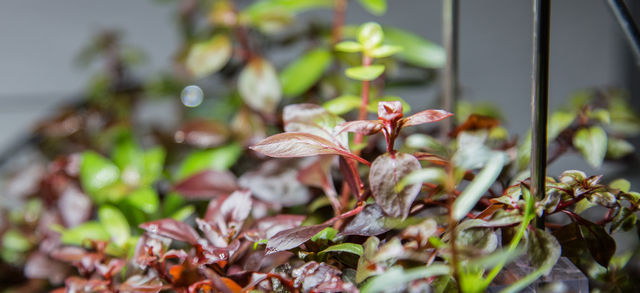
Why aquarium plants grow poorly or even die off completely can have various reasons. We have summarized the 10 most important causes for you.

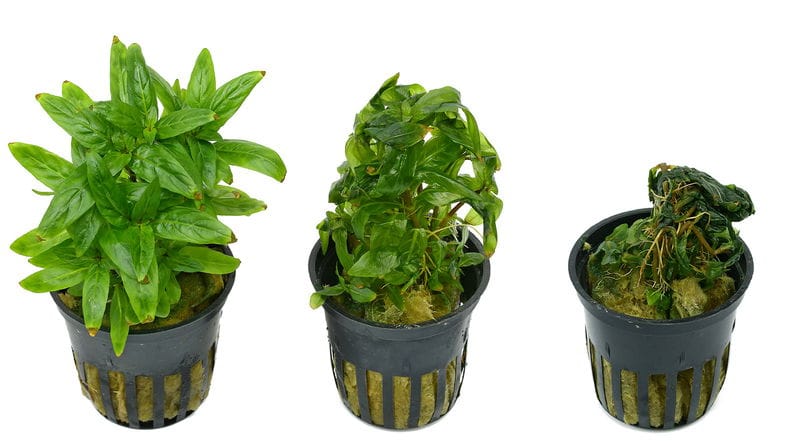
We all know it: the aquatic plants are freshly bought and look good at first. You then plant them, and after a few days the aquarium plants get worse and worse. Individual leaves or even whole parts of the plant die off. The cause is often that the plants still have to adjust. In the sales forms of potted plants and in-vitro, the plants are still in the emersed state, that is, in their above-water form. For the submersed form (underwater form), an adjustment takes place that changes the plant's appearance, above all leaf shape and color. It can then indeed happen that emersed plant parts die off or are shed.
This is not a big reason to worry, however. To a certain extent this process is completely normal. As long as you above all provide good growth conditions in the form of a sufficient nutrient supply, the aquatic plants can form healthy new shoots from the rhizomes or stems that are adapted to life underwater. You can find further tips on this topic here.

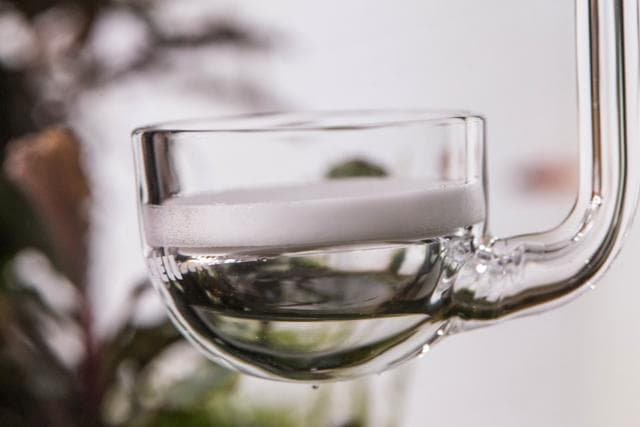
Especially in a well-equipped planted aquarium, a sudden lack of carbon dioxide is one of the most common causes of poor growth of aquatic plants, often in combination with the appearance of algae. Often there is a technical problem here: the bottle has run empty, the diffuser has become dirty or one of the CO2 components has a defect. Therefore service and check your CO2 system regularly so that it can always reliably supply the plants with carbon. A CO2 drop checker and bubble counter help you monitor the carbon dioxide supply in the aquarium well.

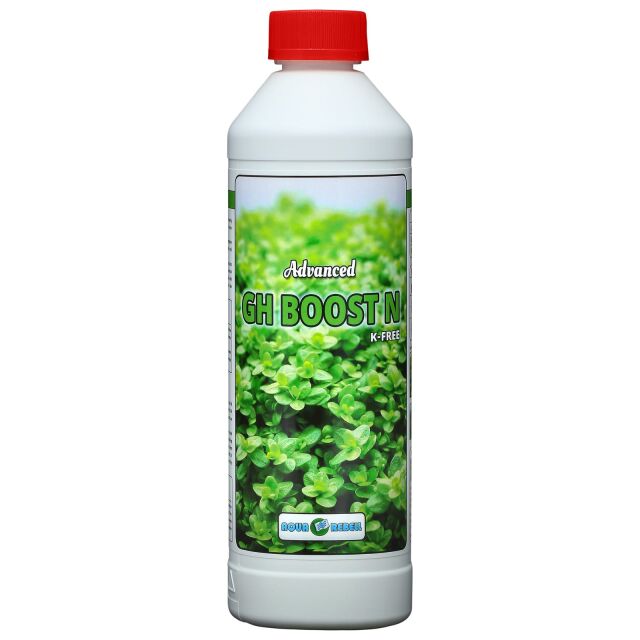
Deficiency symptoms in aquatic plants can arise from various nutrient deficits. Besides insufficient CO2, however, a nitrogen deficiency in a planted aquarium is among the top 3 reasons for poor plant growth. This applies in particular when many fast-growing plant species are present and at the same time intense lighting, additional carbon supply and liquid fertilization are used. The plants are actually supplied fully and at first grow very well. A deficiency often arises when the plant mass, and with it consumption, keeps increasing. An undersupply then often occurs with the nutrient that is needed in particularly large amounts. In most cases this is nitrogen (NO3). This shows up, among other things, in stagnating growth, yellow leaves and also the appearance of algae in the aquarium.
Nitrate can, however, be determined quite easily with a suitable water test and adjusted very specifically in the fertilization using pure nitrogen fertilizer.

Besides CO2 and NO3, other nutrients can of course also be the cause of deficiencies through undersupply. From experience, however, they do not occur as often as with nitrogen and carbon. That is why we have listed these two parameters separately. Other important nutrient elements for aquatic plants are iron (Fe), phosphate (PO4), potassium (K) and magnesium (Mg). In addition, plants need various trace elements, which are generally contained in a complete iron fertilizer. Potassium, magnesium and phosphate are among the so-called macronutrients. In some cases, certain damage patterns or growth patterns with deficiency symptoms can also be assigned to specific nutrients. To learn more about this, we recommend reading our article "Deficiency symptoms in aquatic plants".

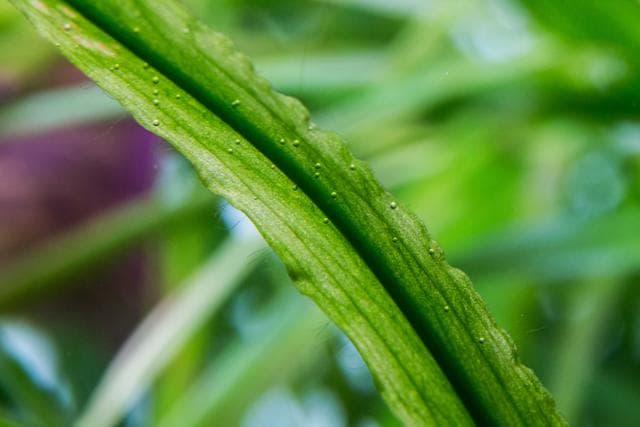
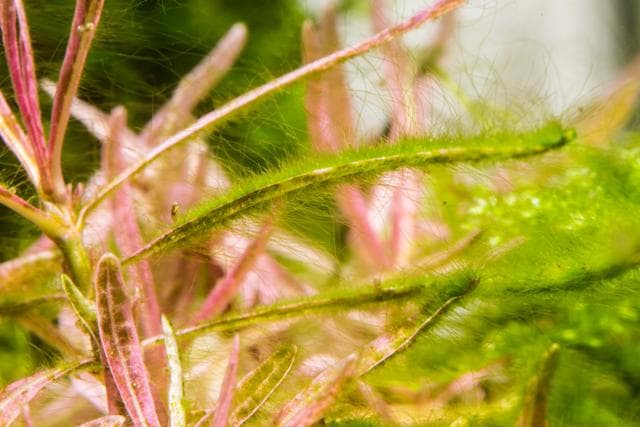
Another factor that can prevent plants from growing healthily is algae growth. With heavy algae infestation of the plant leaves, less and less light reaches them, which makes photosynthesis harder. Algae species that spread over a large area, such as cyanobacteria and fuzz algae (see picture), but also black beard algae, are a problem here. The plant's metabolism is disturbed by the algae overgrowth, so that it becomes weaker and weaker over time and dies. It is therefore important to react early and eliminate the algae. The causes of the algae growth should also be eliminated. Mostly there is a nutrient imbalance here. For suitable advice, you can browse our algae guide.

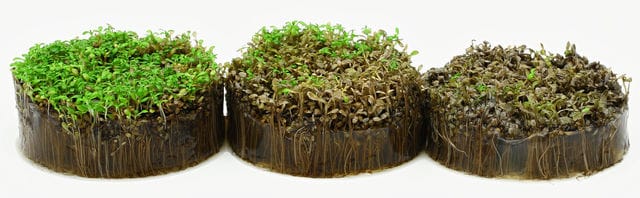
Dying aquatic plants that fall apart into mush are often attributable to fresh soil during the cycling phase. Its strong cation exchange capacity makes the water very soft and acidic, which weakens sensitive species. A similar effect can also occur when only RO water without hardening is used or when too few water changes take place in the first weeks.
Aquarium plants, but also the aquarium inhabitants, need enough minerals to grow healthily. You should therefore not let the general hardness drop below approx. 6 °dGH. In addition, at least a slight carbonate hardness helps to buffer the pH value. This prevents a pH crash. Especially during the cycling phase, you should therefore counter-buffer a little with enough water changes and/or the use of a hardening salt to minimize the risk of plants dying off through over-acidification.

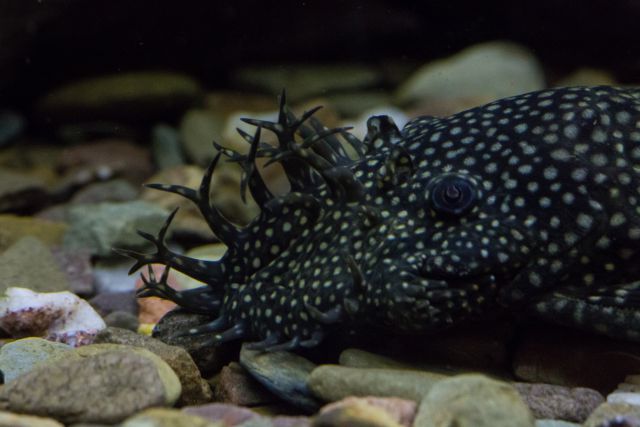
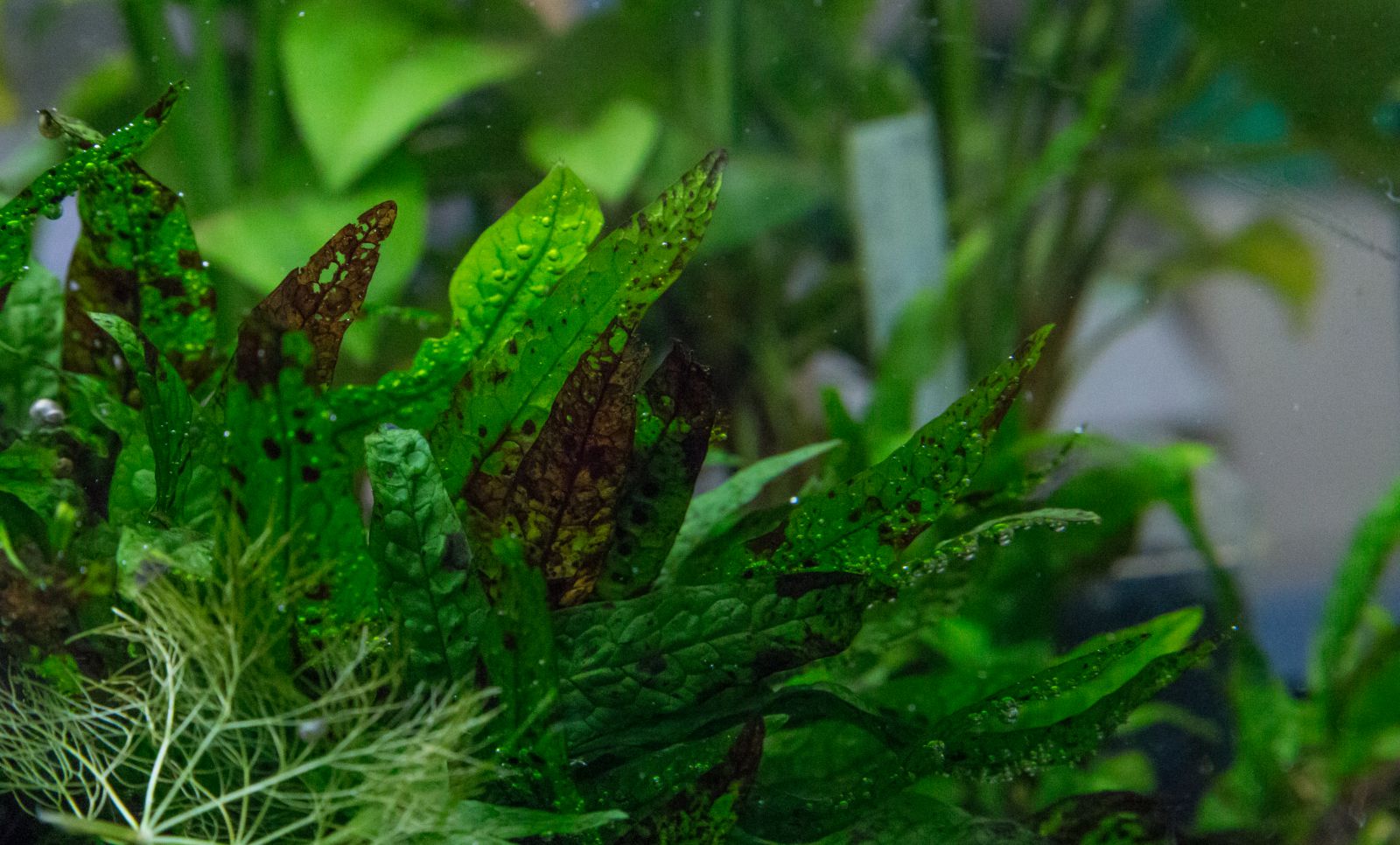
Do you find strange holes in the leaves or frayed leaves? Then it may well be feeding damage from plant-eating animals. These include, for example, various catfish, shrimp, crayfish, snails, but also garras or Chinese algae eaters. Often the feeding damage is not recognized as such at all. Holes in leaves are often diagnosed as a deficiency symptom in the sense of a potassium deficiency. That is not always the case, however.
A remedy for feeding damage is sufficient feeding of plant-based food for the animals. Leaves, for example, are an ideal food supplement for shrimp and crayfish. Appropriately prepared vegetables also appeal to plant-eating aquarium inhabitants. You can find more info on this in this article.

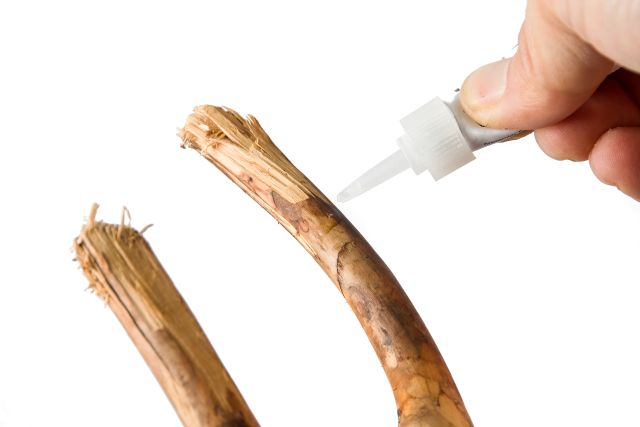
Plants can also be damaged if too much plant glue is used. This is a cause that of course mainly affects plants that are attached to hardscape with glue. These include above all mosses but also epiphytes such as ferns, Anubias or Bucephalandra. A gel-type plant glue based on cyanoacrylate should be used as a suitable glue. The amount to be used is very decisive, however. Here you should really work only drop by drop, especially with mosses. It is enough to apply the glue at points and not over the whole surface. Too much glue causes plant parts that come into contact with it to die and also leaves quite conspicuous white spots on the hardscape.

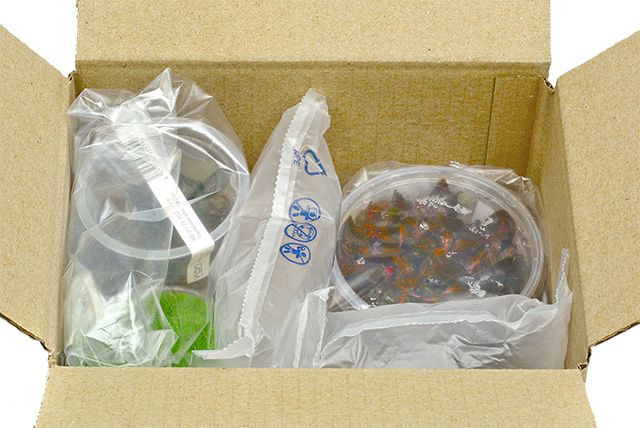
Especially if you have ordered aquatic plants on the internet, something can go wrong during transport under certain circumstances. As a precaution, we at Aquasabi only ship healthy-looking aquarium plants, which are also checked once more before shipping. The plants are packed and cushioned accordingly well to suit the weather and the rest of the order. If necessary, we also ship plants and other accessories in separate packages, e.g. if there is a risk that heavy items such as stones or substrate could damage the plants too much. We do everything so that your aquatic plants arrive at your home intact.
Unfortunately, something can also go wrong on the way, and the plants can be damaged as a result. This includes, for example, physical damage such as broken or crushed stems and leaves, for instance through rough handling during transport. Drying-out damage in the form of dried-up or wilted leaves can occur if delivery takes too long and the plants do not get enough moisture for a longer time.
As a first-aid measure, we put a plant flyer in our packages. In an emergency, follow the measures described there and check the plants immediately upon receipt. If you receive plants damaged by us, please take photos and contact us by email. We will then surely find a good solution for your problem.

So-called frost damage is one kind of transport damage. We have listed it separately, however, because it is a special topic. Frost damage can, for timing reasons, only occur in winter and is caused during transport by temperatures that are too cold. In practice, however, this phenomenon occurs much more rarely than is often assumed. At Aquasabi, we make sure the packaging suits the weather for winter shipping, if necessary also with a heat pack. In addition, most aquatic plants tolerate a cool temperature slightly above freezing quite well.
If frost damage does occur, it shows, generally speaking, in wilted-looking leaves and significantly reduced vitality. Their healthy coloring is often lost across the whole plant - the once vigorous green fades and gives way to grayish, brownish or dark green tones. With partial frost damage, the discolorations often appear only in certain areas of the leaf surface. Depending on the species, however, frost damage can also develop differently in individual cases.
Would you like to learn more about the topic of frost damage? We have a separate article on it here.