Spontaneous companion fauna in aquariums: crustaceans
Published
Translated from German with AI assistance and reviewed by our editors.
In aquarium keeping, small animals that show up unintentionally in the aquarium are called companion fauna. They can find their way into the aquarium in various ways, for example through swapping or buying aquatic plants, adding live food, or introducing used substrate and decoration – but even with the dust in the air, small creatures can get into the water. Such an introduction can never be avoided completely. After all, an aquarium is a piece of nature and thus a biotope for many different tiny organisms and microorganisms, without which the breakdown of pollutants would not work. Nevertheless, there are some small animals that seem annoying to the aquarium owner or can even be pests for the inhabitants such as fish, snails, shrimp and crayfish. In this article, you will learn everything about the companion fauna that falls into the category of so-called crustaceans.
Crustaceans
Crustaceans (scientifically: Crustacea) are an extremely species-rich subphylum of the arthropods. Like other arthropods – arachnids, millipedes and insects – they have a segmented body and a chitin-containing body covering. The crustaceans include various classes such as seed shrimp, branchiopods and malacostracans. Most species live in water, both in the sea and in freshwater, but some also on land.
In the course of evolution, crustaceans have adapted strongly to very different habitats and the conditions prevailing there, so they show an enormous diversity of forms. This makes it very difficult to define clear characteristics that mark crustaceans as a whole. Some of these characteristics are the presence of gills as respiratory organs, the fixed number of two pairs of antennae, and so-called biramous limbs.
The body of a crustacean is divided into different segments, split into a head section and a terminal section. Because of the considerable diversity of forms, the limbs (for example claws, mouthparts) differ greatly depending on the species.
In aquariums, a large number of spontaneously appearing small animals can be sorted into the categories snails and worms, but small crustaceans also appear frequently, which we would like to introduce in more detail in this article.
Copepods
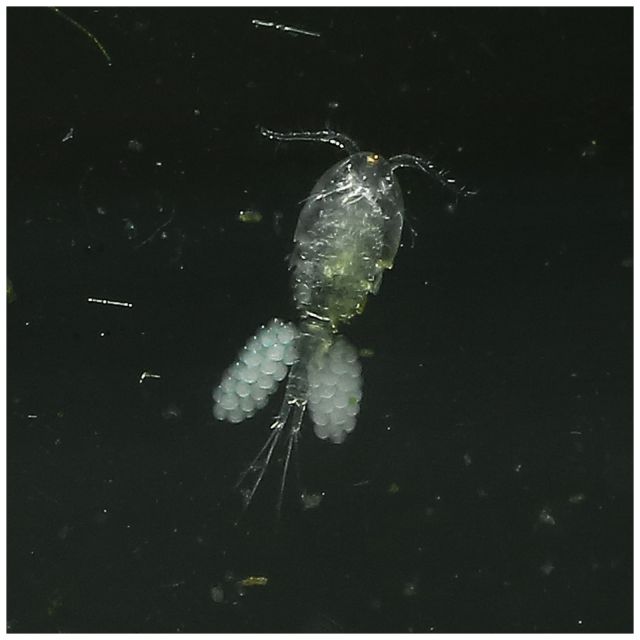
Copepods are a species-rich group of crustaceans. They live in nearly every body of water around the globe, even in puddles. However, 80% of the species live in the sea. Copepods include, among others, the cyclops (Cyclops), so called because of how they move, which are known as fish food and can also appear spontaneously in aquariums fairly often. These tiny whitish animals only grow to about 1 mm, which makes them hard to recognize for an untrained eye. Characteristic are the head section that widens, with the two protruding antenna-like swimming legs, and a very thin abdomen. At the front of the head between the swimming legs, you can discover with a good magnifying glass the mostly reddish cyclops eye (single eye), which gave the copepod its scientific name Cyclops. The females each carry a whitish egg sac to the right and left of the abdomen (pleon). These eggs are carried until the young copepods hatch. First, nauplius larvae hatch, which develop into adult copepods over several molts. For very small fish larvae, these nauplius larvae are excellent food.
The swimming legs serve Cyclops as a means of locomotion. With their help, they can move forward in jerky jumps. This twitching, fast way of moving is very characteristic of Cyclops and also led to its colloquial German name "Hüpferling" (little hopper).
In principle, these small crustaceans are to be regarded as harmless to aquatic plants as well as fish, shrimp and snails. However, if there is an excessive amount of food for copepods, a massive proliferation can occur, which is at most a visual problem. Cyclops feed on dead plant material and food leftovers and are therefore a useful part of the aquarium ecosystem as scavengers. Almost all aquarium fish accept copepods as welcome live food, so a dense population of these animals is more likely in fishless aquariums such as shrimp breeding tanks.
If their natural habitat dries out, cyclops form cysts that survive drought and also cold. These are whirled up by the wind and then form part of the normal dust in the air. This is, by the way, also how copepods get into the aquarium – literally out of the blue. They can also be introduced with plants from stocked aquariums or from nature, and introduction with frozen food is also reported from time to time.
Seed shrimp

Seed shrimp (scientifically: ostracods) are a very species-rich group of small crustaceans that occur everywhere in water, including the deep sea and groundwater; some species even live in moist forest soils. They live mostly as scavengers of leftovers, but among them there are also carrion eaters, predators, herbivores and filter feeders. Predatory seed shrimp species are very rarely found in freshwater. In the sea they are more common. In rare cases, you have a carrion-eating species in the tank, which you can observe in masses on dead snails. These seed shrimp have not killed the snail but merely make use of it. If this happens more often, you should try to find out what the snails are dying of. Sometimes the reason lies in external filter inlets, skimmers or other pump inlets, from whose holes the snails can no longer get out and die there.
Seed shrimp should not be confused with clam shrimp, which are bred in certain circles of aquarium keeping and count among the "living fossil crustaceans". The seed shrimp that we aquarists deal with are mostly between 0.5 and 2 mm long and oval to round in shape. From the two-part shell, which – similar to a mussel – is open a crack, hair- or brush-like organs protrude that serve for feeling, swimming, crawling and taking in food.
These small crustaceans crawl on the substrate and can also move by swimming at times; the swimming pattern is very even. Seed shrimp mostly stay close to the bottom, on and in the detritus, around plants or on grains of sand, which they can quite closely resemble. You can also see them grazing on panes. With heavy food input, seed shrimp can multiply correspondingly more and become a cosmetic problem. You should then adjust the amount of food. All in all, seed shrimp in the aquarium are generally at most a cosmetic problem. From time to time, however, it can happen that a single seed shrimp strays under the operculum of an aquarium snail such as a piano snail or Brotia. This stresses the snail, and it may then close its operculum and starve. But this also happens very rarely and is certainly not a targeted attack by the seed shrimp.
Adhering seed shrimp or eggs are introduced with aquarium plants and, for example, moss balls, but also through decoration or animals from stocked tanks or natural waters. The eggs are carried by the wind from dried-out natural waters, so seed shrimp, like Cyclops, can appear spontaneously in the aquarium even if no plants, animals or decoration came in from outside.
Water fleas
Water fleas are mostly also called "daphnia" after their best-known genus Daphnia. Aquarists know them more as common, fiber-rich live food and less as small animals that appear spontaneously in the aquarium. Introduction is possible, if at all, for example by seeding the aquarium with pond mud, adding live food or adding aquatic plants from private hands. Provided there is fish stocking, you cannot really count on these animals surviving, since they are simply eaten within a short time. These small crustaceans also cannot cope with the strong current and the very food-poor water in most aquariums, so they starve after a few days. Their energy needs for swimming in a current are simply too high. In fishless tanks with weak current, however, they can persist (see further below).
Water fleas (scientifically: Cladocera) are actually a diverse group of tiny aquatic crustaceans. The vast majority of species live in inland waters, very few in the sea. They include not only the classic "daphnia" such as Daphnia pulex (common water flea) and Daphnia magna (giant water flea), but also many other genera such as Moina, Bosmina (snout water fleas) or Scapholeberis (skiff-rider).
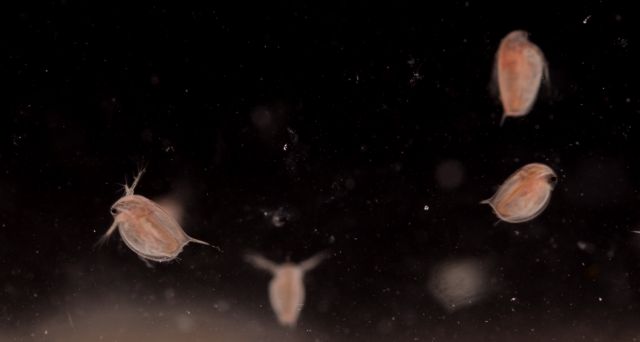
Water fleas can be recognized by their fairly broad, often roundish, laterally flattened, translucent body and two large, branched antennae on the head. They move by beating these antennae: a hopping that often looks somewhat clumsy. The body sits for the most part inside the carapace, which often ends in a spine at the back. In most water fleas, a dark compound eye in the middle of the transparent head is very easy to see.
Most water fleas feed as filter feeders: with their thoracic legs inside the carapace, they create a water current and sieve out food particles as well as suspended algae and other microorganisms drifting in the water.
Water fleas pose no danger at all to aquarium inhabitants and aquatic plants; quite the contrary, they are gladly accepted as live food not only by fish but also by small crayfish or dwarf crayfish and some shrimp. A water flea population can therefore at most develop in fishless containers, such as shrimp breeding tanks and plant vases, if the conditions are right: low current and a sufficient food supply in the form of suspended particles and microorganisms.
Water fleas can, by the way, filter cloudy water clear. By adding a larger quantity of daphnia, algae or bacterial cloudiness can be eliminated.
Water fleas reproduce by eggs. Asexually produced eggs are visible as a light saddle on the water flea's back, whereas the sexually produced winter eggs or resting eggs are dark in color. These resting eggs survive drought and cold very well, which is why they are formed when conditions worsen, such as lack of food or an impending drying-out of the water body.
Mexican amphipods ("fighting crayfish")

Image credit: Scott Bauer [Public domain] via Wikimedia Commons, license information, source attribution.
Mexican amphipods (Hyalella azteca), also called fighting crayfish because of their toughness, belong to the amphipods and come from Mexico and South America. Their appearance roughly matches that of the European freshwater scuds (Gammarus pulex). They are, however, smaller than their European relatives and, under a magnifying glass, have clearly visible, pointed dorsal scales. They are also much more robust with regard to water parameters such as temperature or oxygen content. In harder water, their reproduction rate seems to be higher. These amphipods are often kept as a breeding stock in a separate container in order to offer them, for example, as live food for turtles, frogs or larger fish.
The animals can grow to around half a centimeter. Mexican amphipods are agile and fast swimmers that are often first perceived as a line darting through the aquarium.
Mexican fighting crayfish can be introduced into a normal aquarium, for example, through private exchange of aquatic plants. Once established, these very robust animals are hard to get rid of again, since they also live in the aquarium's filter, among other places, and even settle in cavities in aquarium driftwood. Under good conditions, a mass proliferation can then set in. Female Mexican amphipods carry their eggs under the abdomen until hatching and thus practice intensive brood care. Besides the visually disturbing aspect, there is definitely a risk that the hungry small crustaceans go after aquatic plants, snail eggs and fish eggs. They also seem to be good algae eaters, however, and even eat black beard algae. They are problematic in shrimp breeding tanks, because they pose extremely strong competition for food and also do not say no to a freshly molted young shrimp.