 Spontaneous companion fauna in aquariums
As already mentioned in the article "Animals on purchased emersed plants", aquatic animals can get into the tank in various ways, for example with newly acquired underwater plants or animals, decoration material and equipment from other aquariums, or with live food.
Many aquarium owners are then very worried that these might be "pests" (which is by no means always the case) or are simply disgusted by the "vermin". They then want not only to identify it but also to get rid of it again as quickly as possible.
Although "nature" is the central subject of aquarium keeping, even in "Nature Aquariums" many creatures from real nature – sometimes unjustly – are not tolerated, or they find no lasting means of survival in our aquariums anyway.
In fact, aquariums, these small, artificial aquatic biotopes, can never be entirely "nature". Intact natural waters teem with diverse small fauna with different ecological roles; a distinction between beneficial organisms and pests makes no sense there. By comparison, aquariums are very poor in such fauna. On the other hand, predators, parasites or herbivores can become a problem for the aquarium's charges (see the article "Pests in the aquarium").
But many introduced little animals are rather unproblematic for the aquarium. That is also a reason to learn to tell them apart; in general, studying the small aquatic fauna, whether "aquarium pests" or not, can be interesting and educational. Nature lovers even set up special pond aquariums for this. Many species from the aquarium companion fauna only eat microorganisms and algae growth, organic waste (including leftover food, dead aquarium inhabitants or plant remains), or filter their food from the water. Some are gladly eaten by aquarium fish and are therefore found especially in fishless or invertebrate aquariums.
In this article, we give an overview of the most varied aquatic animals that can be counted as the spontaneous companion fauna in an aquarium. They are roughly divided into the categories snails, worms, crustaceans and other organisms. You can find more detailed introductions of the individual animals in the corresponding links.
Snails and their egg clutches
Not all snails, and especially their egg clutches, are recognized as such by the aquarist. The spawn of these animals in particular can sometimes look rather bizarre. Even though there are definitely some species that go after aquatic plants, for example, most aquarium snails are generally not to be regarded as pests. Quite the contrary, they are even a biological support for the ecosystem in the aquarium and help stabilize it and advance the breakdown of pollutants. Nevertheless, for some aquarium owners they represent a visually disturbing element and are therefore unwanted. If enough food is available, a mass proliferation can even occur, which is then called a snail plague.
In the following, we look at various snail species that can typically be introduced into the aquarium along with aquatic plants, substrate or decoration.
Freshwater limpets
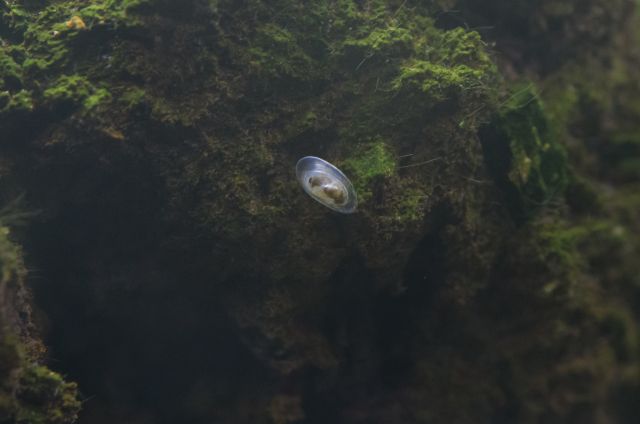
These snails are often hardly perceived as snails at all. In fact, their appearance is rather reminiscent of a mussel, since they have no typical curved shell. Freshwater limpets (Ferrissia fragilis) stay relatively small at 3 mm, feed on algae growth and biofilms, and are harmless to aquarium inhabitants. Their spawn is hardly visible to the naked eye. You can find more information on freshwater limpets in our article "Spontaneous companion fauna in aquariums: snails" from the Aquascaping Wiki.
Bladder snails

Copyright: Chris Lukhaup.
Bladder snails of the genus Physa are probably the snails most commonly found in aquariums and are often introduced by buying submersed aquatic plants. They generally only grow to just over a centimeter and often stay even considerably smaller. Bladder snails have a left-coiled shell that tapers to a point or a blunt end. The body is rather gray in color, while the shell is translucent and looks brown to slightly yellow-gold. Bladder snails are hermaphrodites and can multiply very strongly under good conditions. Their egg mass is often curved and transparent. Individual eggs are easy to see. Otherwise, bladder snails pose no danger, either to the animal livestock or to the aquatic plants in an aquarium. If you want to learn more about them, we recommend our article "Spontaneous companion fauna in aquariums: snails" in our Aquascaping Wiki.
Ramshorn snails

Copyright: Chris Lukhaup.
Ramshorn snails (German aquarists like to abbreviate them as PHS) of the genus Planorbella are popular in aquarium keeping, mainly because of their great variety of colors. Besides brown ramshorn snails, there are blue, pink or red variants. They are therefore often bought deliberately as livestock for an aquarium but can also be introduced via newly acquired aquatic plants. The shells have a pretty spiral shape reminiscent of a post horn and can grow to around 2 to 3 centimeters. The egg clutches of the hermaphroditic ramshorn snails are quite firm, flat and shaped like a watch glass. They pose no danger in the aquarium but can multiply in masses under the right conditions. Occasionally, feeding damage to the shoot tips of delicate aquatic plants may occur. This depends on the species, however. You can find more information on these snails in the article "Spontaneous companion fauna in aquariums: snails". You will also find tips and help with a snail plague in our Aquascaping Wiki.
Malaysian trumpet snail
Copyright: Chris Lukhaup.
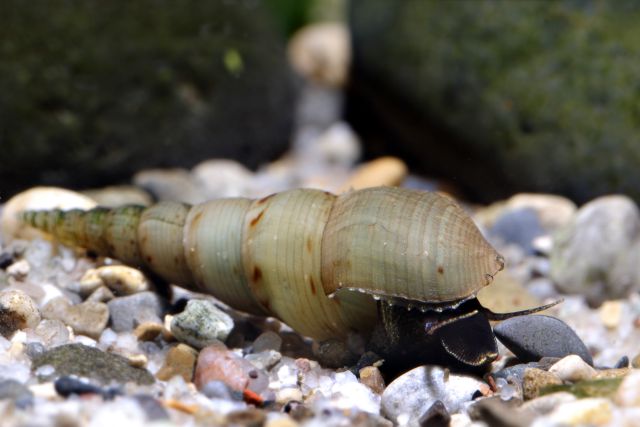
The Malaysian trumpet snail Melanoides tuberculatus, often abbreviated as MTS in the hobby, has become well established in aquarium keeping. This snail species lives in the substrate, where it feeds on detritus and food leftovers. It can grow up to 3 cm long. The coloring varies from brown to cream. Malaysian trumpet snails do not lay eggs; they are livebearing and reproduce by parthenogenesis. As such, these snails are very useful and absolutely harmless. Under good conditions, however, a mass proliferation can take place, resulting in a snail plague. You can find more information on MTS here.
Spiny trumpet snail

Copyright: Chris Lukhaup.
Mieniplotia scabra, the spiny trumpet snail (spiny MTS), looks quite similar to the Malaysian trumpet snail that is widespread in aquarium keeping. It is characterized by features such as a shell about 2 to 3 cm long and a light brown color, but above all by its spiny knobs, which sit on every whorl of the shell. Spiny trumpet snails feed on leftovers and detritus in the substrate, reproduce by parthenogenesis and can therefore develop a large population in a short time given a suitable food supply. You can find more detailed information on the spiny trumpet snail here.
Plate snails
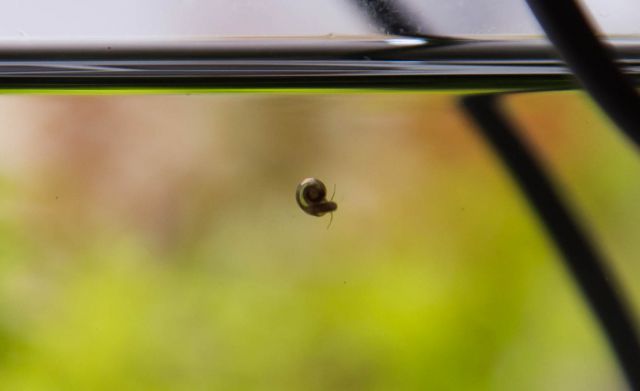
Plate snails are tiny (approx. 4 mm), slightly brownish in color and resemble the larger ramshorn snails. In fact, they are related. The shells of plate snails, however, do not stick out from the body but lie on it like a "plate" (hence probably the name). These hermaphroditic snails are not pests; their population can be kept in check quite well with controlled feeding and corresponding food competitors (biofilm eaters such as other snails and shrimp). You can find more information on these aquarium snails here.
Pond snails
Copyright: Chris Lukhaup.
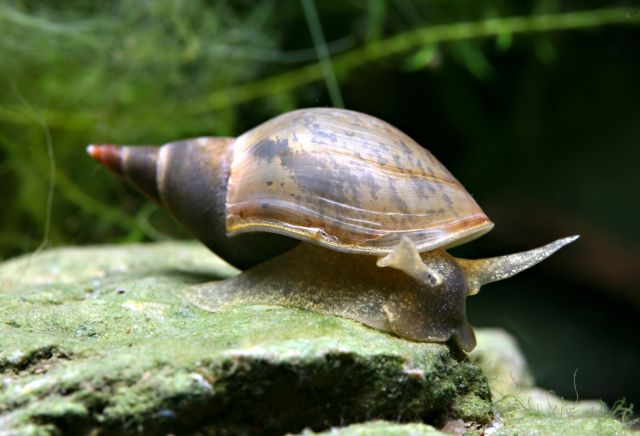
The pond snails that are occasionally introduced into an aquarium include above all the great pond snail (Lymnaea stagnalis). Typical features are a bulbous shell that tapers clearly to a point at the back, and a stately total length of up to 6 cm – which is hardly reached in the aquarium, however. A typical feature is the triangular tentacles. Pond snails can go after aquatic plants and are probably rather unwelcome guests in an aquascape or planted aquarium. However, they are also used as biological control and as predators of hydra to fight it. Would you like to learn more? Here you will find a more detailed introduction to pond snails.
New Zealand mud snail
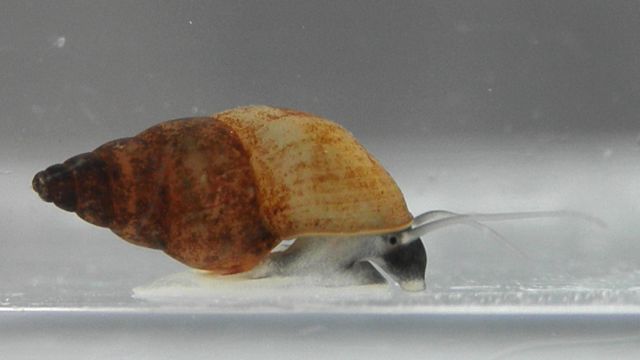
Image credit: Michal Maňas - Own work, license: CC BY 4.0.
Potamopyrgus antipodarum, the New Zealand mud snail, is quite often confused with a trumpet snail but is really tiny at a length of only about 3 mm. On closer inspection, its shell is also not as slender as that of an MTS but somewhat more compressed. This snail poses no danger in the aquarium, but a large population can develop here too if the feeding conditions are right. A visual impairment in the form of a snail plague can then arise. You can learn even more about the New Zealand mud snail here.
"Worms"
This collective term covers everything that fits the typical appearance of a worm: invertebrate, long, soft-skinned and legless. Strictly speaking in biological terms, however, various animal groups belong to it. Some pests such as leeches or planarians fall under this collective term. But there are also a lot of other worms in the aquarium that are harmless. Telling them apart at first glance is often hardly possible.
Below you will find a short overview of all kinds of common worm-like organisms that can show up in the aquarium.
Oligochaetes

Oligochaete Pristina sp., little-bristled worm
Oligochaetes include, for example, well-known species such as the classic earthworm, but also tubifex or white worms (enchytraeids), which are well known as live food in aquarium keeping. The most important features are a segmented body and the bristles on it. In the aquarium, oligochaetes that stay small (under 2 cm) are found more often; they eat leftovers and loosen the soil. Their snake-like swimming movements are typical. There is a risk of confusion with nematodes (see description below), which, however, have no segmented body. In general, oligochaetes are to be classified as harmless. You can find more information in the article "Spontaneous companion fauna in aquariums: worms".
Nematodes (roundworms)

Caenorhabditis elegans is a nematode. Image credit: Bob Goldstein - Own work, license: CC BY-SA 3.0, source attribution.
Nematodes are less commonly found in aquariums. Their body is elongated, slightly pointed and not segmented. They can easily be confused with other small worms such as oligochaetes, but these have a segmented body structure. Nematodes are often only a few millimeters long. They generally stay in the substrate or in the filter. Among the many species that occur, there are definitely some parasites – rather rare in the aquarium – that can endanger the fish livestock, for example. The majority of nematodes, however, are harmless, and some species such as vinegar eels are known as live food for ornamental fish. Would you like to learn more? Here you will find even more information on the topic.
Leeches

Leeches are generally annelid worms that live as predators or parasites. In aquariums, species such as the snail leech or the Asian leech can appear, which can in part become dangerous for inhabitants such as fish, snails and shrimp. All leeches are quite easy to recognize by their forward movement. It is not wriggling or gliding but like that of an inchworm. The leech "walks" by alternately drawing forward its two body ends. By the way, leeches swim quite well. You can find more detailed information on leeches in our articles "Pests in the aquarium" and "Leeches in the aquarium".
Planarians

Planarians are among the predatory flatworms, which are also called turbellarians. You can recognize them by their flat body of up to about 2 cm in length and by their gliding locomotion. For species of the genus Dugesia in particular, the easily recognizable pair of eyes and a triangular head are typical features. Planarians of the order Tricladida in particular can become dangerous for invertebrates in aquariums. In the articles "Pests in the aquarium" and "Planarians in the aquarium", we go into the problem with these unwelcome guests in more detail.
Glass worms / Rhabdocoela

Macrostomum sp. Copyright by Tamara Stamm.
Besides planarians, glass worms such as those of the order Rhabdocoela also belong to the turbellarians. Worms of the genus Macrostomum are whitish in color without a distinct head and are to be classified as harmless. The color of the species Bothromesostoma personatum is reddish. These glass worms are predatory, but purely because of their size they are harmless to fish and shrimp in the aquarium. They feed mainly on tiny organisms and pose no danger to the typical livestock of an aquarium in the form of fish, shrimp and adult snails. You can find more detailed information on glass worms in our article "Spontaneous companion fauna in aquariums: worms".
Hydra / freshwater polyps

Hydras, also called freshwater polyps, belong to the cnidarians. Hydra is mostly green or white in color and grows to around 2 cm in length. The animal attaches itself to the surface with a foot disc, and at the end of the stalk-like trunk there are several capture tentacles. Depending on the species and size, hydras can become dangerous for fry and smaller shrimp, so they are regarded as pests in aquarium keeping. You can find more details on this topic in our articles "Pests in the aquarium" and "Hydras - freshwater polyps".
Crustaceans
The subphylum of crustaceans (Crustacea) includes an incredible number of different species that have adapted to a wide variety of living conditions in water as well as on land. In the aquarium, this includes spontaneously appearing small animals such as water fleas, freshwater scuds or copepods, to name just a few. Typical features are a segmented body plan with in part strongly developed limbs (mouthparts, claws), gills and two pairs of antennae or feelers.
Copepods
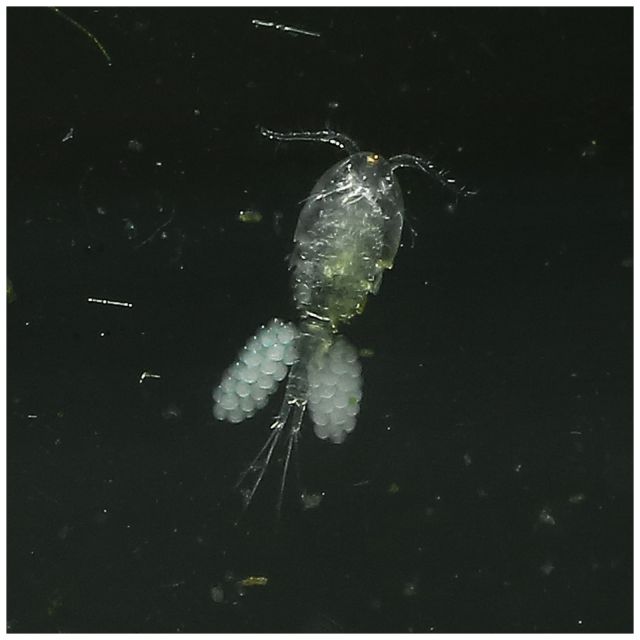
Copepods occur in almost every body of water. In an aquarium, the cyclops (Cyclops) among them appear more often. On close inspection, you can recognize these tiny creatures (under 1 mm) by their broad head fitted with two swimming legs. Their movement is jerky. These animals are harmless to all aquarium inhabitants and aquatic plants and are gladly accepted as food by fish. Only in the absence of predators (for example in a pure shrimp aquarium) can a visual problem arise given a suitable food supply. You can find more information on cyclops in the article "Spontaneous companion fauna in aquariums: crustaceans".
Seed shrimp

Seed shrimp are generally harmless, spontaneously appearing small creatures in the aquarium. They mostly stay under 2 mm and have a roundish to oval body shape. If enough food is available, a visual problem can arise. A few seed shrimp species are carrion eaters (feeding, for example, on dead snails) or even predatory. In a normal aquarium, however, these are very rarely encountered. You can find more information on seed shrimp here.
Water fleas
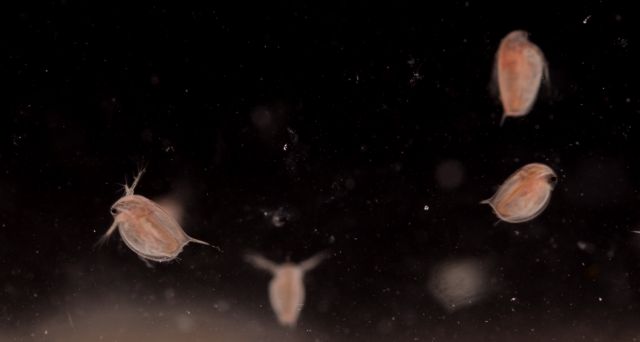
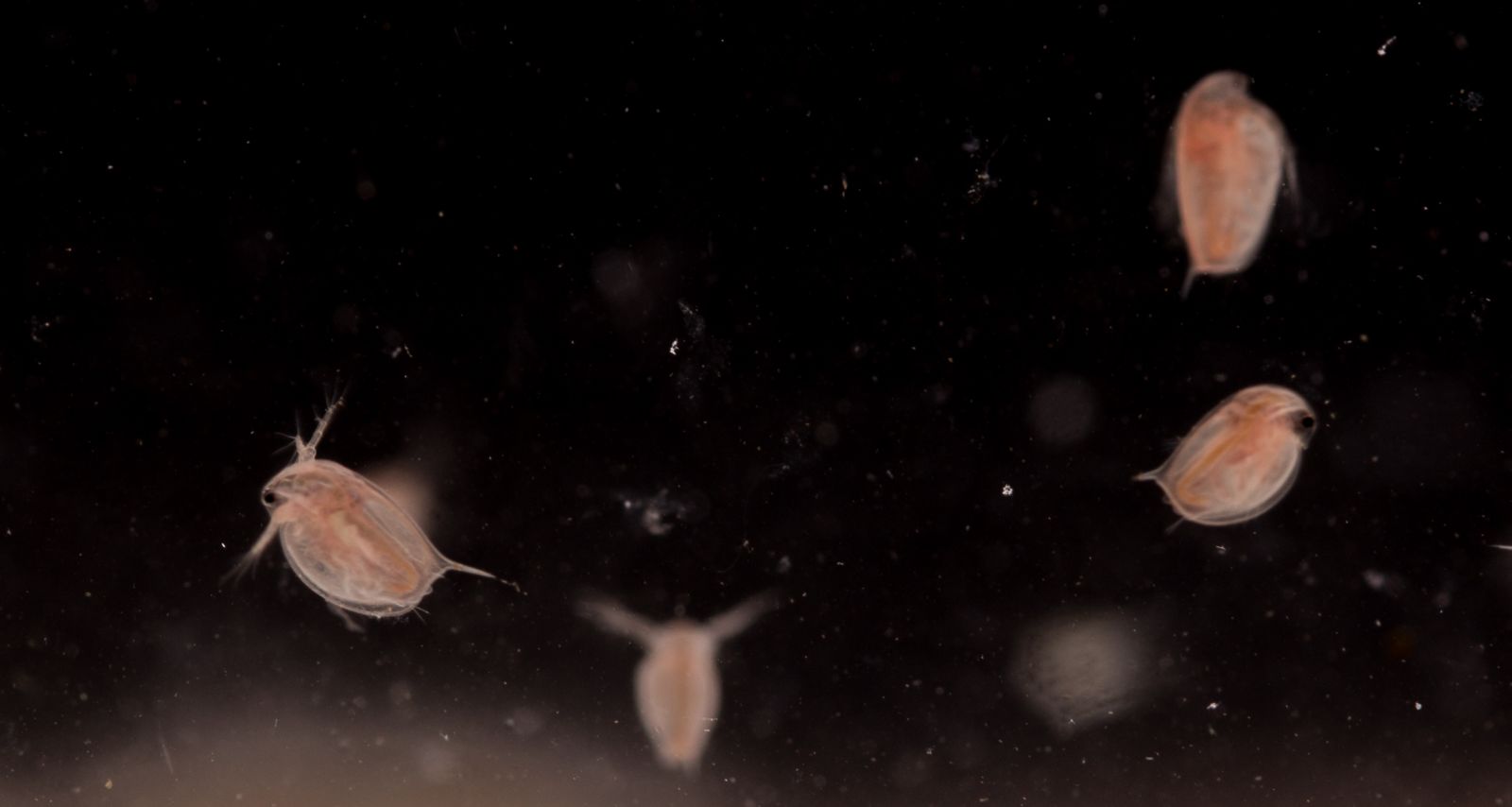
Water fleas or daphnia can be recognized by their roundish body shape and the two branched antennae at the head end. These also serve as swimming organs and provide a fairly jerky, clumsy-looking locomotion. Water fleas pose no danger to any aquarium inhabitants. Quite the contrary, as live food they are an integral part of the aquarium keeping scene. Would you like to learn more about water fleas? Our article "Spontaneous companion fauna in aquariums: crustaceans" has even more information for you.
Mexican amphipods

Image credit: Scott Bauer [Public domain] via Wikimedia Commons, license information, source attribution.
Mexican amphipods (Hyalella azteca) are also known as fighting crayfish. They stay considerably smaller than their European relatives (Gammarus pulex). This robust amphipod species is also often sold as a breeding stock for live food, for example for amphibians or larger fish. In a normal aquarium or aquascape, these animals can become a problem because you cannot get rid of them again. With sufficient hunger and a growing population, aquatic plants, fish fry and young shrimp can also end up as food, or the so-called fighting crayfish represent enormous competition for food. Our article "Spontaneous companion fauna in aquariums: crustaceans" offers you even more background information.
Bell animalcules

Image credit: Frank Fox - Own work, license: CC BY-SA 3.0 DE, source attribution
Bell animalcules are single-celled organisms that often live in colonies on solid surfaces, and here preferably on organic material. They belong to the ciliates. They often settle on plants, but they can also sit on crustacean shells, snail shells or shrimp. Bell animalcule colonies have even been observed on fish. The colonies are very delicate, they have a whitish-transparent color, and with the help of a good magnifying glass you can see very small white dots. The individual animals consist of a thin stalk and a somewhat thickened, inverted bell-shaped body. Around the mouth opening at the top are cilia, with which bell animalcules sweep in their food. They feed on bacteria and other single-celled organisms in the water. Bell animalcules are not dangerous, but they are a clear indication of a high bacteria count in the water. Especially in fresh aquariums where no nutrient balance has been established yet, bell animalcules like to show up. As a rule, they disappear on their own again when they find little food (that is, bacteria in the water) because the biological system in the aquarium has settled down.