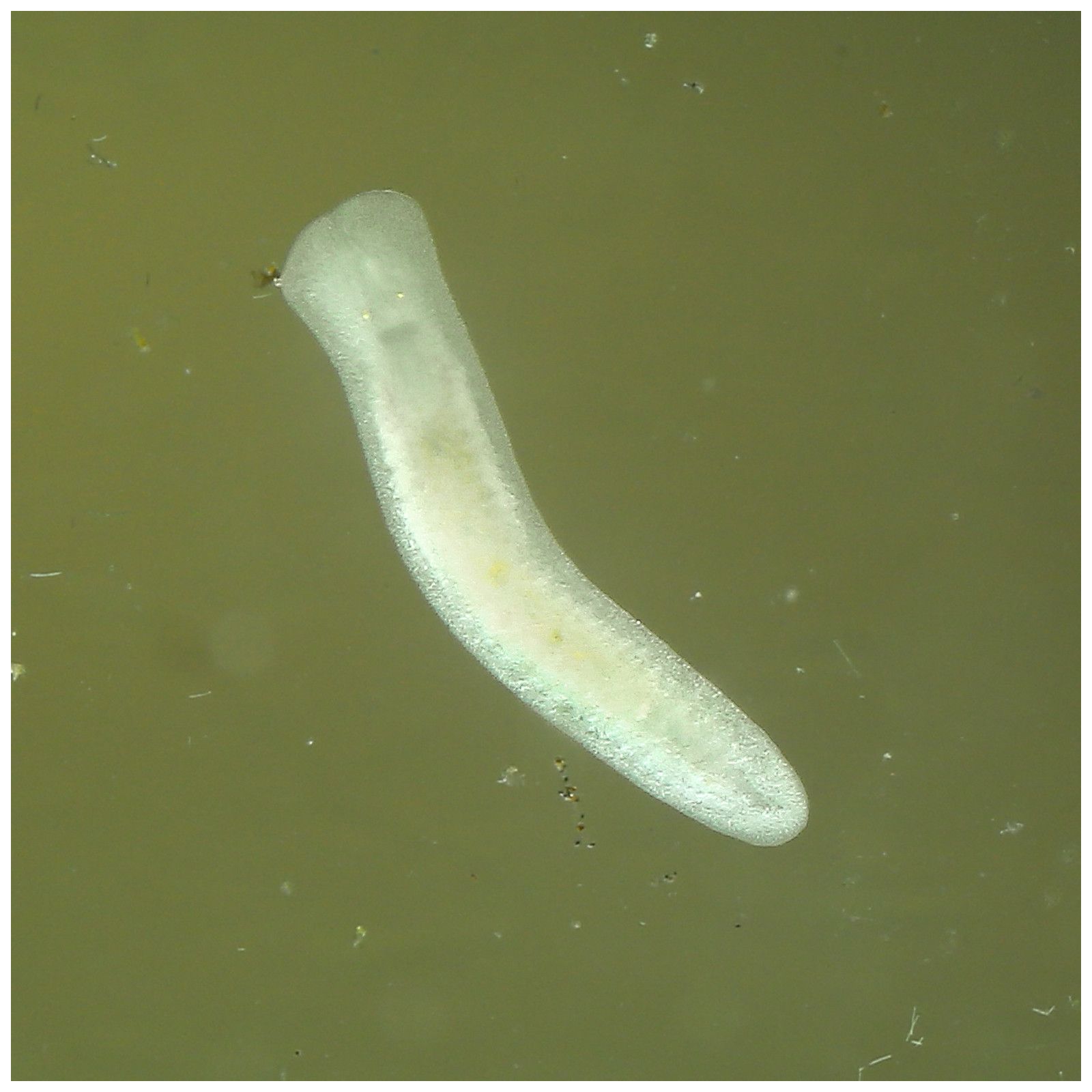
Spontaneous companion fauna in aquariums: "worms"
Published
Translated from German with AI assistance and reviewed by our editors.
It can happen every now and then that small animals suddenly show up in an aquarium that you did not deliberately introduce. These aquatic animals, which fall under the keyword "companion fauna", are mostly introduced with plants, decoration or live food. For many aquarium owners, the main question is then whether they are pests or organisms that are harmless to the rest of the livestock.
You can find a detailed overview of the various small animals that can appear in aquariums in this article. In the following, we want to take a closer look at the topic of "worms".
"Worms"
This is the name for all kinds of legless, soft-skinned, mostly elongated invertebrates. "Worms" are not a related group but a collective term for most invertebrate animal groups at all, as long as they are not sponges, cnidarians, arthropods, mollusks or echinoderms.
Many different worm-like creatures can appear in freshwater aquariums, and telling them apart is not always easy.
Various "worms", especially planarians and leeches, can become harmful to the aquarium inhabitants. But many are rather harmless tank mates that are in part also eaten by fish and other aquarium animals. Here we introduce some common worm-like aquatic animals in aquariums.
Oligochaetes
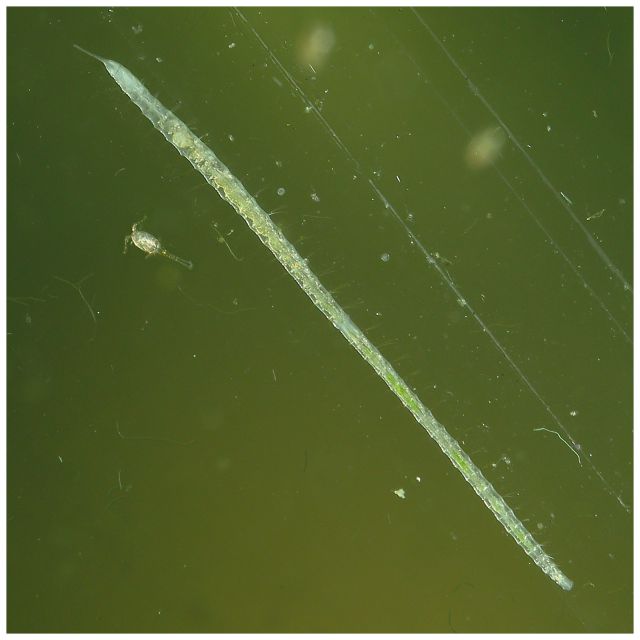
A tiny oligochaete annelid worm: snout worm, Pristina sp.
Oligochaetes are an order within the annelid worms that includes, for example, earthworms, tubifex or white worms (enchytraeids), all of which are known as fish food. In the aquarium, you more often find species of oligochaetes that stay quite small at 1 - 20 mm. Aquarists often mistake such little worms for nematodes (roundworms, see further below), from which they can be clearly distinguished on closer inspection.
They are whitish and translucent, and on closer inspection you can also clearly see their segmented body and their relatively long bristles. They use these to get a hold, and the bristles also serve for locomotion. The body cross-section is mostly round. Many species have a long drawn-out "tip" at the head end (e.g. the “pond snake”, Stylaria lacustris, and the snout worm shown above, Pristina) or instead a kind of disc that is pressed flat against the surface (oil droplet worms, Aeolosoma).
Their way of reproducing is striking: many species can reproduce by transverse division, so it is not uncommon to see whole chains of animals that have not yet completely separated from each other.
They feed on detritus, algae or the biofilm that forms on the panes, among other places. These worms are in any case harmless and are also eaten by very small fish. Some oil droplet worms in particular look quite interesting under the microscope because of red droplets in their skin.
Nematodes (roundworms)
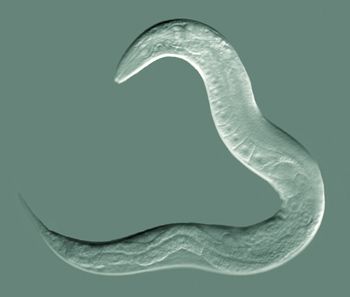
Caenorhabditis elegans is a nematode. Image credit: Bob Goldstein - Own work, license: CC BY-SA 3.0, source attribution.
This word automatically makes you think of certain worm-like pathogens, but those are very special cases. You have to keep in mind that there are about 20,000 species of nematodes, of which by far the largest part is harmless and feeds on bacteria, algae, fungi or single-celled organisms. But there are also known species that damage plants by feeding on their roots or shoot tips.
Nematodes occur practically everywhere, in water and in moist soil. If you take a small sample of soil from the forest or a flower bed, you will definitely find very small roundworms with a microscope as well.
They are also common in aquariums, but rather inconspicuous. Tiny worms on the panes or in the water are often taken for nematodes, but in many cases they are actually oligochaete annelid worms such as oil droplet worms (Aeolosoma). The body shape of roundworms is worm-like and tapered, the body is not segmented (for comparison: oligochaetes such as the oil droplet worm are segmented), and the cross-section is round. While the largest species, a parasite of the sperm whale, can reach a length of over 8 meters, the species we encounter in the aquarium or flowerpot are only 0.05 mm to 10 cm long. Nematodes are generally whitish or transparent.
They move by wriggling; aquatic nematodes normally only swim in the water column in an extreme emergency, performing very fast corkscrew-like swimming movements. Otherwise they stay in the substrate or sometimes on aquarium panes if these have a thick biofilm. The fish in the aquarium are happy about the live food if they happen to catch a roundworm. Some species can parasitize aquarium inhabitants; these are in each case different species specially adapted to their host, but they are very rare in aquariums overall.
In forums, nematodes, oligochaetes and planarians are often confused with each other in threads on topics like "worms on the glass" when more precise information is missing. Would you like to find out more about harmful worms such as planarians? Then we recommend our articles "Pests in the aquarium" and "Planarians in the aquarium" in our Aquascaping Wiki.
By the way, some of the most valuable live foods for fish belong to the nematodes: for example the microworms, which are especially popular for raising fry, and also vinegar eels.
Leeches
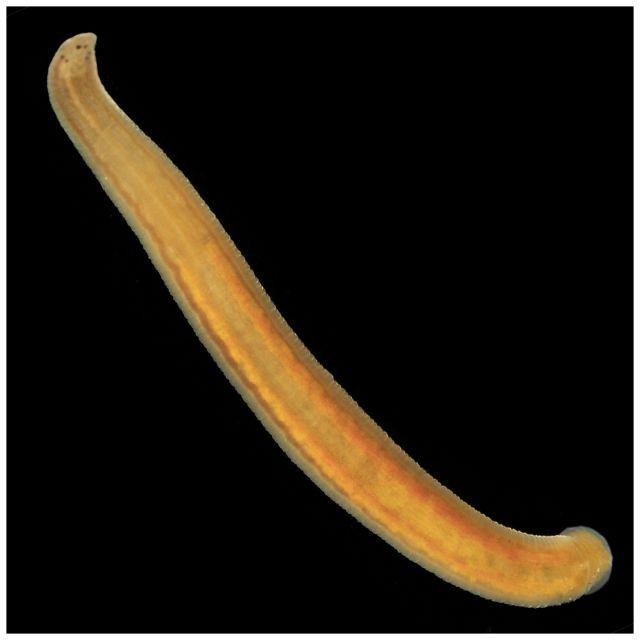
Asian proboscis leech, Barbronia weberi
These animals can grow several centimeters long and belong to the annelids (Annelida) as the subclass Hirudinea. Leeches are quite easy to recognize:
At the rear end there is a conspicuous sucker. The rear end is mostly thicker than the front end with the mouth opening, where there is another, smaller, inconspicuous sucker. The elastic, muscular body is ringed crosswise like an earthworm and often more or less flattened. The animals can contract strongly.
You can also recognize leeches by the way they move when crawling, similar to an inchworm: they stretch out, attach themselves with the front sucker, pull the rear end after them, then attach themselves at the back, and so on. They can also swim through the water with fast vertical wriggling movements.
Depending on the species, leeches live as predators or as parasites on various animals. The roughly 300 species worldwide live mainly in freshwater, but also in brackish and saltwater; in humid tropical forests there are even land leeches. Several smaller leech species occur in aquariums, some of which can definitely become dangerous for aquarium animals. You do not need to expect bloodsucking leeches that also suck human blood, though. We inform you about various leeches as aquarium pests in our articles "Pests in the aquarium" and "Leeches in the aquarium".
Flatworms: not just planarians
Platyhelminthes, flatworms, are a very diverse animal group with a simple body plan.
Many flatworm species are parasites such as flukes (trematodes), liver flukes and tapeworms. But there are also many groups of free-living, non-parasitic but predatory flatworms. These are traditionally grouped together as turbellarians. Depending on the species, they live in the sea, in freshwater and also in moist terrestrial habitats (land planarians).
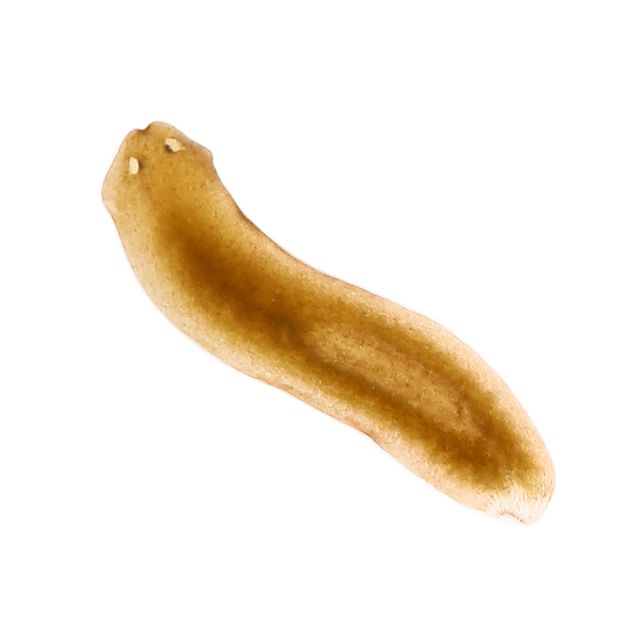
A planarian of the genus Dugesia
The best-known turbellarian group and at the same time very unpopular "aquarium guests" are the freshwater planarians of the order Tricladida, which can be dangerous especially for shrimp and snails in the aquarium. You can recognize them by, among other things, their strongly flattened, smooth (not ringed crosswise), bristleless body of up to about 2 cm in length and their evenly gliding, snail-like locomotion. They are often species of the genus Dugesia; for these, the easily recognizable pair of eyes and a triangular head are typical (see photo above). The body color varies from milky white through pink to red-brown. We go into more detail on planarians and how to control them in the articles "Pests in the aquarium" and "Planarians in the aquarium".
Harmless flatworms: glass worms / Rhabdocoela
Besides planarians, there are many other turbellarians that are rather harmless aquarium tank mates; controlling them is unnecessary. Aquarists often call them "glass worms"; as a rule they are much smaller and in part not as flattened as planarians. They belong to various flatworm groups, but mostly to the order Rhabdocoela.
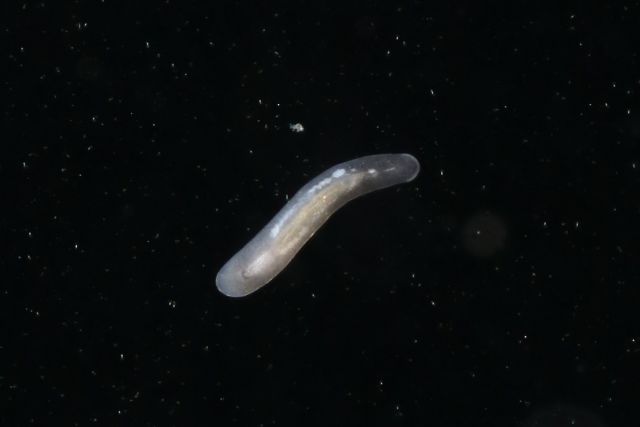
Macrostomum sp. Copyright by Tamara Stamm.
Rhabdocoela of the genus Macrostomum appear as whitish worms without a distinct head, with light-colored organs (see photo above). The eyes are only visible under the microscope.
"Glass worms" occur in large numbers almost exclusively during the cycling phase, as long as the biological system in the aquarium is not yet in balance. Later, according to experience, their numbers decrease, especially if the aquarium is not overfed. Fish eat the little worms very gladly (unlike planarians, which are usually spurned because of their disgusting taste). Worms of the genus Macrostomum also live as predators, but they pose no danger to shrimp. Some species do, however, occasionally go after young snails. As such, there is no need for action when single animals appear. In the case of a mass infestation with "glass worms", the aquarist should ask themselves about feeding – a mass proliferation only takes place if the worms find plenty of food.
Besides the whitish "glass worms", the order Rhabdocoela also includes the reddish worms of the species Bothromesostoma personatum. They are also often called "glass worms". Here too you see no distinct head, but the worm tapers noticeably to a point at the rear end. The color is roughly similar to that of an earthworm. This "glass worm" is also harmless to shrimp, other crustaceans and fish, as well as to adult snails. Bothromesostoma personatum also lives as a predator but, like Mesostoma sp., feeds on tiny organisms such as other mini worms and single-celled organisms.