Types of Aquariums

By Aram Schneider Published Updated
Translated from German with AI assistance and reviewed by our editors.
The world of the aquarium hobby is very diverse. The type of an aquarium does not just refer to the shape and size of the glass tank, but rather to its contents. Which aquatic plants, ornamental fish and other aquarium inhabitants should live in it? Do you want to depict a particular continent or region with a specific focus, bringing the magic of faraway worlds into your own living room? In this article, we explain some typical types of aquariums.
The community aquarium
Copyright: Chris Lukhaup.
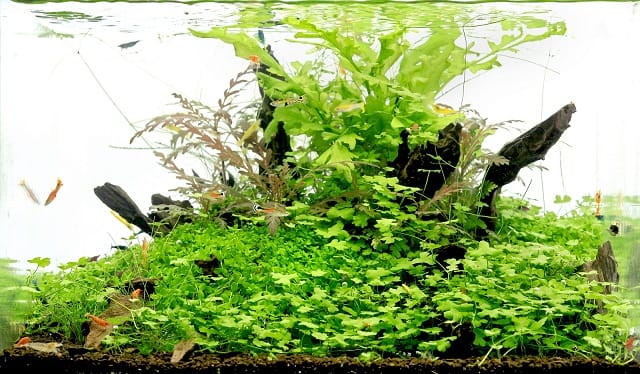
The ever-popular classic among aquariums is the so-called community aquarium. Here, different species of ornamental fish from various countries of origin are kept together, entirely according to the aquarium owner's taste. It is not uncommon for tetras from South America to meet the popular guppies, with African or Asian aquarium fish added on top. To be able to offer enough hiding places, the decoration of a community aquarium is often complemented by easy-care aquatic plants and natural decoration in the form of driftwood or stones. Since quite different needs regarding water parameters sometimes clash here, a community aquarium therefore represents the maximum compromise for different animal species living together. Of course, the aquarist is rewarded by the extreme range and variety of different fish, all of which show different colors, shapes and behaviors. You can learn more about this topic in this article.
The nano aquarium
Copyright: Chris Lukhaup.
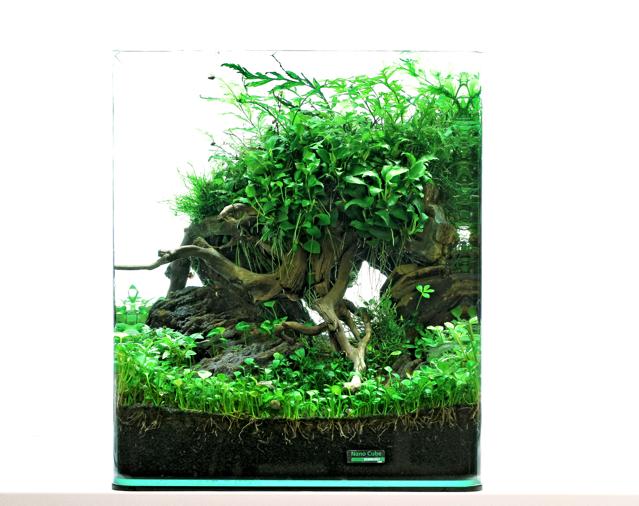
With nano aquariums, together with the introduction of dwarf shrimp, the aquarium hobby received a strong boost a few years ago. Nano aquariums, above all the so-called nano cubes, are extremely popular miniature aquariums with a capacity below the standard volume of 54 liters. The glass tanks often hold 10, 20 or 30 liters, and are often cube-shaped. Although less suitable for fish, a nano aquarium is a very fitting home for invertebrates such as colorful snails and a troop of busy dwarf shrimp. Because of the small size of the aquarium, these tiny animals are also easy to observe. In addition, as an aquarium owner you do not need much space for it; it fits nicely on a desk, a dresser or a small side table. Would you like to learn more about nano aquariums? In this article, we provide even more information on the topic.
The planted aquarium
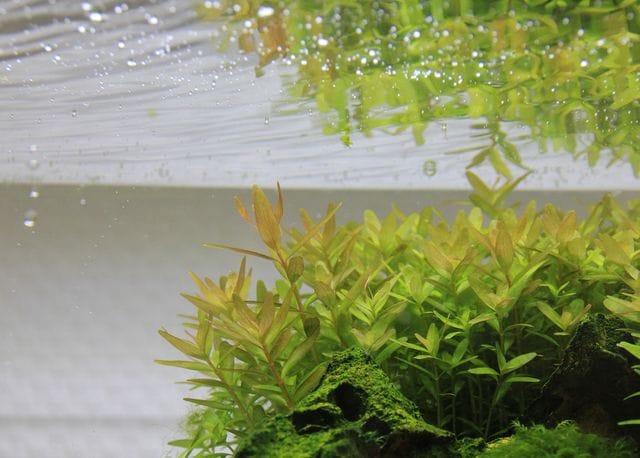
In a planted aquarium, the focus is less on the animal world than on the aquatic plants living in it and the design of the aquarium. In this case, the aquarist is mainly concerned with the care and supply of the aquarium plants. Besides appropriate fertilization with liquid fertilizers and CO2, regular trimming of the plants is among the routine tasks to keep the aquarium design in shape, the creative basic idea of which is often called the "layout". A Dutch aquarium is a typical planted aquarium, which is set up and maintained using very particular stylistic devices. If significantly more natural decorative materials such as stones and driftwood are incorporated into the design, you tend to speak of a Nature Aquarium or even an aquascape.
The Nature Aquarium
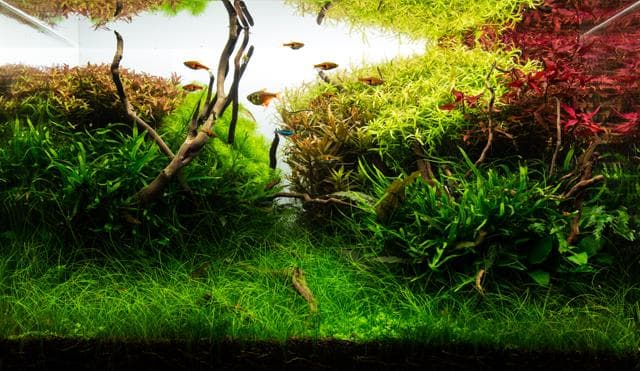
The term "Nature Aquarium" was coined in the 1980s and 1990s by the famous Japanese aquarium designer Takashi Amano and actually emerged even before the term aquascaping. While aquascaping can generally be understood as creating landscape scenes underwater and thus as an umbrella term for aquarium design, a Nature Aquarium is focused on the style and setup approach of Takashi Amano. Although a nature-like design is the priority, this does not mean a pure biotope aquarium that strictly subordinates itself to the needs of the aquarium inhabitants. Rather, it means a less artificial design than in a Dutch aquarium, but an arrangement and planting modeled on nature. Significantly more decorative materials (called hardscape) such as stones and roots are used, and the Japanese sense of beauty (wabi-sabi) also plays a role here, taking up the theme of transience. Consequently, in a Nature Aquarium you will find interplays of light and shadow, but also shade plants such as mosses, ferns, cryptocorynes and anubias. You can find more information on this topic in this article.
The aquascape
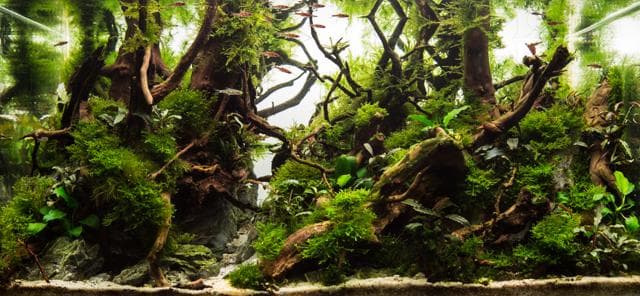
As already explained above in the section on the Nature Aquarium, aquascaping can be understood as a general term for the design of aquariums in which, above all, landscape scenes are created underwater. Aquascaping is short for "aquatic landscaping", and Takashi Amano, with his Nature Aquariums, was the pioneer of this special branch of the aquarium hobby. In aquascaping, the design of the aquarium, the so-called "layout", is very much in the foreground, and the aquascaper uses various design elements in the form of aquatic plants, stones and driftwood, as well as substrates to create their work. In aquascaping there are now also several sub-styles; these include nature aquascaping as the setup style of Takashi Amano, as well as modern aquascapes with a very high degree of realism. These strongly resemble landscape scenery above water (for example forests or mountain ranges). Paired with a high degree of depth, this style is also called the diorama style. Would you like to learn more about aquascaping? Then simply click here.
The Dutch aquarium
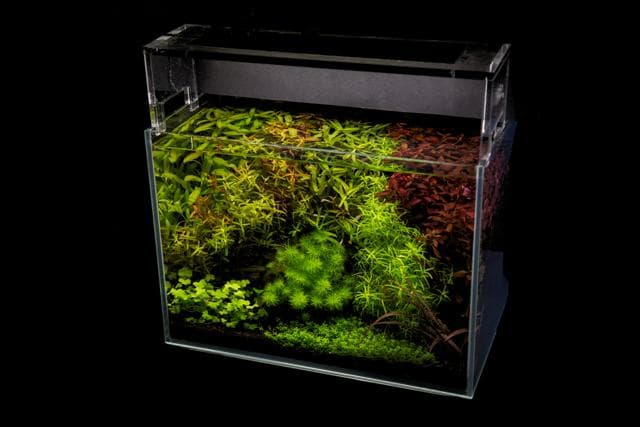
The Dutch aquarium is a particular style of planted aquarium that already has a tradition spanning decades. These so-called "Dutch style" aquariums are subject to very precisely defined criteria in terms of planting, trimming techniques and design. Stem plants in all kinds of colors, sizes and leaf shapes are often used, and little to no other decorative material (hardscape). Different plant groups are always separated from each other by small gaps, and the plants are arranged in so-called streets. A Dutch aquarium is a real feast for the eyes, but compared to the Nature Aquarium or aquascape it appears more artificial in its design. In this article you can learn even more about Dutch aquariums.
The biotope aquarium
The biotope aquarium focuses entirely on the well-being of its inhabitants. To come as close as possible to their original natural environment (the habitat), the aquarist tries to create an optimal biotope for these animals through appropriate water parameters, suitable aquarium equipment and a fitting setup of the aquarium. The natural conditions are replicated as exactly as possible in order to create ideal husbandry conditions for the aquarium inhabitants. In some cases, specific sections of nature are also recreated in an aquarium, such as a particular lake or river section of a natural model (for example a stretch of the Amazon River or Lake Malawi).
If you are not quite so strict about the regional limitation of the species, a kind of community aquarium emerges that nevertheless takes place within a certain continent. This refers to so-called theme aquariums, such as an Asia aquarium or South America aquarium. We present these in more detail below.
Species aquarium
The species aquarium often falls into the category of a biotope aquarium in which, however, several animal species are not kept together. It is thus practically the opposite of the community aquarium. It provides a home for only a single species of fish or invertebrate. There can be various reasons for this. For one, the animals are then among themselves and are less stressed and disturbed by other fish. Especially for more sensitive species or for breeding, keeping them in a species aquarium is more effective. The husbandry can be narrowed down even further and depends on the needs of the inhabitants. Group animals can be kept in a school; with cichlids in particular, keeping them in a harem (a higher proportion of females) or even in pairs is a good option. Even keeping a single animal makes sense in some cases, such as with the popular betta.
The South America aquarium
Copyright: Chris Lukhaup.
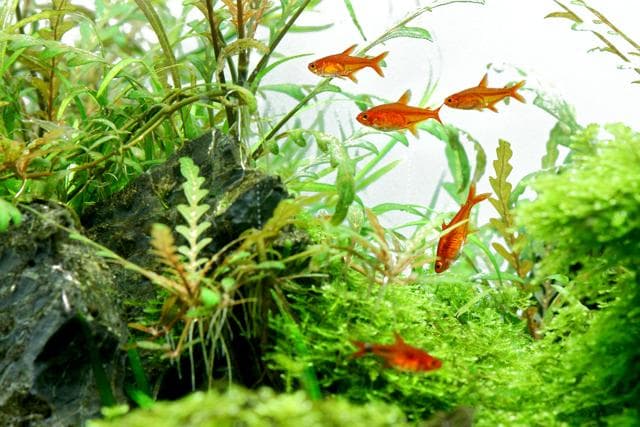
The South America aquarium focuses on South American ornamental fish species, which of course should live in a surrounding that is as close to nature as possible with suitable water parameters. Typical aquarium fish here are tetra species, catfish such as corydoras, L-number catfish or armored catfish, but also cichlids such as the popular dwarf cichlids, discus or angelfish. It is a popular approach to imitate certain biotopes through suitable decoration and planting, such as river sections of the Amazon or Rio Negro. Often, above all, driftwood is used, which gives the aquarium the necessary structure. The South American plant world is also quite diverse, and the well-known Echinodorus plants are a good choice not only for a pure South America aquarium, since they are quite easy to care for. As suitable water parameters, typical soft water values with a low general and carbonate hardness, as well as an acidic to slightly acidic pH below 7, are generally what come into question. Enriching the aquarium water with humic substances creates a nature-like environment and promotes the health of the aquarium's inhabitants, which in South America often come from waters rich in humic substances. You can find more information on the topic "South America aquarium" in this article.
The Asia aquarium
Copyright: Chris Lukhaup.
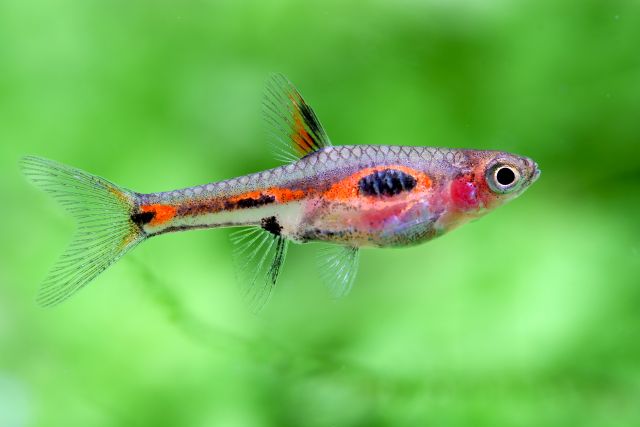
If you limit the animals and plants to Asian species, you get a so-called Asia aquarium. Because of the enormous size of the continent, the selection of living creatures is nevertheless extremely diverse. Popular Asian fish species include many barbs and danios, but also labyrinth fish and loaches. Even the popular betta is Asian, as are the many colorful dwarf shrimp, which have enjoyed increasing popularity in recent years. The selection of Asian aquatic plants is also huge. This includes genera such as Bucephalandra and Cryptocoryne, but most mosses and ferns also come from Asia. So do many colorful stem plants such as Rotala rotundifolia. The water parameters in an Asia aquarium are often kept rather soft and acidic, that is, a pH below 7 and a low carbonate and general hardness. In some cases the animals come from blackwater biotopes, in which case adding humic substances is helpful. For loaches, gobies and hillstream loaches, which tend to come from clear running waters with plenty of current, the water should also be oxygen-rich and clear.
You can learn more about the topic "Asia aquarium" here.
The cichlid aquarium
In the aquarium hobby, cichlids are fish that, depending on their home country, have very individual requirements for the husbandry of these special ornamental fish. They are often territorial species that show interesting social and breeding behavior. Besides smaller dwarf cichlids, which are often kept in a South America aquarium, there are also larger cichlids such as discus and angelfish, which likewise live on that continent. Larger animals have a correspondingly higher metabolism, so besides a suitable aquarium size, appropriate filtration and maintenance measures should also be in place.
African cichlids, for example from Lake Malawi or Lake Tanganyika, are also very popular. In contrast to large cichlids from South America, special water parameters are called for here, such as an alkaline pH. You can find more detailed information in our article "The cichlid aquarium".
The shrimp aquarium
Copyright: Chris Lukhaup.
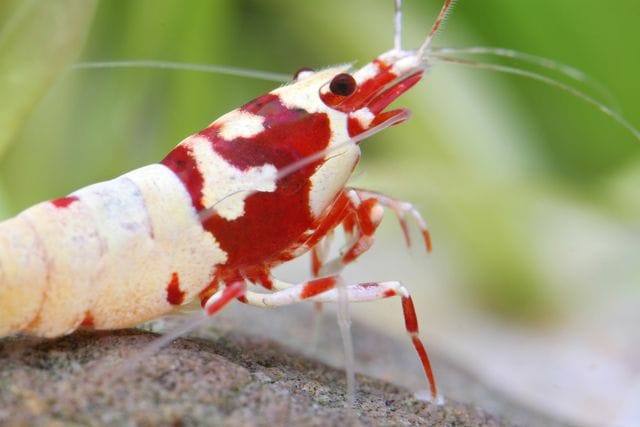
Together with nano aquariums, keeping colorful and lively invertebrates such as dwarf shrimp has become a firm new pillar of the aquarium hobby in recent years. Of course, shrimp also have very specific requirements in their husbandry, both for the water parameters and for the equipment of the aquarium. Dwarf shrimp generally do not need quite as much space as ornamental fish and can therefore also be kept quite well in small aquariums (nano aquariums), for example with 20 or 30 liters. Fundamentally, the husbandry conditions of the species Neocaridina and Caridina differ here. Dwarf shrimp of the genus Neocaridina include the popular Red Fire, Sakura or White Pearl shrimp, to name just a few. These are quite robust and adaptable and can be kept well in soft to medium-hard water. Bee shrimp and other species of the genus Caridina are somewhat more demanding in comparison; here the aquarist should pay attention to suitable soft water values. If tap water is unsuitable for keeping them, water treatment by reverse osmosis together with a matching water-hardening salt is a good option. Most shrimp species prefer rather cooler temperatures of 20 to 25 °C, so it should not get too warm, especially in summer. Active soil substrates are particularly suitable for keeping bee shrimp, tiger shrimp or Taiwan bees, since they help the aquarist achieve and maintain the desired soft water values.
Since shrimp like to graze surfaces for food, plenty of hiding places and decoration in the form of aquatic plants, caves or suitable stone and wood structures are welcome. Mosses in particular are very popular in a shrimp aquarium, as they also offer a good home for juveniles. When offspring appear, the filter should definitely be secured, for example with a filter guard. You can find more information on the topic of the shrimp aquarium here.